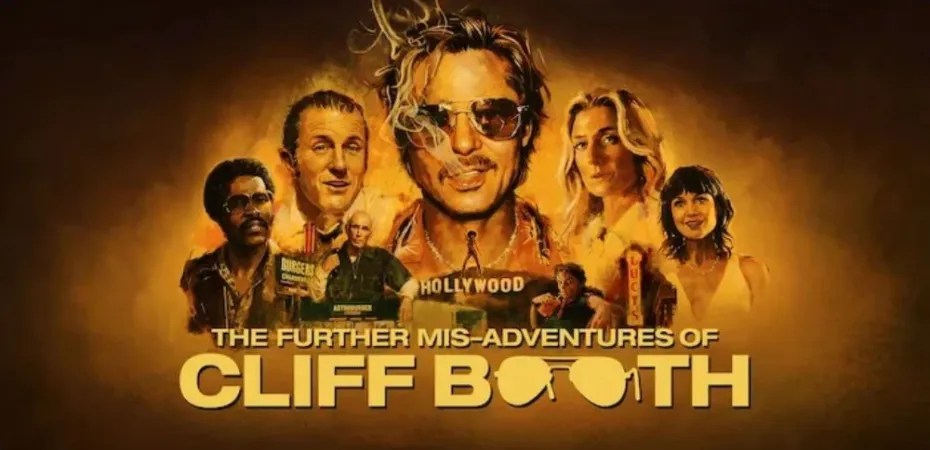
The Further Mis-Adventures of Cliff Booth
3 out of 5 stars
By J.C. Correa
“In Hollywood, two things matter – shelf life and shelf space.” It’s a truism uttered by Gus Booth (played by veteran actor and former RoboCop Peter Weller) to his doting son Cliff and immediately sounds like just the kind of philosophy that someone like Quentin Tarantino would live by, let alone write. Which, of course, is precisely what he did, as part of his latest project, The Further Mis-Adventures of Cliff Booth, which, as the title implies, allows him to revisit the charming, uber-cool stuntman that Brad Pitt played to Oscar-winning glory in the popular auteur’s last directorial feature, Once Upon a Time in… Hollywood. Naturally, Pitt returns along with Tarantino, but the latter mainly in a screenwriting capacity this time around. Instead, the directorial reigns have been handed to none other than David Fincher; a choice that at least makes sense via his history of frequently collaborating with Pitt.

It is fair to say that the new movie is both utterly tethered to Tarantino’s previous one (and to his fictional cinematic world as a whole) and also manages to exist as its own thing. We drop in eight years later, in 1977, on a now-mustached Cliff (though he apparently still has a fondness for Hawaiian shirts), where his run-down body has kept his stuntman days mostly behind him, forcing him to instead now earn his living through a series of odd jobs that include bartending, demolition derby driving, and “fixing” the problems of the Hollywood elite. He is also the projectionist at a cinema (cheekily named after Tarantino’s own New Beverly) that he sometimes uses for shadier business, as illustrated by a fifteen-minute prologue that is completely disconnected from the rest of the story, and whose function only seems to be to remind us of what a badass Cliff is. Being that this is a Tarantino creation, much like the theater location, it shouldn’t surprise anyone that the picture opens as a film within a film, and essentially just ends up being yet another flick wholly enamored with the mere idea of movies, and a desperate need to tell us about it. You get the idea.
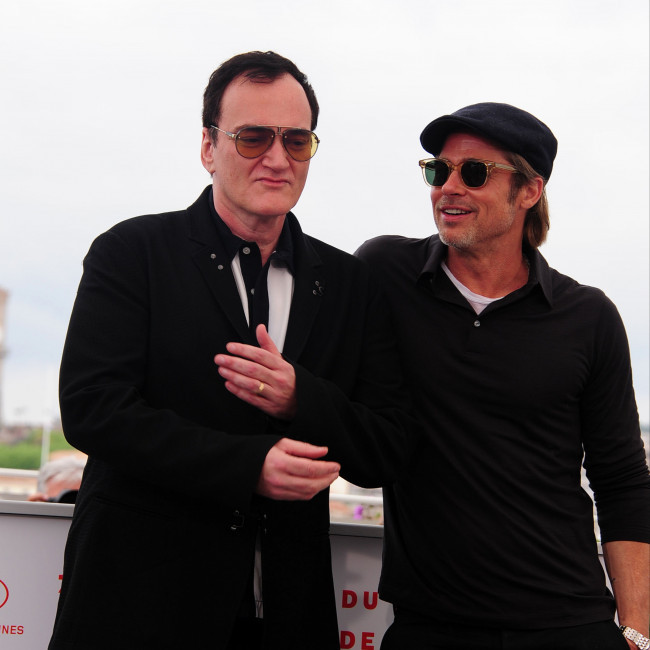
Interestingly, while Fincher does add his signature icy precision, he has mostly forgone his usual, bleak, green-yellow color palette in favor of something more neutral, which I imagine is in deference to Tarantino. If anything, the film is mostly an LA noir, and in this respect at least, it plays to Fincher’s strengths as a dark, and occasionally light, examination of Los Angeles culture, right down to the exact distances of just about everywhere in relation to Hollywood. For example, the Westwood premiere of Looking for Mr. Goodbar (a release of the time) is artfully depicted through simple black and white stills in a photo album. In another instance, Fincher shoots a mud-wrestling scene in a heightened, fetishized manner that is very much in his wheelhouse, while allowing his usual choice of Trent Reznor and Atticus Ross to contribute the score. Of course, there are still plenty of needle drops throughout – both obscure and instantly recognizable ones – though one can wonder who had the bigger say behind that, himself, or Tarantino?
Other than writing the screenplay and serving as a producer (and likely suggesting some tunes), QT’s only other involvement is as a narrator during one segment that aims to explain a television show and a particular actor’s career. In this regard, much like Once Upon a Time in… Hollywood, there is a world within a world, and that first one is primarily the one of TV shows and movies, either being made, or talked about at great length. To that end, fans of the original film may enjoy seeing Timothy Olyphant briefly cameo as the same actor he played then, partly because of where his career has ended up within the new story.
Nostalgia and detailed period world-building aside, though, you are likely to get restless by trying to figure out what the picture’s real raison d’être is. At one point, a talent agent played by Elizabeth Debicki frustratingly declares, “I let you sniff each other out for forty minutes with nothing of substance.” Sadly, the same can be said about the movie up to that point. In fact, the film’s plot is practically elusive until almost the third act. Up to then, everything feels like just an excuse to revisit the character and that specific universe. And yet, despite these flaws, the picture has an infectious quality all the same, and a large part of that has to do with what a thrill it is to see Pitt effortlessly embody the rugged but irresistible rascal once again. As a persona, Cliff works because he is primarily a fantasy projection; a jack of all trades who can seemingly do everything exceptionally well. And whether he’s playfully seducing Debicki’s frosty professional on his terrace, disarming baddies with his charm alone, or waxing poetic about the honorable merits of killing swine with just a knife and one’s bare hands, it’s as if Pitt never stopped playing the part, and the charisma on display once more confirms this to be a perfect marriage of actor and role.
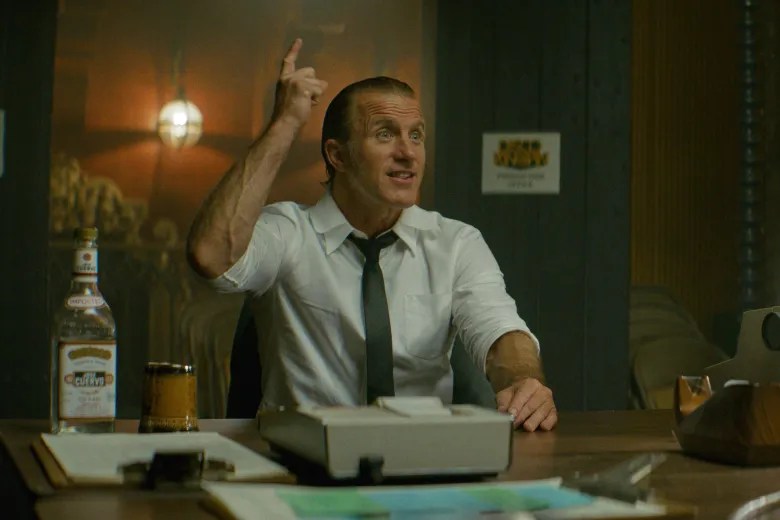
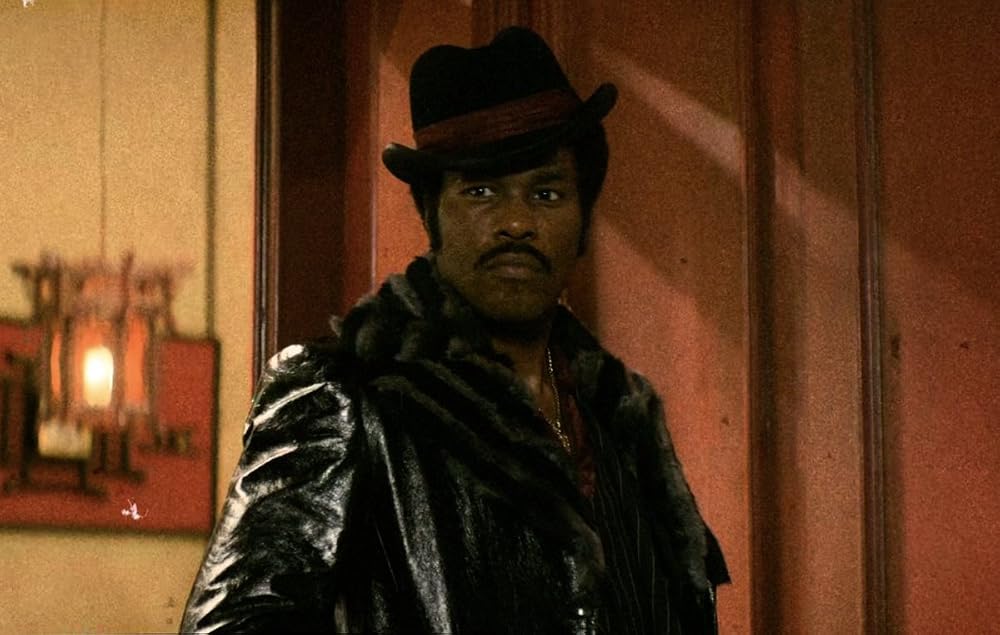
Scott Caan (looking exceedingly like his father James) and a very sexy Carla Gugino are well cast in important parts that are central to what eventually turns out to be the plot. Yahya Abdul-Mateen II is a hoot as a star of blaxploitation flicks, while Debicki pairs off very well with Pitt, and is particularly memorable in a scene in which her agent, after confessing to having once worked as a critic, boldly makes her claim as to why films can never be considered art, resorting to Whoppers and Big Macs as the points of comparison. Echoing a now-legendary dissertation on Quarter Pounders with Cheese, it’s the type of dialogue that is exemplary of Tarantino’s writing style, and the fact that The Godfather is used as a rebuttal in the presence of, of all people, a character played by Caan, speaks greatly to the meta sensibilities of the whole thing.
Of course, this wouldn’t be a complete QT experience if at least a dose of extreme violence wasn’t offered. For one thing, some viewers may find it disturbing, as I did, to witness the brutal murder of two children on camera; and while the moment is fairly swift, Fincher doesn’t pull any punches either. When the drama does reach its boiling point, there is the inevitable catharsis through violence – a Tarantino trademark – though I will give him credit for once more not letting his hero get off easy, even if I imagine many will debate the merits or realism of just how much Cliff is put through in the end. For better or worse, the film’s conclusion reminded me of the one in Tarantino’s worst and often-forgotten picture, Death Proof, precisely because a blunt act of violence seems to signal the end of the movie as if with an exclamation mark.
The truth of the matter is that, despite obvious nods to things like Big Kahuna Burger and Red Apple Cigarettes (keep an eye out for the person advertising them), or even callouts to friends and contemporaries like Paul Thomas Anderson (a place called “Licorice Pizza” is briefly mentioned in a radio ad), this ultimately ends up being a second tier effort for Tarantino, and especially for Fincher. Still, I can’t imagine that what qualifies as a mid-level offering for those two wouldn’t be tantamount to, say, the contents of Marsellus Wallace’s briefcase for most others, and surely for any young buck aspiring to make it in the business.
The Further Mis-Adventures of Cliff Booth is currently playing exclusively on IMAX screens for a limited two-week engagement and will be available for streaming on Netflix as of December 23.

