Looking Back 35 Years Later on Guns N’ Roses’ Boldest Career Move
By J.C. Correa
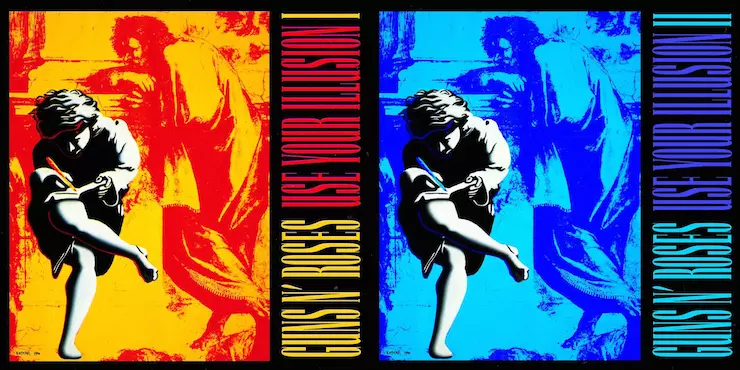
“This fire is burnin’ and it’s out of control, it’s not a problem you can stop, it’s rock ’n’ roll.” That statement, uttered by W. Axl Rose in the song “Garden of Eden,” is an accurate summation of where Guns N’ Roses was in their career the day that they simultaneously dropped not one, but two double albums onto a famished audience across the world. Entitled Use Your Illusion I and Use Your Illusion II, the records were released on September 17, 1991; a time when the band was at the apex of its popularity. As these infamous recordings reach their 35th anniversary milestone, it feels like a good time to revisit their initial impact and discern the legacy that they’ve left over the past three and a half decades.
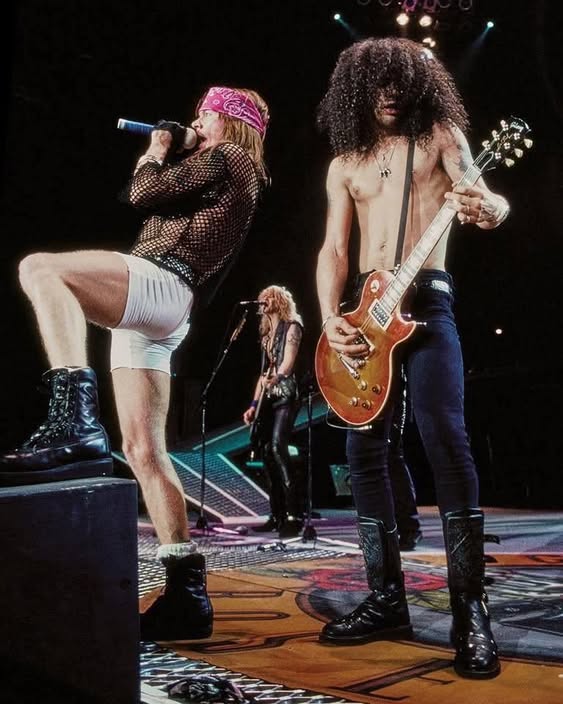
There is no better place to start than by immediately recalling what a brash and bold move it was for the Los Angeles-based group to have the audacity to launch such a souped-up and loaded release for what was essentially only their second full-length LP. 1987’s seminal breakout debut Appetite for Destruction justifiably rocketed them to superstardom and notoriety, while their 1988 follow up, GN’R Lies – a combination of a previously released EP and four new acoustic tracks – momentarily satiated their fans’, for lack of a better word, appetite. And yet, despite such limited output, the band had managed to become the biggest act in the world by 1991, already headlining a massive two-year tour that began four months before the gargantuan Use Your Illusion records even saw the light of day.
Because of their sprawling and eclectic nature – not to mention a total runtime of 152 minutes befitting four LPs – the move was, to put it in simpler terms, equivalent to releasing Physical Graffiti and The White Album as your second official career statement. There was no denying the arrogance on display, disguised perhaps as overconfidence. And regardless of the group’s popularity, it’s not an exaggeration to say that the whole thing was, at least in some ways, a commercial risk. But, as we all know by now, such a gamble paid off and only served to enhance the status and reputation of the outfit as bonafide troublemakers with some serious musical chops and ambitions. The fact of the matter is that, despite its excessive characteristics, Use Your Illusion was and remains a repertory of mostly brilliant rock ’n’ roll. To think of it as a flawed masterpiece is not inaccurate.
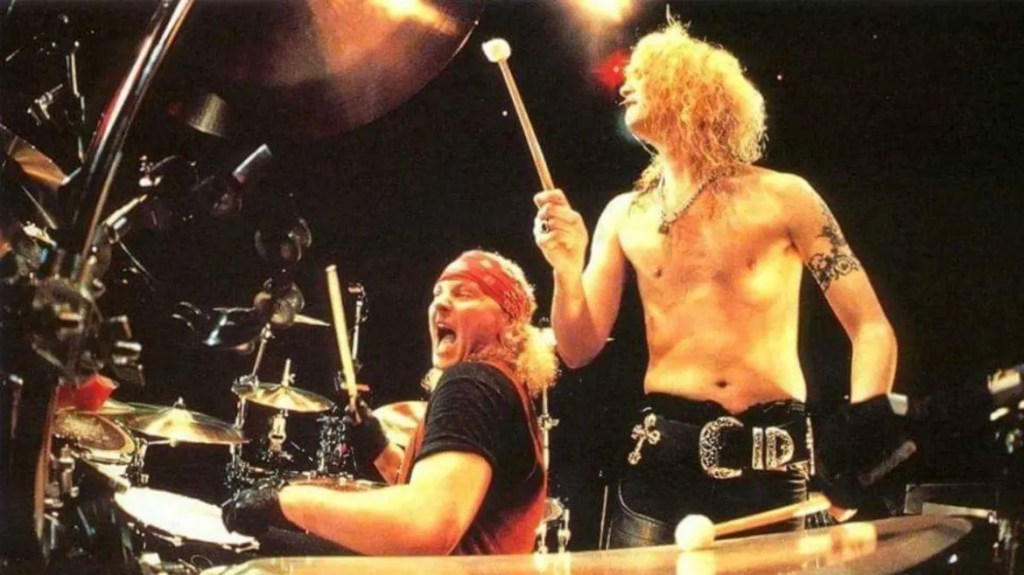
The first thing that becomes apparent when you initially listen to it (especially compared to Appetite) is how much more muscular and polished GN’R sounds. Though Mike Clink, who had originally produced Appetite, returned in the same capacity, producing duties on the new records were also shared with the band members. However, there is another crucial factor that contributed to the increased sonic power. Original drummer Steven Adler had been replaced by Matt Sorum, and their styles couldn’t have been more different. With his swing-heavy approach, Adler had endowed Appetite with a loose, almost improvised feel that gave it such a wonderfully organic groove. It was very much in step with the rawness of the group’s sound as they announced their intentions across twelve straight-up rockers. For Use Your Illusion, on the other hand, Guns N’ Roses was swinging for deeper fences, and the varied nature of the songs required a more sophisticated and wider set of drumming skills. Sorum, a more technically proficient, powerhouse drummer, answered that precise call.
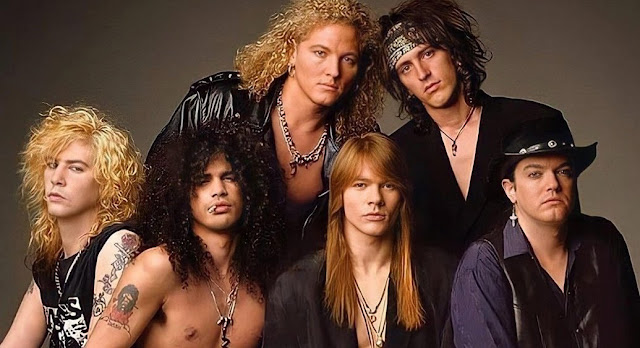
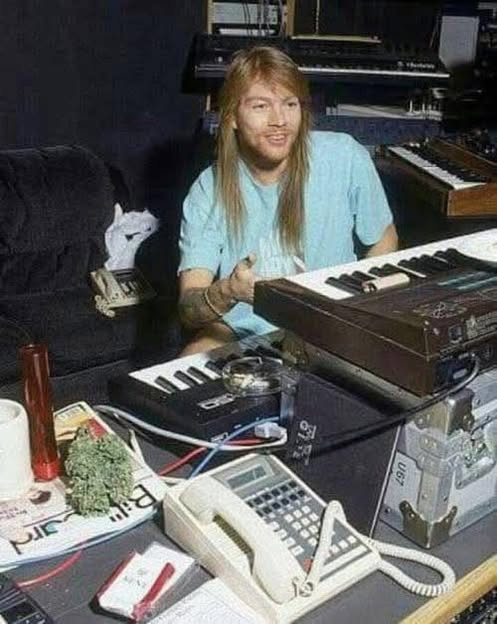
GN’R’s Use Your Illusion era also marked the moment where the outfit expanded from a quintet to a six piece with the addition of Dizzy Reed on piano and keyboards. Through his inclusion, the band, who had initially been labeled as the true heirs to the Rolling Stones, now actually sounded a lot more like the Stones. I suppose it will always be up for debate which early version of Guns N’ Roses was the better one. The truth is that both have their appeal. But it’s hard to deny that Reed’s presence doesn’t make terrific tracks like “Dust N’ Bones,” “Bad Obsession,” “Yesterdays,” and “Pretty Tied Up” all sound like prime examples of what Mick Jagger and Keith Richards might have concocted had they still been rock’s biggest bad boys by 1991.
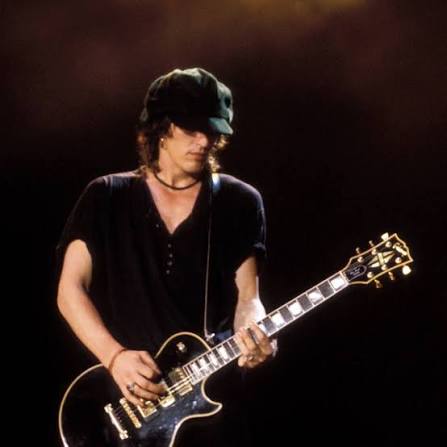
For those who bothered to read the liner notes (that lovely perk of the pre-digital age), it may have quickly become clear that rhythm guitarist Izzy Stradlin (who would sadly leave the group for good around the time of the records’ release) played a major role in this collection by singing lead on a few tunes, and also being the project’s principal songwriter, second only to Rose. The quirky acoustic blues number “You Ain’t the First” bears his sole fingerprints, as do the killer “Double Talkin’ Jive” and the aforementioned “Pretty Tied Up.” The latter two are real standouts, and among the albums’ more infectious moments. Alongside Rose, Stradlin cranked out two other of Use Your Illusion’s biggest staples: the balls-to-the-wall rocker (and leadoff single) “You Could Be Mine,” and the lovely, tender ballad “Don’t Cry,” which is unnecessarily represented in each of the volumes, just with different lyrics. The fact that “You Could Be Mine” was directly linked to Terminator 2: Judgment Day that summer through its inclusion in that seismic blockbuster is only a testament to how much GN’R was inextricable to the zeitgeist in those days.
Slash, the virtuoso lead guitarist that proved to be the Gunner’s secret weapon on Appetite, is musically the MVP of the albums, delivering killer riffs and memorable solos worthy of Jimmy Page and Joe Perry. His leads on “Double Talkin’ Jive” and the anti-war throwdown “Civil War” are tasteful and inventive to a high degree. The driving riff and vicious chord changes behind the almost-9-minute “Locomotive” (along with the delectable outro solo over Reed’s inspired piano) make it one of the records’ best tunes. But the top-hat-wearing axeman’s most memorable moments may be the work he does across the entirety of Rose’s two magnum opuses. In the first of these, the epic piano ballad “November Rain,” Slash adds so many subtle flourishes to Axl’s heartfelt profession of unrequited love and then delivers two devastatingly emotional solos before hitting the gas for its killer coda, all the while helping to place the composition in the same realm as something as game changing as “Layla.”

As expected, across an arsenal of 30 songs, it’s very unlikely to have them all be winners. Use Your Illusion is no different in this regard, with the aforementioned “Garden of Eden,” “Shotgun Blues,” and particularly the industrial knockoff set-closer “My World” serving as the most expendable offerings. Yet, the fact that the latter (an Axl whim knowing no restraint) is the project’s only true misstep is only indicative of how inspired the material is throughout, or at the very least, highly competent. That recalls what is surely Use Your Illusion’s most notorious track; the blunt takedown of the media entitled “Get in the Ring.” Built around a bluesy riff by bassist Duff McKagan, the song adopts a punk rock quality and attitude that simply gives Rose a forum to lash out in the most vulgar fashion against specific members of the media who found a way to royally piss him off. It’s a real WTF moment, unapologetic in its moronic-ness, and clearly aimed at the Beavis & Butt-Head generation. And though no one in their right mind could ever qualify it as inspired, the number is indeed competent at achieving the one thing it sets out to do – make Guns N’ Roses even more controversial than they already were.
You might wonder how a tune as feverishly aggressive as “Get in the Ring” (or the lovingly titled “Back Off Bitch” for that matter) can comfortably coexist with the ample sweetness found in “Don’t Cry,” “November Rain,” or even “So Fine,” another McKagan highlight. I would argue that that is precisely Use Your Illusion’s biggest appeal; the fact that, though some things don’t particularly make sense (and contradictions run rampant), no one would dare question the sincerity and conviction of every moment. That very quality actually applies well to the two epic covers found on the albums. Illusion I contains a version of Paul McCartney’s “Live and Let Die” that, while not as nuanced or sublime, is just as bombastic, but in a more turbo-charged way. The other is the slightly more successful experiment, a reworking of Bob Dylan’s “Knockin’ On Heaven’s Door,” found on Illusion II. With its slightly southern, gospel-tinged approach tastefully blended in with affirming hard rock, it’s by now likely considered the definitive take on that famed composition.
Still, when all is said done, and especially in retrospect, it’s impossible to not recognize that the driving force behind Use Your Illusion, particularly its wild ambition, was indeed Rose. The volatile frontman (at least he was then) with the impressive vocal range and dexterity clearly pushed for these albums to not be a rehash of Appetite, but rather, to musically expand on it in a very broad manner. How else can you explain the 10-minute “Coma,” a freakish reenactment of a drug overdose that completely does away with verses, bridges, and choruses in favor of random riffs, one-off melodies, isolated musical vignettes, and ghoulish theater? The track may be excessively self-indulgent, but the performance is highly committed. The middle section alone, where the music intentionally portrays the moment when the needle first plunges into an arm, is kind of genius, as is the frightening crash depicted in its aftermath, especially because it paints an insanely clear picture of the experience for those of us who have never dared to go there. Rose was not anything if not a great actor, and songs like “Coma,” “The Garden” (another psychedelic druggie simulation with a guest vocal by Alice Cooper), and “Breakdown” (a musically rich, introspective meditation with a bizarre spoken-word outro) give him a wonderful platform to unleash a highly theatrical, demonic snarl that had been all but absent on Appetite.
Most people will probably remember “November Rain” as being Axl’s crowning achievement on these records, and that point would be more than understandable on its musical merits alone, without even considering its iconic and lusciously cinematic music video, which ruled the MTV airwaves for half of 1992. Rose, however, was smart and ambitious enough to give it a flip side, a yang to its ying if you will, with the same scope and musical breadth. Entitled “Estranged,” this other tour de force conjures up an electric mood that is as beautiful as it is eerie, functioning as a sort of wildly experimental dirge that channels Elton John on his darkest day. With Slash providing some truly haunting licks throughout, it’s the pinnacle moment not just on Use Your Illusion II, but on the entire effort.
For fans of the band, the debate has always raged as to which of the two volumes is the better album. I suppose that even now, after all these years, that issue remains unresolved. To me, it all depends on what you’re looking for. Illusion I is the more rambunctious of the two, as it features some of the more straight-up rockers like “Perfect Crime, “Don’t Damn Me,” and “Dead Horse.” Conversely, its counterpart is moodier in tone and showcases a greater number of what can be thought of as epics. The way that each LP begins already distinctly establishes this difference; with the straightforward and brutal “Right Next Door to Hell” launching off Illusion I, while Illusion II chooses to get going via the grandiose and more nuanced “Civil War.” I hope that this anniversary retrospective can at least inspire readers to reevaluate and reconsider the strengths and weaknesses of each one, and maybe even embrace a new perspective that can only be earned through time. Or perhaps it really is as simple as choosing red and yellow over blue and purple, or the other way around. The bottom line is that, barring some unforeseen miracle, while Appetite for Destruction will always be Guns N’ Roses’ finest hour, their most interesting one remains Use Your Illusion. And the fact that the group continues to consistently play to sold out stadiums today has as much to do with what they did in 1987 as in 1991.

