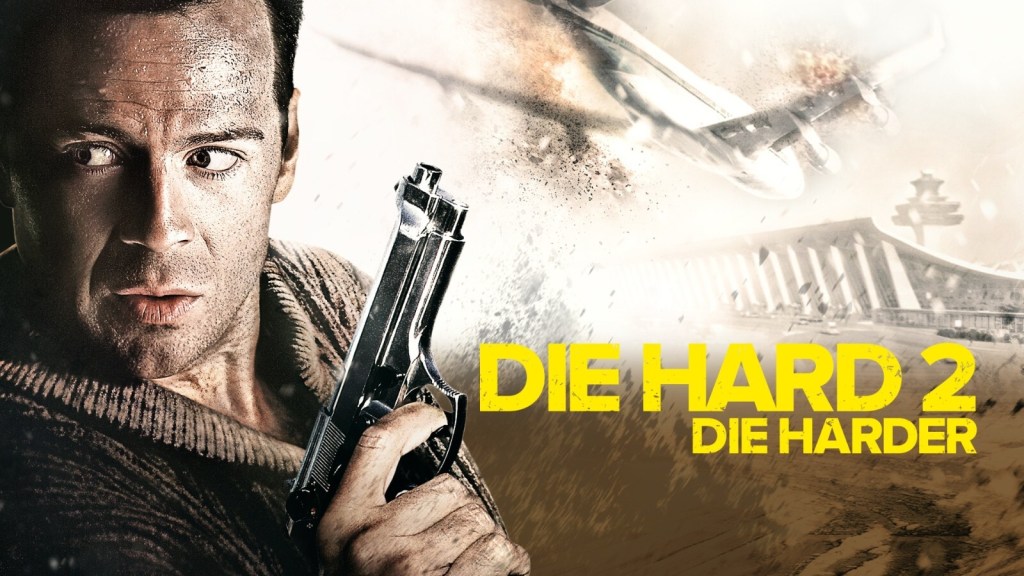
Die Hard 2
3.5 out of 5 stars
By J.C. Correa
Around fifteen or so years ago, for better or worse, fans of Die Hard began to retroactively champion it not just as a Christmas movie, but as the Christmas movie to end them all. They’ve argued that its qualifying bona fides are plenty, as evidenced by a plot centered around a Christmas Eve office party gone horribly wrong, joking references to Santa Claus, themes of family reconciliation and miracles, and the use of a handful of Christmas carols either across its soundtrack, or within the story itself. Though I have no problem whatsoever awarding the flick a Christmas movie designation (testosterone-driven cinema needed at least one ambassador at this particular table), I do not believe that its director John McTiernan ever intended to make a holiday classic all the way back in 1988.
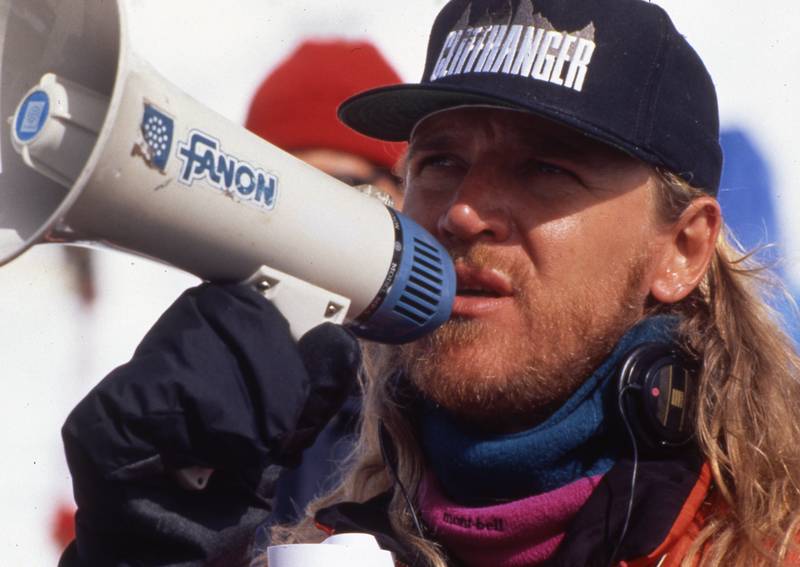
However, that is precisely what I feel Finnish filmmaker Renny Harlin had in mind when he helmed the franchise’s first sequel two years later. Celebrating its 35th anniversary earlier this summer, 1990’s Die Hard 2 (which was then playfully marketed as Die Harder) tore up at the box office back then in much the same way its predecessor had. Part of that was because audiences had quickly fallen in love with Bruce Willis’ rambunctious cop John McClane the first time around and couldn’t wait to get more of him. But it also had to do with the fact that the sequel was in many ways a repackaging of the first movie, with the main difference being that the setting was now switched from a building to an airport.
To my eyes, though, one of the obvious distinctions between both films is how desperately Die Hard 2 wants to be a Christmas movie in a way that the first one never truly aspired to and only ended up that way mainly by accident. I’m here to make the case that the sequel, while surely not as great or iconic as Die Hard, is arguably the one more worthy of representing the series come the Yuletide.
Consider the claim that Die Hard 2 makes right out of the gate: Unlike Die Hard, which takes place in sunny Los Angeles, this one unfolds in the middle of a blizzard in Washington D.C. (the very first shot features a flurry of snowflakes). Just like the first film, the sequel also takes place on Christmas Eve, but Harlin makes it a point to cram the background of the opening scene with all sorts of holiday decorations outside the airport. Once inside the packed terminals, we see dozens of folks carrying wrapped presents of all sorts. It’s the kind of sight that you would very much witness on any Christmas Eve, including the one from the first movie. Still, a crowded airport is a blunter way of hammering this particular point than a private office party.
The visual winter theme continues by featuring a snowmobile chase across a ridge filled with pines, multiple action sequences that take place on top of snow-covered runways, and a final shot depicting an agglomeration of airplanes randomly parked across them. This latter sight gives off a bizarre winter wonderland vibe, just as Vaughn Monroe’s version of “Let It Snow! Let It Snow! Let It Snow!” plays over it and into the end credits. Although it’s the exact same manner in which the first film concludes, this time around the use of the song really does feel earned in a way that trumps the original.
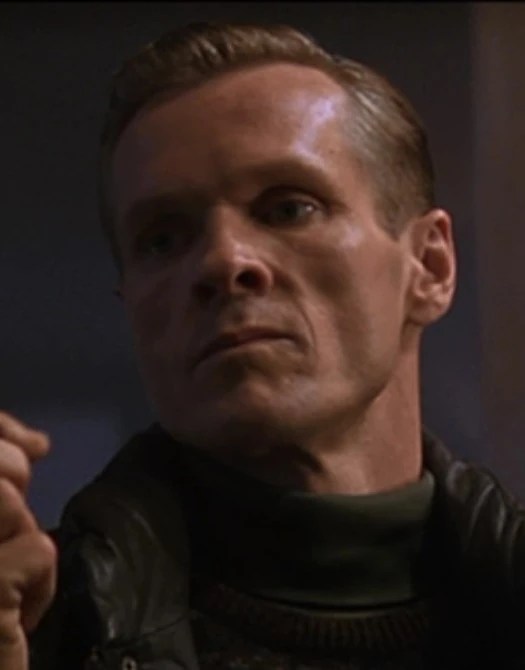
All that being said, Harlin’s true intentions are revealed in a way that is much more subtle (and subconsciously effective) than in any of the aforementioned qualities. Several of the movie’s key scenes take place in the airport’s control tower, or inside the cockpits of various planes that are flying above D.C. Others occur in the interior of a nearby church that William Sadler’s Colonel Stuart, the film’s chief villain, has set up as his base of operations. And yet, the visual palette of practically all of these predominately displays hues of red and green. Call me crazy, but last time I checked, those are not only the defining colors of Christmas, but they certainly don’t feature in such an overt manner in Die Hard.

Of course, none of this makes Die Hard 2 the superior effort by any measure. Be it through its originality, humor, impact, character stakes and development, and characters themselves – though fairly menacing, Sadler’s Stuart cannot hold a candle to Alan Rickman’s Hans Gruber in the charisma department – the original still has just about everything else going for it. However, I’ve always maintained that McClane’s adventure inside an airport is the best of all the sequels (something that a recent rewatch again confirmed), and surely better than the inexplicably more popular Die Hard with a Vengeance, which suffers from not only too much convolution after a terrific first half, but also a sadly limp finale.
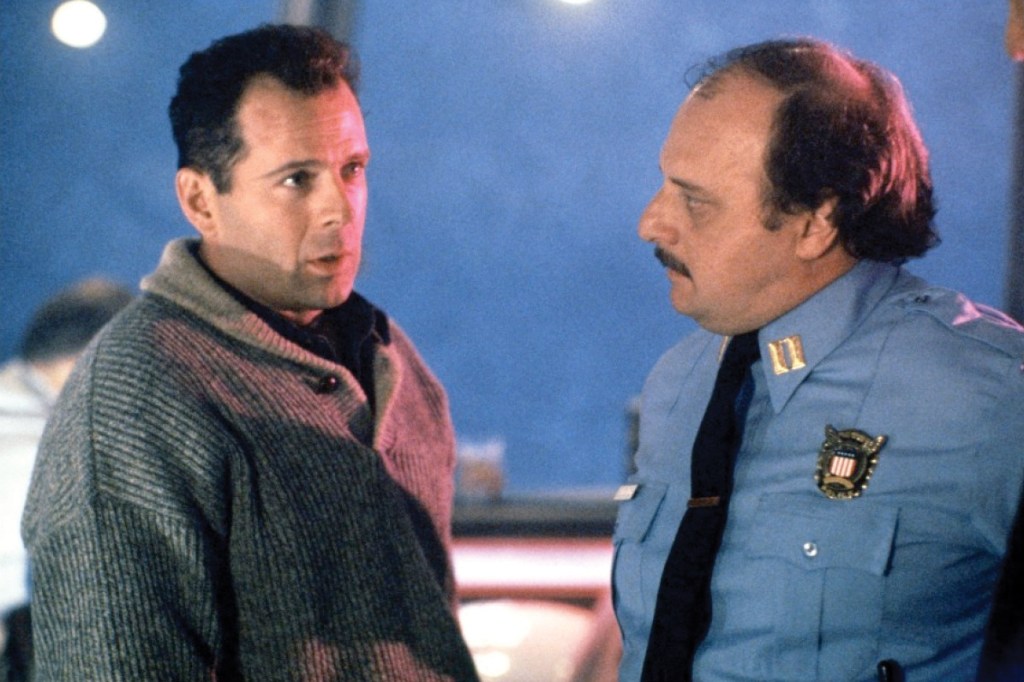
Harlin uses a fair amount of slow motion throughout the action sequences of Die Hard 2, certainly much more than McTiernan did in his picture. The effect usually works, but it does also compromise the intensity of some of the shootouts. Elsewhere, the movie warmly brings back Reginal VelJohnson’s character from the first film for what feels like an encore scene, but this also mostly positions McClane as a lone hero throughout, something that never again happens in the series. As it is, the trope of the incompetent and antagonistic chief of police is once again repeated (the only other time this occurs in the franchise), but this time around Dennis Franz’s perpetually irate copper at least gets a brief redemption at the very last moment.
One of the key elements that made Die Hard so fantastic was its concept-driven structure. Confining the entire premise to a single building added to the tension and claustrophobia of the experience and allowed the filmmakers to have a lot of fun with this very idea. It was only natural that Die Hard 2 was going to go a little broader, but the movie, which retained one of the first one’s screenwriters (Steven E. de Souza), benefited greatly from also being constructed as a concept piece confined to a single setting, albeit a larger one. This particular trait made both pictures seem genuinely special in their uniqueness, something that later entries, perhaps at the mercy of plausibility, abandoned altogether. Both films also share the claim within the series of taking place predominantly at night, and use the invasive element of the press as a plot devise to heighten the tension, even if the second time around rides hard on the idea of coincidences (something that the film openly and humorously addresses throughout as a way of getting us on its side).
The movie does have one big weakness, and it revolves around a nonsensical plot element that occurs near the end. McClane’s primary objective the entire time is to ensure the safe landing of the plane that is carrying his wife. That is the only reason why he takes on the terrorists who have taken over the airport and held all of the circling planes hostage by not assisting their landings during the storm. Once Stuart has organized his entire battalion’s escape in a 747 with Latin American dictator Ramon Esperanza (Franco Nero) in tow, McClane has no reason whatsoever to try to stop them, aside from his own ego and bravado. While he literally admits to this being the case, it seems like a senseless reprioritization considering that it doesn’t solve his wife’s predicament or aid it in any way. Elsewhere, a more amusing nonsensical detail involves the casting of Robert Costanzo, one of the most Brooklyn-sounding actors in Hollywood, as the cop brother of Franz’s airport police captain, who speaks with the epitome of a Chicago accent. Inexplicably, both practice law enforcement in the nation’s capital.
Still, as the only true spiritual sequel to Die Hard, Harlin’s flick functions as precisely the type of early ‘90s action blockbuster that it was intended to be. It repeats most of the things that gave its genre-staple predecessor that very distinction, and ups the ante where it needs to (such as in a graphic recreation of a commercial airliner crash that is not only the series’ most horrifying set piece, but also one of the premier examples of a swift body count across any picture you’re likely to come across). It’s also fun to see a pre-NYPD Blue Franz rehearsing the cop thing and catching fleeting glimpses of a pre-fame John Leguizamo and Robert Patrick; the latter, a mere year before he traumatized us all as a stalking, liquid metal terminator. In spite of all of this, Die Hard 2 will and should never be placed above Die Hard in any list of movies, Christmas or otherwise. However, should fans of the series opt for it during the festive season instead of the requisite first chapter, they might be surprised at just how snuggly it fits into their Christmas stocking.
Die Hard 2 is currently streaming on Disney+.
 Generation X Wire