Back to the Future
5 out of 5 stars
By J.C. Correa
I have always maintained that Back to the Future is a perfect movie; perfect in the sense that every one of its elements works at an optimum level. I would not change a single thing about it – not a frame, not a take, not a performance, or any directorial decisions. Of course, this excellence I speak of starts with its very foundation – the brilliant screenplay written by Robert Zemeckis and Bob Gale – one that has been continuously studied at film schools over the years for not just its inspired originality but also for its, for lack of a better term, clockwork-like mechanics.
Having just revisited the film last week for the umpteenth time, and via a spectacular IMAX re-release in honor of its 40th anniversary, I was struck by the virtuosity of its opening scene, and in how those initial five minutes help to launch its flawless script on the best footing possible. As such, what follows here is less a critical review of the flick itself, and more an in-depth analysis of the sublime bedrock that helps to get everything going. Since I imagine that practically all of you reading this are familiar with the picture, I will forgo my concern about giving anything away.
The movie starts with a simple tracking shot introducing us to the home/work lab of Dr. Emmett Brown (Christopher Lloyd), the wild-eyed scientist on the cusp of the biggest scientific breakthrough in human history. The Doc isn’t home during the sequence, but from everything that we see – and we see a lot – we immediately ascertain a great deal about his eccentric personality. But before we even get to glance at a single image, the film begins by gradually introducing the sounds of ticking clocks over a black screen that slowly reveals the main titles. Being that time is the single biggest theme of the movie, it doesn’t waste a millisecond in establishing that.
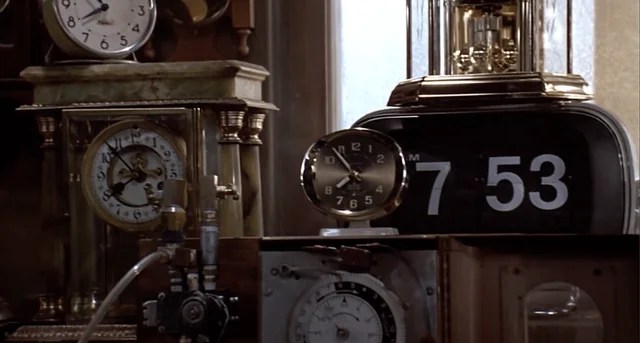
Once we fade in on Doc’s dwelling, we are bombarded by the sights and sounds of dozens of clocks of all varieties, shapes, and sizes. A few of them are wall-mounted, but most sit on counters, including one that features a tiny image of Harold Lloyd dangling from its minute hand; a direct nod to the iconic scene from the 1923 silent film Safety Last! It may seem minor – in part because it’s thrown in amidst such a large collection – but the sight of this particular clock proves to be the movie’s first bit of foreshadowing, as later on, during its climax, Doc himself will be doing that exact same thing for the sake of sending his teenage buddy Marty McFly back to the future. The fact that both actors who immortalized this stunt share the same last name is surely a bizarre coincidence, but a welcome one all the same.
Immediately afterwards we see newspaper clippings taped to the wall with headlines indicating that Doc’s mansion was destroyed, his family estate sold to developers, and he himself labeled as a “bankrupt inventor” (an envelope with a “past due” notice stamped on it sits nearby to underscore this point). Underneath the clippings are portraits of Benjamin Franklin, Thomas Edison, and Albert Einstein. This is telling because not only are the latter two legendary scientists that Doc clearly looks up to, but Franklin himself, beyond the political realm, was someone who made a name for himself through his scientific experiments and inventions. It all tracks with regard to Doc’s life and personality, and the fact that Franklin is also immediately associated with money by virtue of his face adorning the one-hundred-dollar bill only makes the irony that much juicier.

After getting a quick glance at a few discarded Burger King wrappers that indicate Doc’s chaotic existence – all of which lie next to a red JVC camcorder that will later play a major role once Marty uses it to film Doc’s unveiling of the time machine – a radio automatically turns on to reveal an ad for Toyota cars. Though it may seem trivial, one critical piece of information is conveyed through the commercial by way of the vehicles on offer: The fact that we are in October of 1985. In a movie about time, the need to establish this little detail immediately is as important as oxygen.
Continuing the trend of mechanics springing to sudden life, we next see a coffee machine shoot out a streak of water, followed by a clock whose side lever casually activates a switch that turns on a television. The TV presents us with a news report that details the theft of plutonium from a nearby research facility, and, in a seemingly throwaway line that ties in to the plutonium’s disappearance, also introduces one of the film’s biggest antagonists by casually mentioning a Libyan terrorist group. This very lot will soon be responsible for Doc’s murder (as the plutonium itself will be critical to his success with the time machine), but this is the first time that these particular seeds are planted.
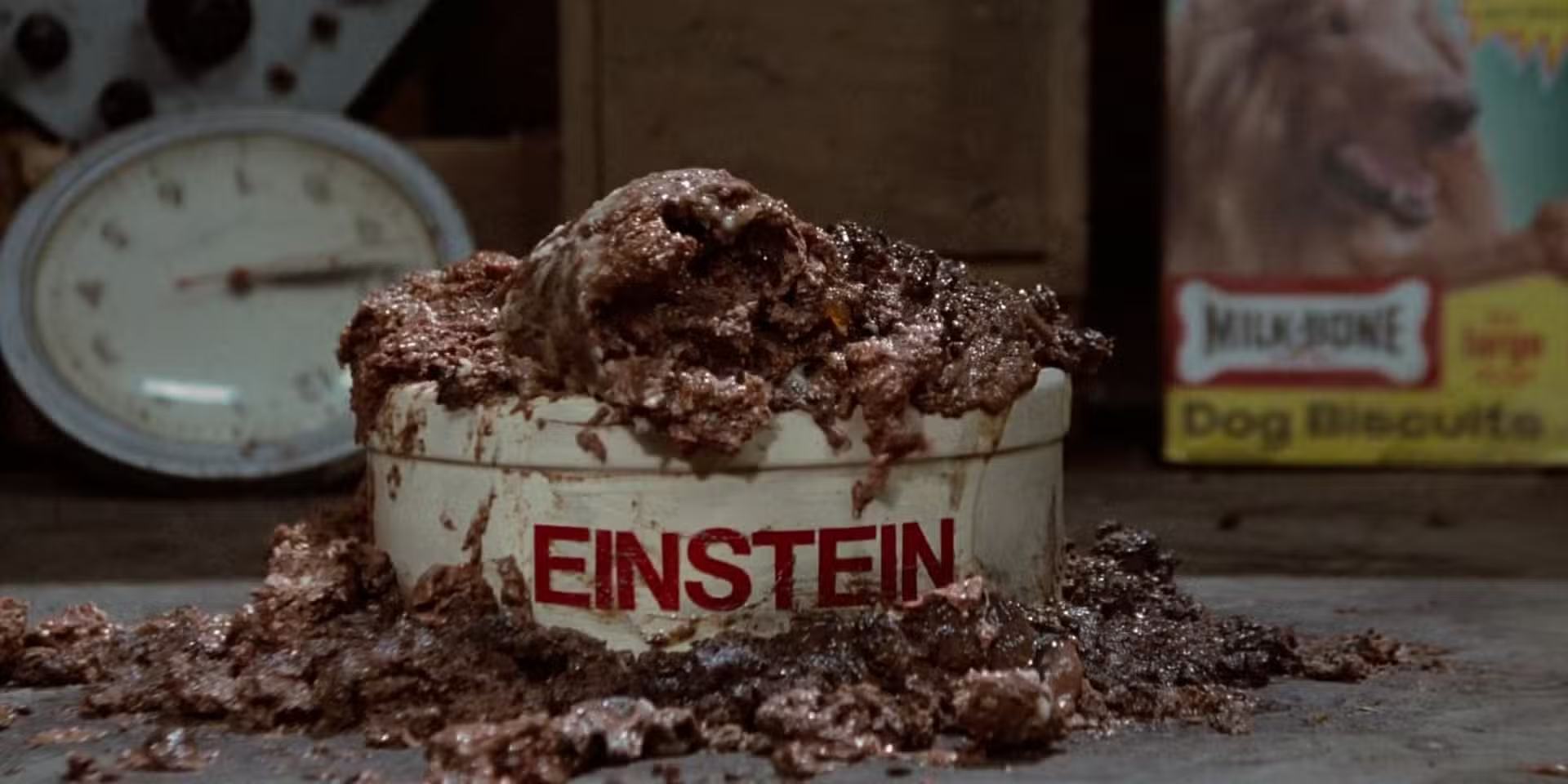
Staying on this theme of electronics, a toaster shoots out two squares of burnt toast, which is soon followed by the sight of a mechanical, factory-like claw grabbing a can of dog food and pivoting to the other side where an electric can opener awaits to do its job. Once opened, the claw dumps the contents of the can into a dog bowl that rests on the floor below. Said bowl bears the inscription “Einstein” on its side – the second mention of the genius scientist in the last two minutes – and the fact that it is disgustingly overflowing with wet dog food only accentuates the point that neither Doc nor his canine have been home as of late, and are clearly busy with other matters.
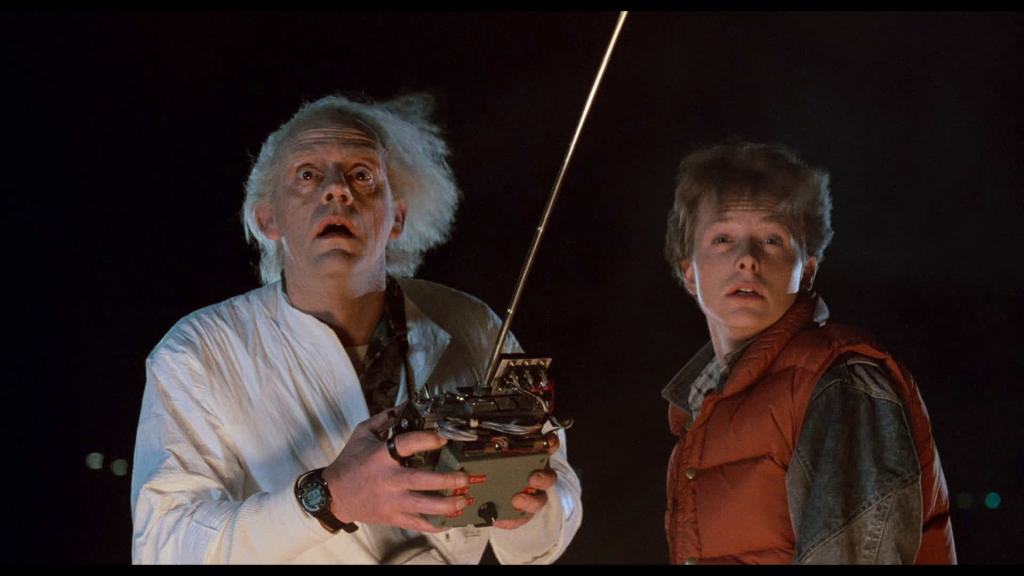
At this, we are introduced to Michael J. Fox as Marty, just as he opens the front door to the place. Considering that he is shot from the waist down, the very first thing that we see of him isn’t so much a part of his anatomy, but rather, the skateboard he carries. As we will soon find out, said board is not only a symbolic extension of his body, but will soon prove to be a mode of transportation as well as a means to avoid actual peril. Marty enters Doc’s home and quickly kicks his skateboard to one side, where it comes to a halt upon smacking into a case whose label reads “Plutonium – Handle with Care.” The details are all subtle, yet absolutely brilliant in how it is all conveyed and carefully constructed.
Marty takes this solitary moment in Doc’s lab to turn on his friend’s sound gear and plug his electric guitar into an amplifier that is hooked up to a speaker the size of a ship’s radar dish. After turning all of the nobs to a level even higher than what the members of Spinal Tap would ever require, an intense hum begins to emanate from the speaker. During this whole time, we have been shown credits that overlap with the entirety of the sequence. At this precise moment, though, right as the hum from the speaker is about to burst, the last credit fades from the screen – that of director Zemeckis – allowing the movie to announce that it’s off and running by having Marty strike a chord with his metal plectrum, the effect of which sends him flying ten feet across the room as the space reverberates with a thunderous twang. Up until here, we have yet to see Marty’s face. But that’s not so important. What is, however, is the fact that we already have a clear understanding that he is a rocker. And that detail, much like the skateboarding, will pay off enormous dividends down the line.
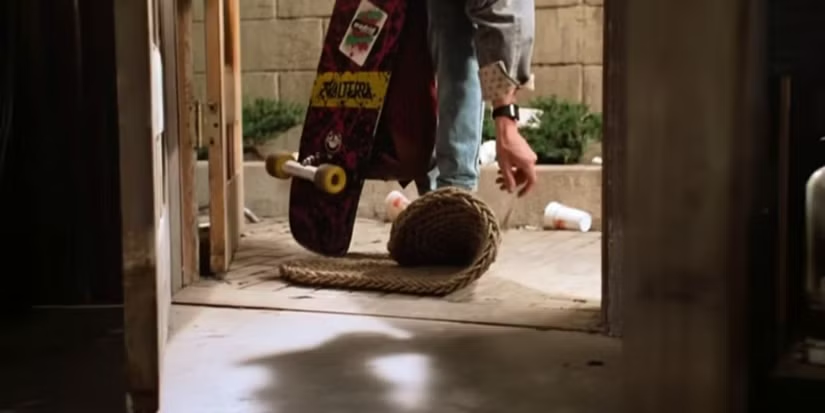
The scene ends shortly afterwards once Marty receives a phone call from Doc, in which he learns that all of Doc’s clocks are 25 minutes slow, therefore making him late for school. After the initial blast from the speaker, this exchange immediately reconfirms the humorous tone of the picture, something it will carry throughout its remaining runtime. The exuberant sounds of Huey Lewis and the News’ “The Power of Love” blare on the soundtrack, just as Marty exits Doc’s place and tries to get himself to school as quickly as possible by showing off his clever prowess on the skateboard.
In just these five minutes, Back to the Future has played a masterful game of show and tell. With very little dialogue, and relying mostly on images and sound design, it shows us exactly who these two characters are, including many of the quirks within their personalities. In Doc’s case, it even gives us a fair understanding of his backstory. The sequence also sets up some of the major elements and plot points that will play out wildly later on: the specificity of time, the plutonium, the Libyans, Marty’s musical and skateboarding abilities, Doc’s heroics on the clock tower. In addition, it establishes the relationship between Marty and Doc as an unlikely, but curious friendship.

What makes Back to the Future one of the best movies ever made is precisely everything that follows that opening prologue. All that we witness from that point onward is a perfect marriage of idea and execution, a true rarity in cinema. But it all happens on the strength and deftness of that opening. It’s a showcase of precise, economical filmmaking at its best. And, to put it plainly, it’s timeless.
The re-release of Back to the Future is currently playing in theaters.
 Generation X Wire