
Rocky IV: Rocky vs. Drago – The Ultimate Director’s Cut
3.5 out of 5 stars
By J.C. Correa
In 1985, Sylvester Stallone sat on top of the world. The explosive success of Rambo: First Blood Part II that summer gave the writer/director/actor his biggest hit to date, suggesting that he was one of Hollywood’s grandest stars of the era. Six months later, the massive box-office triumph of Rocky IV, which equaled it in numbers, cemented that status.
Gen Xers who came of age in the mid-1980s surely remember the pop-cultural influence of films like The Breakfast Club, Top Gun, Back to the Future, and The Karate Kid. And for a fleeting, zeitgeist-defining moment, it would be remiss to not include Rocky IV in that hallowed list. Released in late November of 1985, the third sequel to 1976’s Oscar-winning Rocky had every reason to exhibit the ‘been there, done that’ staleness of a tired formula. But Stallone was commercially smart in doubling down on that reliable recipe, this time coating it with sensationalized Cold War politics, all the while embracing the visually kinetic MTV sensibilities of the day.
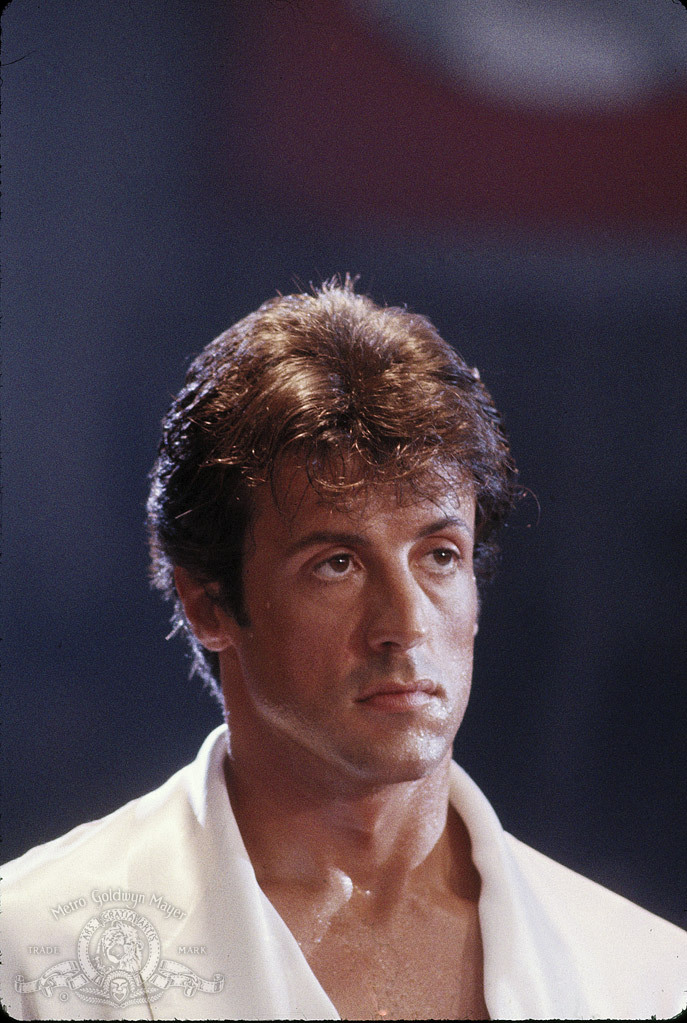
Though Rocky IV was a monstrous hit – the biggest in the history of the beloved series – it did come at a cost. To sell the movie as an aggrandized U.S.A. vs. Soviet Union boxing extravaganza, Stallone traded in the quieter, character-driven sensibilities that made the original so special for sheer bombast and spectacle. Gone were the pensive, meditative moments and emotionally rich dramatic interactions that were the touchstones of the first two pictures. They were replaced instead by a gaudy showcase of beefcake throughout, and flag-draped, exploding boxing gloves for the opening. In simpler terms, vanity and pageantry trumped humanity and depth. As such, it was easy to love Rocky IV back then in the same way you would bubble gum. And though the flick may have been thought of as ultra cool at the time, it’s impossible to deny the overt kitsch of it all.
During the pandemic a few years ago, Stallone, by then in his mid-70s, used that time to revisit the film; specifically, the vast amount of footage that he shot for it that never made it into the final edit. Doing so, he discovered that he had actually written (and filmed) a deeper and more well-rounded sports drama that tonally tied in more directly to the previous installments. After spending several months in the editing bay, he emerged with a substantially different version of the picture entitled Rocky IV: Rocky vs. Drago – The Ultimate Director’s Cut. It was subsequently given a blink-and-you-miss-it release in the fall of 2021 but will now be returning to theaters this week in celebration of the original movie’s 40th anniversary.

Since I suspect that most of you reading this are unfamiliar with this new version, all of the analysis that follows will be done with the intention of not spoiling anything. The first thing worth acknowledging is that the director’s cut, while only two minutes longer in runtime than the original, removes 40 minutes of footage and substitutes it with material never seen. This includes both entirely new scenes, as well as alternate takes to existing sequences. In doing so, Stallone reshapes the structure slightly while markedly altering the tone.
The tone shift has several objectives. Arguably, the primary one is to heighten the emotional and dramatic stakes around the death of franchise fan favorite Apollo Creed (Carl Weathers). This is partially accomplished through the inclusion of extended flashbacks from the previous film that recall Apollo’s burgeoning friendship with Rocky. By eliminating certain dialogue and shortening some scenes, the impact that the fear of being forgotten has on Apollo’s ego is also noticeably enhanced. During his glitzy entrance to the bout against Russian strongman Ivan Drago (Dolph Lundgren) – which still features the iconic James Brown cameo – new reaction shots of Rocky’s wife Adrian (Talia Shire), Apollo’s missus (Sylvia Meals), and even Rocky himself, underscore this point. Stallone also recuts the fight itself to make the beating come off as more brutal. But more than anything, in addition to elevating Rocky’s trepidation about Apollo tempting fate, he delivers an alternate speech at his friend’s eventual funeral; one that is so poignant and honest (and very much in line with his character) by way of how it directly references their linked history dating back to the first movie. It is also fraught with guilt, thus allowing a clearer understanding behind Rocky’s motivation to fight Drago. As a whole, it is the standout moment of the director’s cut and easily better than anything that made it into the original version.
Interestingly, another of Stallone’s aims is to further humanize the character of Drago by veering him away from the persona of a robot-like pawn of the Soviet propaganda machine, and more into that of an athlete whose primary objective is to advance his career. He accomplishes this by giving the verbally limited Drago a few more lines of dialogue, and also by shifting the cloak of villainy onto his manager (a perfectly-cast Michael Pataki), who may as well be an officer of the Kremlin. Drago himself, in the original, came across as a borderline sci-fi killing machine whose punches were capable of decimating opponents to an absurd degree, as evidenced by the over-the-top sounds used to mark those blows. Stallone has now had the good sense to make adjustments to these technical touches, making it all appear a little less fantastical. Just as importantly, considering that Drago went on to play a critical role in franchise spinoff Creed II – which Stallone had a hand in writing – the intent to retrofit him into that narrative seems clear.

The final confrontation between Rocky and Drago (still the film’s centerpiece, as the new title clearly points out) is still beyond the realm of most people’s idea of realism. However, through the inclusion of shots that make Rocky seem a little less of a David to Drago’s Goliath (though less uneven, the fight is now also more intense), not to mention a subtler approach to all of the proceedings, Stallone now imbues the whole thing with at least a fragment of plausibility that was never truly there before. Evidence of this is that the last few moments of the vicious contest now carry an undercurrent of greater drama. It also helps that he abandons, to the best of his ability, the gladiatorial flourishes to the confrontation by forgoing images draped in vanity in favor of less flashy ones. All of this makes the movie more accessible, and a little more in step with previous installments.
Rounding out the improvements are additional scenes between Rocky and Adrian that only enhance the emotional stakes while staying true to the nature of their relationship. A different version of the scene between Rocky and his young son is also better and more meaningful than how it was originally portrayed. Being that composer and series stalwart Bill Conti sat this one out, it helps enormously to have some of his musical cues from the earlier films recycled for some scenes here, and this detail alone goes a long way to making this entry feel much more tethered to the series. During a famous scene in which Rocky goes for a pensive drive as the soundtrack blasts Robert Tepper’s “No Easy Way Out,” the decision to change the many memories that play out in our hero’s head from color to black and white, while a minor one, doesn’t hurt. Lastly, though Rocky’s Cold War-ending speech to an adoring Russian crowd is still ridiculous in concept, Stallone opts for some alternate dialogue as well as different takes, which makes it land a little more effectively and with greater sincerity. While I won’t reveal the details here, after said speech the narrative does not end as it did in the 1985 version. Instead, though briefly, we witness Rocky do something fairly radical that actually adheres to the overall theme that Stallone is trying to promote here. He also chooses to end the movie in a manner that not only more strongly connects it to Rocky III but is simply just that much cooler.
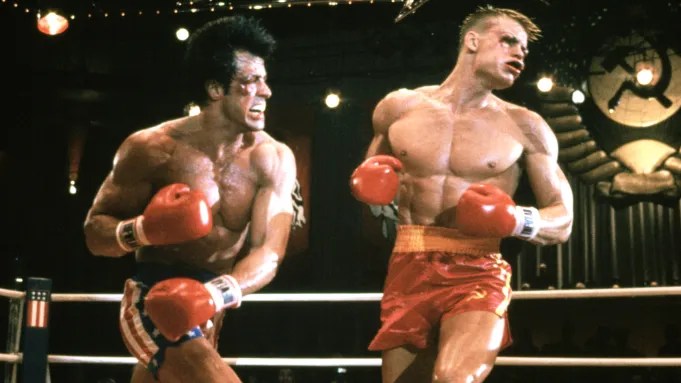
Of course, not everything works. Or at least not at the level at which Stallone may wish. Naturally, this often has to do with the fact that he must edit around or within scenes that were not necessarily written to play out that way. As such, some of the cuts are indeed a bit awkward. For example, we get to the Apollo fight almost too quickly; a result of there simply not being enough footage that supports the new tone to remedy that. The most dramatic change, from a visual standpoint at least, is the alteration of the film’s aspect ratio. Rocky IV, just like all of the series’ other chapters, was photographed in a “flat” 1.85:1 aspect ratio. The director’s cut, however, opts for the 2.39:1 “scope” widescreen format. Though I could be wrong, I suspect that Stallone’s intent here is to make the movie come across as more epic and heightened through this adjustment. And while that effect is partially achieved in doing so, the image has been cropped at the top and bottom to accomplish this, thus allowing for the loss of visual information that is frequently not a good thing.
The character of Paulie, Rocky’s irascible brother-in-law that Burt Young wonderfully always played for laughs, is unfortunately the biggest collateral damage of this new edit, partly because the choice was made to completely eliminate the silly robot that Stallone initially wrote into the script, most of whose scenes had to do with Paulie. Similarly, the involvement of Drago’s wife, played by Brigitte Nielsen (who was famously engaged to Stallone during the making of the picture) is reduced dramatically. While one can debate whether this is actually a bad thing, taking into account the couple’s acrimonious split, it seems painfully clear that the decision may have been as personal as it was creative.
The simple truth is that, while undoubtedly fun, Rocky IV was never a good movie, and its superficial aspirations jarred even harsher in light of the sublime intentions of the Oscar-winning original. The idea that a boxer such as Rocky, through grit and heart alone, could get America’s biggest foe in his corner against one of its own is, well…an insult to anyone’s intelligence. As a kid, while I loved the original theatrical version I grew up with for all its pomp and larger-than-life aesthetic, even then, it always seemed like it didn’t quite fit with the rest of the series. It was a cool outlier that had nonetheless strayed too far. I commend Stallone for realizing this, however late, and doing his best to correct that. Once you remove yourself from the nostalgia, it’s hard to argue that his director’s cut isn’t the far richer experience.
Rocky IV: Rocky vs. Drago – The Ultimate Director’s Cut will be playing in theaters on November 5 and 9.
 Generation X Wire