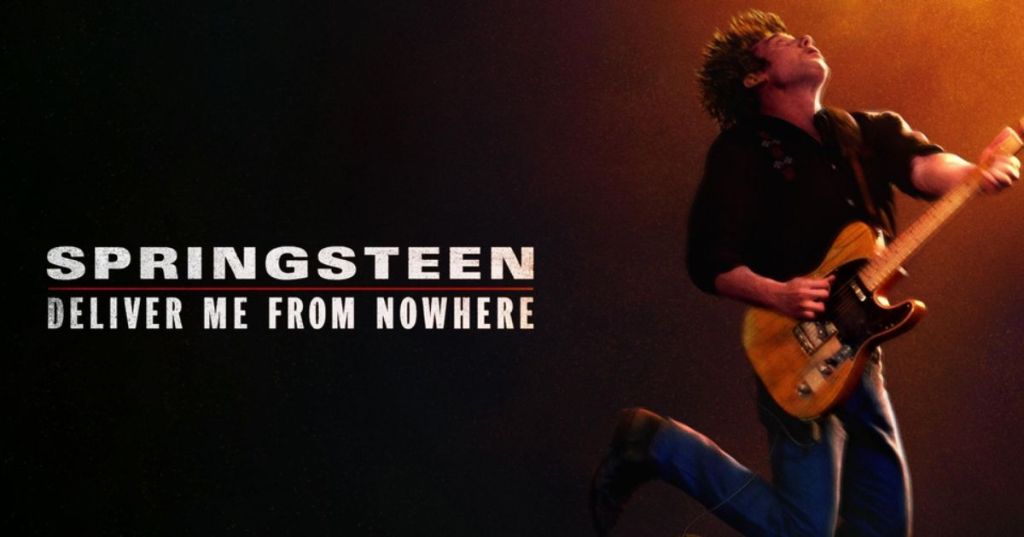
Springsteen: Deliver Me from Nowhere
3.5 out of 5 stars
By J.C. Correa
Few would argue that Bruce Springsteen isn’t one of the most important and influential musical artists of the past fifty years. Having been such a seismic cultural force is usually reason enough to merit a great biopic that explains how such status was attained. Springsteen: Deliver Me from Nowhere is not that movie, and in many ways is its antithesis. But you wouldn’t know it just from the posters that make it a point to sell the image of Jeremy Allen White as The Boss triumphantly commanding the stage.
The film, written and directed by Scott Cooper (Crazy Heart), and adapted from a book of the same name by Warren Zanes, save from a few fleeting instances, eschews the requisite depictions of an artist self-actualizing through live performances; which is ironic considering that Springsteen is known to be one of the finest to ever do it. Instead, the story places its focus on a turbulent time in his life; a period where just the idea of true fame and success could be as crippling as the emotional scars from his youth, which continued to haunt him well into his 30s.
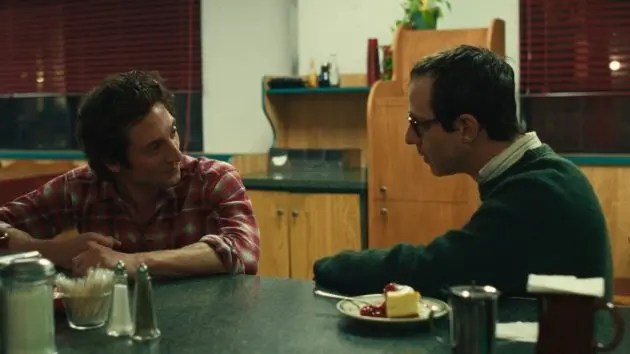
Said wounds were primarily the product of a threatening and emotionally absent father, played with quiet menace by the wonderful Stephen Graham. He makes Douglas Springsteen a hulking brute who spends his time drinking in solitude, when not making life difficult for his wife and young son. In the rare moment of internal peace, he takes the boy to the cinema to see The Night of the Hunter, a fitting choice on all accounts. These early, important chapters of Springsteen’s life are sprinkled throughout the narrative in effective, if somewhat cliché, black and white imagery. Returning to a normal existence after the conclusion of a concert tour, he spends a great deal of his free time allowing them to dominate his psyche.

Because he can’t let go of his family’s dark past, Springsteen embraces dour thoughts and, naturally, tries to turn them into some sort of art. This leads him down the road to create his seminal, brooding, lo-fi album Nebraska, which proves to be the opposite of what the record company wants. Alone, in the bedroom of his New Jersey home, he records the haunting demos for these songs, and it is here where White most shines in the role. The actor’s replication of Springsteen’s raspy singing voice is frighteningly accurate, and he does a splendid job at channeling his mannerisms and overall aura.
Though we witness the creation of this fabled LP – along with part of the infinitely more well-known Born in the U.S.A. – and all of the battles that Springsteen has to fight in and out of the studio to have it his way with the unwavering support of his guardian angel-like manager Jon Landau (Jeremy Strong), the film, at its core, is not really about the making of Nebraska, any more than it is about music or art. Instead, it is the story of a troubled man desperately trying to reconcile with the past, make some kind of sense of it, right its wrongs, and find internal peace through the creation of music. The clearest evidence of this is that the most powerful and memorable moment in the movie happens far away from the recording studio in a therapist’s office. This brief instance serves as the dramatic culmination of everything, and White absolutely kills here.
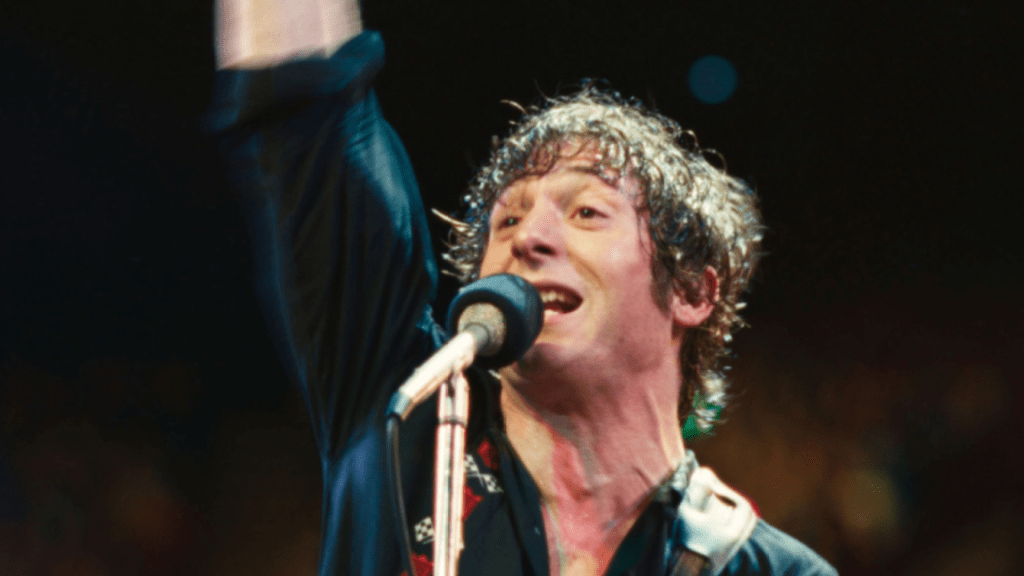
Strong, who last year created a Roy Cohn for the ages as Donald Trump’s ruthless mentor in The Apprentice, leaves his own mark here again. He portrays Landau as the best friend we all wish we could have, especially in business; a calm, sensitive, and utterly protective presence who enriches all the scenes he is in. Dramatically speaking, this proves vital in keeping Springsteen feeling reassured and secure, especially considering how, in spite of his humble and unassuming demeanor, the singer-songwriter constantly exudes fear and trepidation, which White wears well on his face.
The narrative unfolds primarily inside Springsteen’s house, in the streets and studios of New York City, and throughout the town of Asbury Park where he first became famous, and where he frequently returns to play in his downtime. It is here where he also meets a single mother named Faye (Odessa Young) who is keen on dating him. Pulling some strings, he soon takes her to the town’s vintage carousel after hours, and the sequence reminded me of Sylvester Stallone’s and Talia Shire’s first date at the empty ice rink in Rocky for precisely the same reasons. The script tries to make Faye’s character more important than she probably should be, and her only real purpose here is to accentuate the fact that Springsteen is afraid of commitment. However, the film would achieve its ultimate goal regardless of whether or not it omitted her altogether.

Considering the bleakness of the story, it’s a shame that there isn’t much humor to be found. Among the few existing examples is a recurring joke about a cassette tape – containing the all-important Nebraska demos – being recklessly passed around without a case; surely a signifier of the homemade nature of it all. There is also the requisite scene of a record company suit (David Krumholtz) listening to the end product while agonizing over the fact that there is nothing remotely marketable about what is coming out of the speakers. Aside from these outliers, another rare light moment occurs when Springsteen and his band members (all of whom are cast well enough to look the part) record the jubilant-sounding, if lyrically-subversive, “Born in the U.S.A.”
Like most films about the life of a famous person, this one takes its occasional liberties with the facts. Here, the two biggest culprits involve Springsteen’s relocation to California and eventual reconciliation with his ill father, in terms of when these events actually occurred. The latter incident serves as the inevitable resolution to everything, and though the scene is staged in a tender enough fashion, the emotional poignancy required of it is lacking, and thus, feels like a missed opportunity. Similarly, the decision to suddenly end the picture with the image of Springsteen on the Asbury Park Boardwalk is purely a symbolic one that mostly comes across as forced and too obvious. It also likely won’t resonate with casual moviegoers in the manner it’s intended, or with anyone beyond the Bruce faithful.

Inevitably, all of these characteristics should influence how well the project goes down with different people. Those expecting a traditional music biopic, or a celebration of an artist of Springsteen’s caliber, will probably be very disappointed. Conversely, viewers who welcome a tale that deals with the struggles of depression and mental illness are more likely to be rewarded. How well you reconcile one with the other will ultimately influence your overall enjoyment of it. Be it through the commendable acting from its leads, its ability to ethereally stage the nostalgic turbulence that gave birth to a song like “Mansion On the Hill,” or the sight of an artist passionately fighting for a vision on which his emotional stability depends, there is much to like about the film. Even as it occasionally embraces tired genre tropes and keeps a small focus on an artist who is anything but.
Springsteen: Deliver Me from Nowhere is currently playing in theaters.
 Generation X Wire