Karate Kid: Legends
2 out of 5 stars
By J.C. Correa
Trite, illogical, and ultimately pointless, Karate Kid: Legends takes all the goodwill amassed by the successful Cobra Kai spinoff and squanders it for no other reason than to keep cashing in on an old, albeit revived, IP. In this regard, it overtly aims itself at the Netflix hit’s audience, but lacks any true originality, verve, and playful spirit to earn their attention. As such, it is no surprise that upon its theatrical release at the end of May, it mostly floundered at the box office and rapidly left the public consciousness.
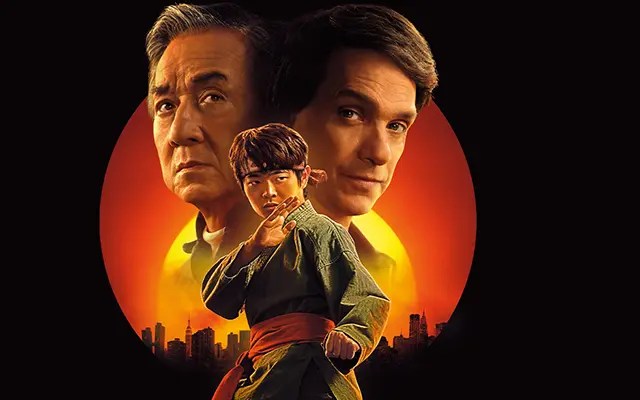
The movie, helmed by TV director Jonathan Entwistle from a script by Rob Lieber (Goosebumps 2: Haunted Halloween for Christ’s sake!), aims to fuse all eras of the franchise by casually throwing them into one big bowl of spaghetti (though Chow Mein is probably the better analogy here). In this, it leans into a throwaway scene from The Karate Kid Part II and finds a way to bring original protagonist Daniel LaRusso (Ralph Macchio) into the same orbit as Mr. Han (Jackie Chan), the kung fu shifu from 2010’s Jaden Smith-starring remake, but not without sprinkling a little Cobra Kai mojo on it for good measure. Come to think of it, the title alone reads like your standard rudimentary video game. Maybe that’s the first sign.
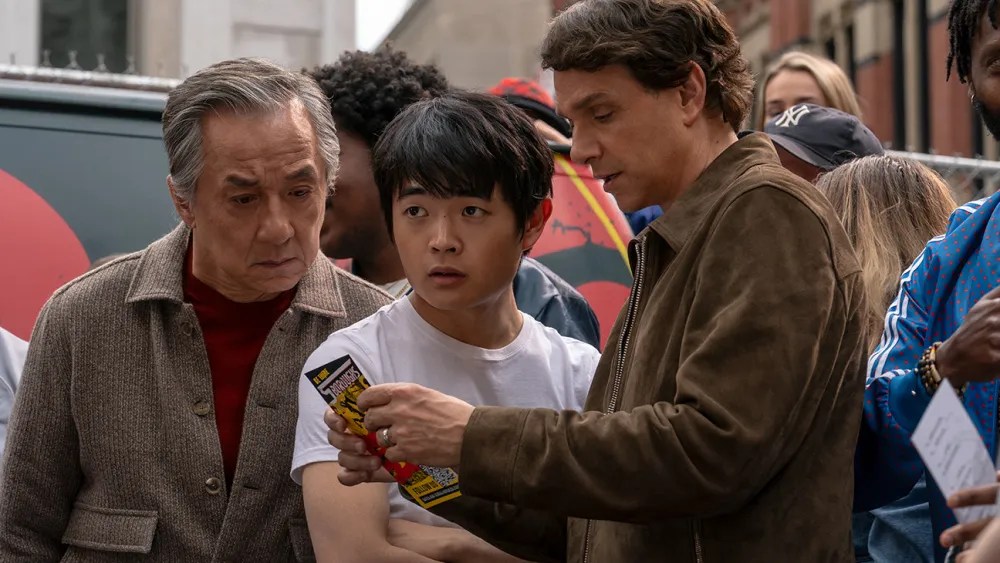
Brash teen Li Fong (Ben Wang), after training for years in Beijing under Mr. Han, relocates to New York with his doctor mother to start a new life. Here he meets a girl (Sadie Stanley) who takes to him, but who also happens to have a history with a local karate champion (Aramis Knight) of the thug-like variety. This inevitably causes our cocky and charming hero to get his ass kicked by the bully and eventually seek redemption through a local martial arts tournament that will eventually pit him against his foe. Sound familiar? Cue yawn here.
Be it through the story structure, or the requisite montage of not fitting in at school due to culture shock, all of the beats from the original film, as well as its remake, are replicated here. And Entwistle makes sure to tell it all in just over ninety minutes. Whether this is a case of lazy storytelling, or an actual display of good sense remains a mystery to me.

To honor its legacy, the movie continues the tradition of metaphorically tying a martial art to everyday actives. One of the most prevalent examples of this is the unusual tag-team of kung fu and pizza. As it turns out, we learn that the former can be used to gracefully make and cut up the latter. I am in no way asking for a sequel, but should one inevitably be made, Kung Fu Pizza would make for a fitting and worthy title.
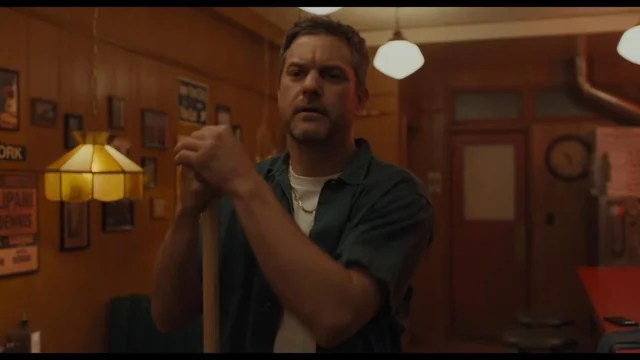
Not everything is a misfire, and some elements do work well enough in either a subversive manner or as straight-up comedy. As a charismatic pizzeria owner, Joshua Jackson is a welcome presence that gives the film some life. His character, Victor, quickly befriends Li – he takes to calling him “stuffed crust” – and establishes a fun dynamic with him and his daughter Mia (Stanley), who looks like a young Jennifer Lawrence. In an unexpected twist, Victor asks the newly arrived teen to train him in a boxing match so that he can pay off his loan shark. The way that the flick stages the whole thing, and its buildup gives you the sense that the fight could go either way, and it does.

A combat scene in an alley where Victor and Li battle a group of baddies is elegantly shot, and Entwistle also manages to make the movie’s final fight fairly exciting. Since almost all of the story takes place in the Big Apple, the film does take the effort to paint Manhattan and its skyline in a beautiful light. The rooftop setting for the finale is easily the most spectacular this series has ever conceived. And though he undoubtedly manages to get his hands dirty, Chan leans into his considerable comic gifts (he makes eating a pizza slice look funny) and essentially plays the Johnny Lawrence role in his dynamic with Macchio’s LaRusso. With both Han and Daniel in Li’s corner, the overload of the two widely different styles at the kid’s expense milks a fair amount of comic mileage.
Unfortunately, what truly sinks the film more than anything is the script’s complete disregard for logic, realism, and character, and its open embrace of contrivances. While on a date with Li, what are the chances that Mia just happens to run into her psychotic ex-boyfriend on the NYC subway of all places? The fact that Han throws Li into the tournament so abruptly – supposedly to help Victor – then in the next scene is suddenly in California asking Daniel for help feels extremely forced. Mia, who works for her father, delivers a pizza pie to Li at a surprise location that unexpectedly wows her, which makes her decide to stay, inexplicably abandoning her shift. Daniel never once questions the motive for Li’s desire to fight in the tournament, a move that after six seasons of Cobra Kai seems completely out of character. And why on Earth would the loan shark want Victor to lose the boxing bout when having him win it would be the only sure way to have his money paid back?
These aforementioned examples, as well as an almost clinical reliance on tired formula and montages (the one that depicts the tournament happens so quickly that it does not even give you a chance to breathe), make Karate Kid: Legends a failure and a disappointment by almost any measure. I have a hard time recommending it to even the most avid fan of this beloved franchise, especially in the wake of Cobra Kai. But I will say this: Its last sixty seconds are easily the most rewarding part of the movie, and almost, almost make waiting for it feel justified. In that sense, it’s not dissimilar to waiting eternally for the most delicious pizza pie of your life, one that you’ll inevitably have to eat cold.
Karate Kid: Legends is available to rent on Fandango at Home.
 Generation X Wire