No Holds Barred
1 out of 5 stars
By J.C. Correa
The recent death of pro wrestling icon Hulk Hogan surely has had many fans revisit his legacy and embark on requisite nostalgia trips in the days since. It’s a complicated legacy, made so by the various reported transgressions that Terry Gene Bollea (Hogan’s birth name) engaged in in his personal life; the most notorious of which were racist comments caught on tape, as well as a Gawker scandal that started by him being secretly filmed having sex with his best friend’s wife. It’s the type of stuff violently at war with the incorruptible, heroic image that Hogan played to perfection for legions of children who came of age in the 1980s and early 1990s that idolized him in the process.
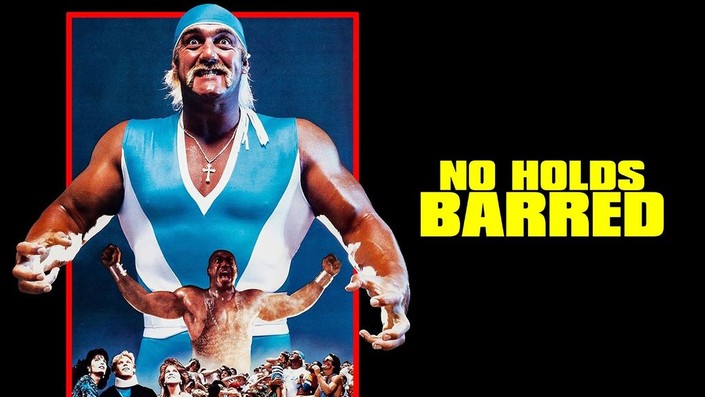
One of Hogan’s attempts to expand upon that image and diversify his career was a carefully-calculated foray into feature films that began by the end of that first decade. Though he had briefly appeared in Rocky III in 1982 – and made enough of a visual impact there to have it serve as a springboard for him to soon become the most famous wrestling superstar on the planet – it wasn’t until 1989’s No Holds Barred that he officially took on a starring role. I use the term “role” very lightly considering that Rip, a WWF (now WWE) champion who tears off his tank tops and is a beloved role model to millions, was simply a chance for Hogan to continue playing himself. He was now performing the same schtick for the big screen that he had been mastering on television and across American arenas for the past five years. His trademark red and yellow costume was given a blue and white makeover under the guise of Rip, while substituting his signature leg drop finisher for a double axe handle. But the effect is identical.
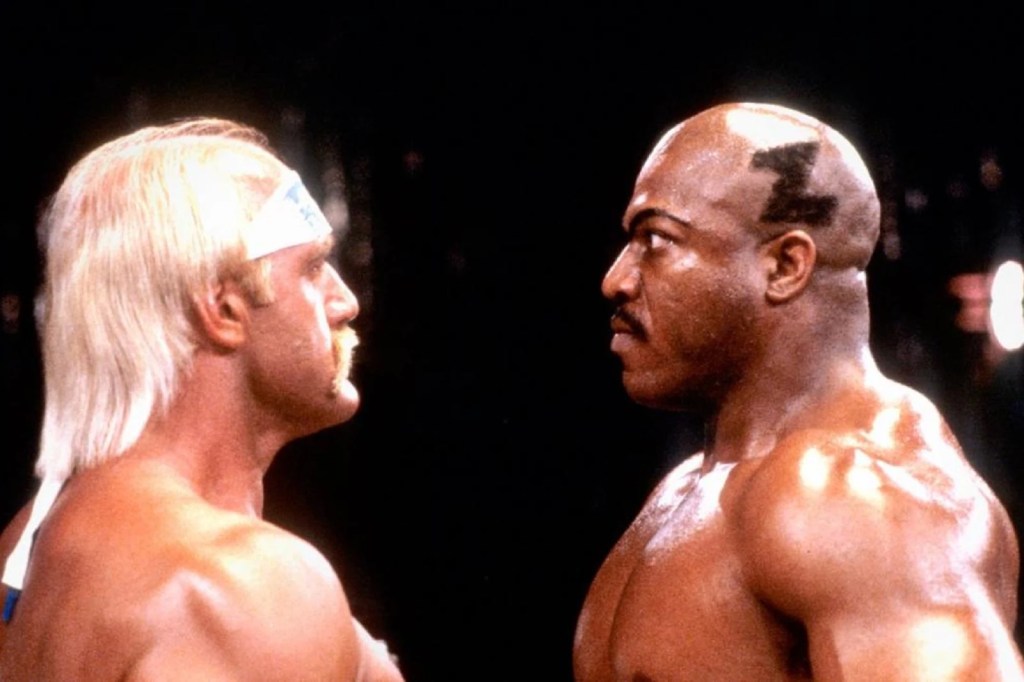
Since his passing, instead of revisiting his wrestling highlights, I decided to take another look at this late ’80s offering that unsuccessfully tried to turn Hogan into a major movie star. Seeing it with adult eyes, however, only verifies the absolute turkey that most have always known the flick to be, but it also does allow one to marvel at the level of crassness on display, while at the same time better understand its function as nothing more than another WWF marketing gimmick created for the sole purpose of generating ticket sales in the ring and guaranteeing a strong buy rate come pay-per-view time. Considering that then WWF chairman Vince McMahon spearheaded the entire project and is also one of its executive producers, that is all you need to know.
The movie’s poor excuse for a premise is basically this: A greedy television head honcho wants the ratings-darling wrestling top dog on his network at all costs. When Rip refuses, the disgruntled businessman stages a ruthless underground competition called “The Battle of the Tough Guys” in the hope of competing. Through this talent contest he discovers Zeus, a maniacal ex-con built like a behemoth, then soon realizes that pitting him against Rip will prove to be a sure-fire ratings bonanza. Just pepper all of this with various set pieces that try to sell the idea of Hogan as an action star, as well as a romantic subplot that allows his fans to see him under the lens of a sexy leading man.

In spite of these intentions, the end results are an entirely different matter, and frequently embarrassing for all involved. Kurt Fuller plays Brell, the crazed network head who constantly berates his two doofus subordinates, the latter of whom become the butt of penis-size jokes. Contemptuously calling Rip a “jock ass,” Brell has no strategy whatsoever when it comes to wining him over and is clearly clueless as to the art of schmoozing and seduction, or the importance of being likable. Also, his catty desire to have Zeus destroy Rip makes zero economic sense for him considering that Rip is the industry’s only meal ticket. Wondering how this moronic, cartoonish villain ever ascended to his corporate position is not worth the brain cells wasted. To his credit, though, Fuller is one hundred percent committed and hams it up to such an extent that it suggests he may have been the only one truly in on the joke. Fittingly, his character’s death is appropriately asinine.
Former model Joan Severance appears as Samantha, a Brell stooge sent undercover to seduce Rip, before eventually falling prey to his charm. After posing as his new account executive, she takes him on a trip to another town for no purpose at all other than to give them scenes together. As a seductress she is absolutely inept as she simply never even attempts it, opting instead to fight off our hero’s subtle advances. Everything between Samantha and Rip is stupid and contrived (no woman would sleep in just a bra for any other reason than to appear sexy, yet inexplicably do nothing with that) and is never given a chance to organically develop. However, despite an idiotic scene at a French restaurant, or a more forgiving one in a motel room, these setups do allow Hogan to show a softer, more sensitive side. Considering that, up until that point, his millions of Hulkamaniacs had only heard him charismatically scream and shout during the countless weekly promos he recorded in front of WWF cameras, the chance to witness him speak in a low, calm, and soothing voice was probably not only a first for many, but also a welcome variant.
When he is not in the ring, Rip is frequently seen fighting off goons in various settings, if not outright chasing them on his Harley Davidson. Using lots of slow motion to make Hogan look imposing, a parking lot melee aims for an A-Team aesthetic, but without the charm. Its end also represents the flick’s rock bottom as a limo driver literally craps his pants at the realization that Rip might tear him to shreds. The toilet humor is played out with such infantile grotesqueness, and with Hogan overselling it to such a degree, that you have to wonder how anyone in their right mind thought this would be a good idea, let alone funny. Just as silly, albeit a bit more fun, is a scene at a diner in which a robbery conveniently takes place thirty seconds after Rip and Samantha have sat down to eat, allowing the big guy to save the day by launching a barrage of readily-available pies into the faces of the baddies. Best of these is the all-too-brief motorcycle chase, if only because the sight of Hogan on a Harley, with snakeskin cowboy boots to boot, is an admittedly cool one, even if dripping with ‘80s kitsch.
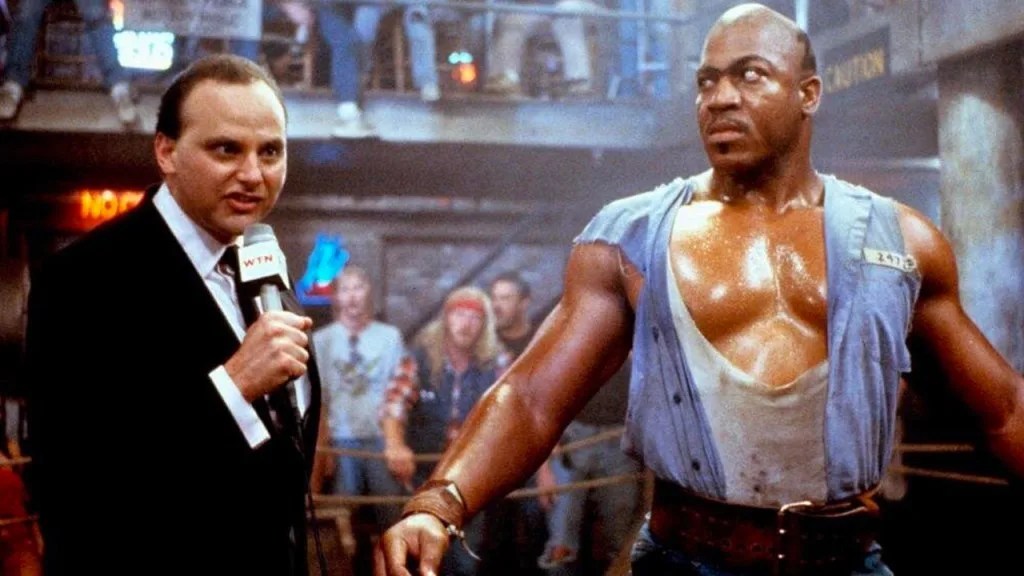
Zeus, played by the immensely muscular Tom “Tiny” Lister Jr, lacks any human qualities and instead seems ripped out of a horror graphic novel, as evidenced by how his awkwardly-outstretched arms make his walk look intentionally monster-like. It’s ridiculous for sure, and Lister Jr. doubles down on the effect by stupidly howling and grunting like an enraged animal any chance he gets. The character has no personality whatsoever, and his only real function seems to be to set up an actual feud with Hogan, which is precisely what happened in the WWF across the rest of 1989. His entrance, though, does provide the movie’s best moment when a bar brawler’s version of a double take sees him remove an eye patch so that he can properly process the monstrous sight of Zeus with his covered eye. It’s the only instance worthy of a genuine laugh.

Consider that “The Battle of the Tough Guys,” which is frequently held at the trashiest dive bars imaginable or in warehouses that resemble steel mills, is supposed to be a fight contest without rules or referees. Yet its depiction is so cookie cutter and uninspired (you’ll be forgiven for thinking that a cheering dwarf in a cage is Peter Dinklage) that the only thing calling our attention is the constant questioning of what kind of lawless society would allow something like this to play out without batting an eye. And that addresses the film’s greatest peculiarity: The fact that it takes place in a world where pro wrestling is apparently as real as the backyard skirmishes that are vying for its audience. Though we see Rip in various areas of his personal life, at no point does the flick acknowledge the staged and scripted aspect of wrestling, opting instead to maintain the kayfabe beyond any logical explanation. By this rationale, we may as well take No Holds Barred as a slice of science fiction because it certainly does not unfold anywhere that remotely resembles reality.
At its best, the film plays like a doltish and emotionally-manipulative TV movie, probably because it was directed by Thomas J. Wright, whose long list of credits are almost all from that realm. Still, its overt sexism and homophobia were tasteless even then and have only ensured that it has aged alarmingly badly. The best thing about it is probably the title song written by Jim Johnston and performed by John Noyce. Playing over the end credits, it’s the typical B-level rocker that was a de facto trait of this sort of late ‘80s action fare.

Despite several efforts, Hogan did not achieve a successful career as a screen actor, and this clunker certainly did him no favors in the pursuit of that quest. The truth is that the camera has always loved him, and, in his day job at least, he was a master of knowing how to manipulate it. But playing to wrestling audiences in a packed arena or on TV is very different than emoting in front of something as unforgiving as a film camera. Here, more often than not, Hogan relies on his default setting of overacting. This works fine for the wrestling sequences but looks sorely out of place everywhere else. It’s worth noting that at one point he is actually tasked with crying onscreen. Whether or not those tears emanated from a small bottle before the cameras rolled is anybody’s guess, but Hogan handles the scene convincingly enough, partly because his WWF character had already frequently required him to portray grief and anguish on a different stage. Scenes like this one, as well as those in which he is allowed to show his softer side, may have led one to believe that he had more acting chops than we had initially assumed. Unfortunately, he went on to litter the rest of his filmography with a long list of drivel that would only stunt him as an actor and never give him the opportunity to dramatically shine in any capacity.
No Holds Barred is currently streaming on Tubi.
 Generation X Wire