4.5 out of 5 stars
By J.C. Correa
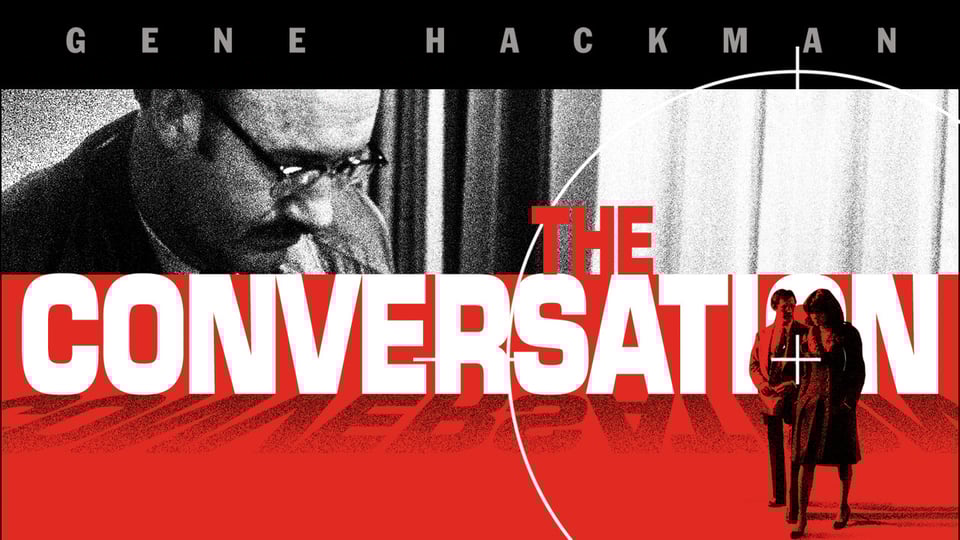
One of Gene Hackman’s absolute best and most layered turns is in this 1974 Francis Ford Coppola cult classic that last year made the rounds in cinemas around the world as part of a 50th anniversary re-release. As Harry Caul, a surveillance expert whose perpetual nervousness and paranoia match the intensity of his Catholic devotion, the Hollywood thespian soars in a role that is equal parts heroic and pathetic.
Wearing glasses that are perennially out of style and make him look older than he is, Harry chooses to match these with a cream-colored shirt and brown tie that perfectly complete the look of a relic, a phantom. He is basically an invisible man. Which is sort of the point considering his profession. But Harry goes to great lengths in being so, be it the manner with which he fervently protects the privacy in his home (he does not own a phone, he consistently changes locks, the minimalist decoration is devoid of personality), or the way in which he intentionally comes across as a complete enigma to a girlfriend (Teri Garr). It is not a glamorous role by any means, but Hackman was never one to chase after that sort of thing anyway.

We get a window into Harry’s humanity through his affinity for playing the saxophone. It seems to be the one thing that brings him some sort of calm and peace and allows him to just let go. But he is not a prodigy by any means and, unsurprisingly, is insecure about how he plays it. When he is at his workstation, Harry is laser-focused and downright irritable towards anything and anyone that could distract him, as evidenced by the funny and tense dynamic he shares with his assistant Stan (the always excellent John Cazale).
In fairness, Harry is not anxious and cantankerous for no reason. A previous surveillance job some years ago had inadvertently resulted in the deaths of three people; a fact that still haunts him. Though he is only a contractor not responsible for how his clients use his work, he carries guilt from that incident all the same, which also helps to explain his commitment to religion. This is best exemplified during a key scene in a church confessional, partly because it is also wonderfully-rich with metaphor. While Harry opens up about his sins, Coppola visually presents the sequence in a surreal manner, reminding us all along that what is unfolding is also a form of surveillance.

The project Harry is currently working on reawakens his conscience through a specific detail. He has been tasked with eavesdropping into the conversation of a couple who repeatedly walk in circles in San Francisco’s Union Square. After painstakingly removing the copious background noise and filtering through all the tapes he has put together, he comes across the phrase, “He’d kill us if he got the chance.” This sends Harry into a moral tailspin that begs him to question not only the nature of his work, but also forces him to confront his anonymous employer, however unexpected and unprofessional that is.

In this regard, The Conversation draws clear inspiration from Michelangelo Antonioni’s Blow-Up. And while both films have that eureka moment where the protagonist stumbles upon something that he believes to be very sinister, unlike David Hemmings’ Swinging London cool cat photographer in that 1966 classic, Harry is overcome by nervousness, guilt, and paranoia. Hackman plays this perfectly and carries it incrementally through the rest of the picture.
After meeting an antagonizing competitor (Allen Garfield) at, of all places, a “buggers” convention, at a party afterwards his rival admits to have planted a harmless bug on Harry just to illustrate a point. This is a massive blow to Harry’s ego, but also serves to send him further along his psychological downward spiral. It is a phenomenal moment, partly because we do not see it coming, but also because of how well Hackman plays it.

Besides his wonderful lead and all-around great cast, Coppola benefits from working with sound guru extraordinaire Walter Murch. Because sound is so vital to not just the mechanics of the plot, but also functions as a theme, the filmmakers insist on keeping it at the forefront. Shooting in his beloved San Francisco, Coppola opens the movie with a terrific, snail-like zoom into Union Square – he uses various slow zoom-ins throughout – introducing all of the randomness very carefully, among which is Harry. Murch complements all of this through weird, alien-like sounds that filter through the microphones that Harry and his team are using. Though the effects of confusion and disorientation are successfully attained, there is still an analog beauty about the whole thing, and the picture makes it a point to romanticize that. The moody and atmospheric piano score by David Shire feels right at home in this world.
Those unfamiliar with the film will be surprised to see Harrison Ford appear here in an early turn. It is a small part, but one that still leaves its mark by way of how coldly menacing he comes across whenever he is on-screen. Robert Duvall, a Coppola favorite, also has a brief appearance.

But the movie belongs to Hackman through and through. It is thoroughly effective because of how many things it truly is and represents, though at its heart, it is first and foremost a character study that is at once both amusing and sad. It is a statement about how intense passions and peerless abilities can also turn against and consume one entirely. The film’s ending, which I will not reveal here, is a painful dissection of a person’s psyche, and its final images are potent enough to sear themselves onto your brain so that they still burn long after it has ended.
The Conversation is available to stream on Amazon Prime through June 30.
 Generation X Wire