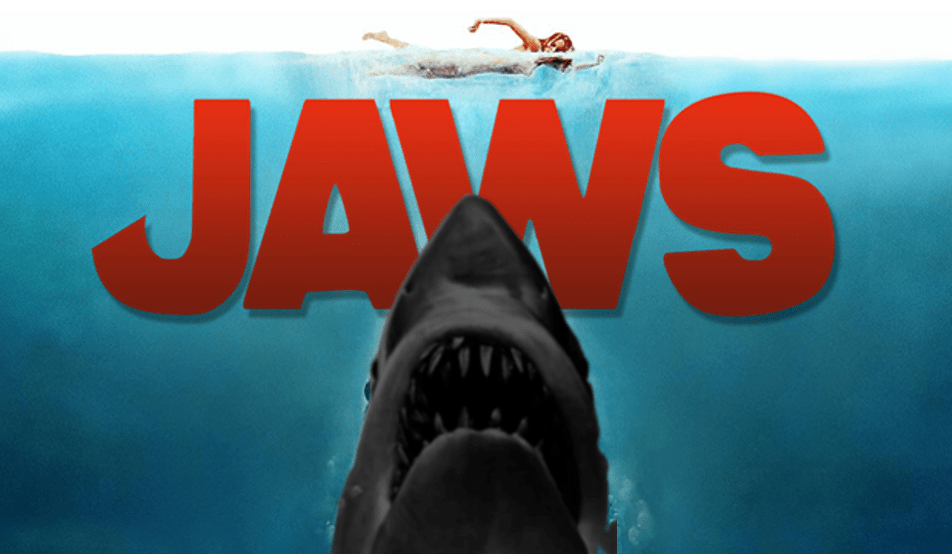
Jaws
5 out of 5 stars
By J.C. Correa
What more can be said or written about Jaws that hasn’t already been done? By now, a half-century into its life and legacy, most have probably seen it. At the very least they might know it was responsible for not only properly establishing Steven Spielberg as the consummate commercial Hollywood director, but also for inadvertently creating the concept of the summer blockbuster. Not to mention giving an entire nation second thoughts about going in the water while at the beach that summer.
Similarly, it is no secret that the film suffered from one of the most chaotic and labored productions in history, accruing a staggering number of setbacks along the way that logically pointed toward it becoming anything other than the enormous success it turned out to be. Fate, serendipity, and mechanical sharks indeed work in mysterious ways, even if that means not working at all.
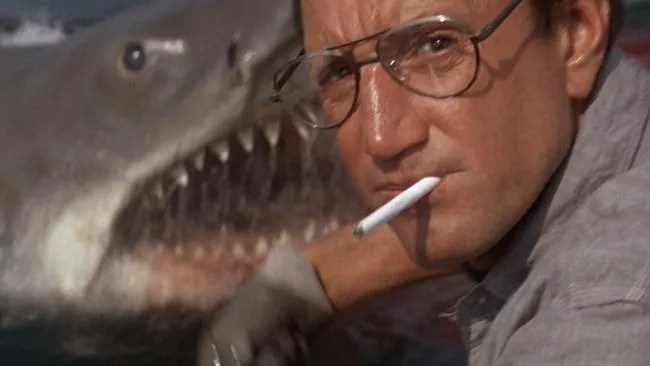
On account of its release fifty years ago today – June 20, 1975 – it is as good a time as any to revisit the feature that, for better or worse, changed cinema forever. Jaws will surely be screened randomly all over the world this year, allowing moviegoers the chance to experience it on a big screen again. Though I suspect just as many viewings will occur in living rooms near and far. Personally, I was happy to have given myself the chance to rewatch it over the weekend, and what I am about to write, I do so under the assumption that you too are familiar with it.
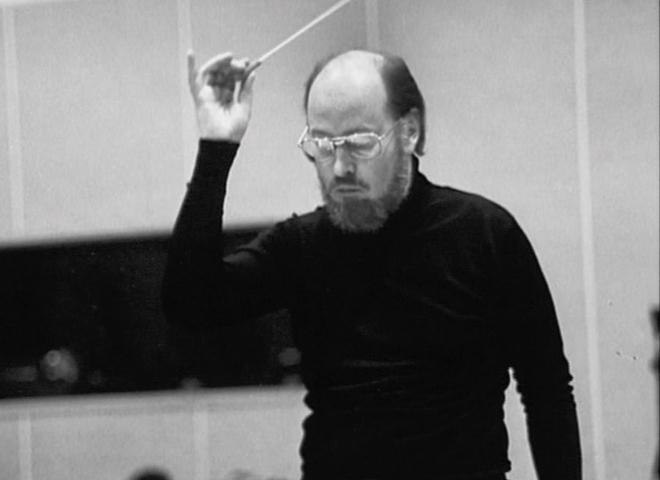
Interestingly, Jaws, in a way, abandons the traditional three-act structure and instead plays like a picture with two defined and distinct halves. In the first of these, Spielberg taps into horror and suspense tropes by alluding to a mostly-unseen killer shark as it wreaks havoc across the fictional New England town of Amity Island. Its residents and visitors, initially stubborn about their desperate need to be at the beach, grow increasingly wary about taking a swim once the death toll begins to rise. Because no one has seen the shark – least of all the audience – it immediately adopts the ominous presence of an aquatic grim reaper. Through this monster movie approach Spielberg relies heavily on John Williams’ brilliant two-note cello theme to create fear and panic.
For its second half, the picture transitions into a more straightforward adventure in which three men embark on a dire expedition into open water to kill the shark at all costs. By virtue of their wildly different personalities, the triumvirate of skeptical Police Chief Brody (Roy Scheider), fussy oceanographer Hooper (Richard Dreyfuss), and grizzled fisherman Quint (Robert Shaw) forms such a combustible collective so as to make one wonder if they’ll survive long enough in each other’s company to even get to the shark. Though Quint longs to be the savior, and Hooper would accept being so if pressed, it’s the water-adverse Brody who in the end rises to the occasion to fulfill the role of the reluctant hero of mythologies. The battle they bring to the giant fish is as intense and fraught with obstacles as the one they wage on each other. In this regard, Jaws essentially becomes a hunting movie, and even though it rarely gets classified as such, it’s probably the greatest and most celebrated hunting flick ever made.
There are many things that make it work as it does. Verna Fields’ Oscar-winning editing creates an outstanding pace while adopting the Hitchcockian flair that proved essential to compensate for the malfunctioning shark. And even in the areas he actually could control, Spielberg certainly knew how to generate tension by opting more often than not on the omission of either visual details or sound. A good example of the former is Hooper’s anxious description of a young woman’s mutilated corpse. With him firmly in the frame, even though we don’t see the grizzly details, we certainly feel them. Later on, while on the boat, the eerily slow, quiet and careful manner with which Quint fastens himself onto his deck chair while clutching his giant fishing rod is a textbook model of how to build suspense through the use of minimal sound, or its absence altogether.
Furthermore, the young filmmaker always knew where to place his camera and how to move it expertly within a scene, relying, more often than not, on long takes that allowed performances to breathe and blossom. A personal favorite is his extended, single take of Brody’s first conversation with the obtuse town mayor (Murray Hamilton), which begins with them on land and sees the characters board a vessel, which then carries them to a dock on the other side of the island, at which point they disembark and conclude the dramatically-incremental talk they’ve been having the entire time. Shortly afterwards, when an erroneous shark is caught by a group of fishermen all believing to have saved the day, the overlapping dialogue and fluidity of character blocking on the dock is even reminiscent of Robert Altman.

And yet, what also makes the film a stellar motion picture is the amount of drama that abounds throughout. In its first half, it is of a familial nature, as well as a socio-political one. Brody has to quell the worries of his wife (Lorraine Gary) while keeping a constant eye on the safety of his two boys. At the same time, he is forced to fight a frustrating number of political battles against a town leadership (and population) that simply does not want to listen to his word of warning for fear of having their summer ruined. When the story finally takes to the seas, the drama adopts a personal flavor by centering on the emotional and psychological tug of war between the three men. Peter Benchley’s screenplay, which he adapted from his own best-selling novel along with Carl Gottlieb, pays careful attention to all of this and always keeps it front and center.
In fact, the character of Quint, one can say, is the embodiment of drama. His legendary entrance is strong enough to silence an entire room, instantly demanding the attention of everyone, us included. It’s one of the all-time greats by any character anywhere, in part because Quint himself is one of cinema’s most memorable creations. A large part of this is due to the unhinged, almost-operatic performance by Shaw. The British thespian and playwright was a troubled but brilliant performer, with a life sadly marked by much internal turmoil. Said struggles undoubtedly informed his turn, giving the volatile sea captain a rugged, antagonistic nature that constantly finds its prey in the younger, “college boy” Hooper. Their clash of old-world bravado and new-world intellect is so good that it makes us frequently forget that an even bigger enemy awaits them in the water. When Quint does in fact face him in the end, Spielberg stages a send-off so earned and fitting that it instantly becomes the stuff of celluloid legend. It is a genuine shame that Shaw was not recognized with the Academy Award nomination that his director championed him for that year.
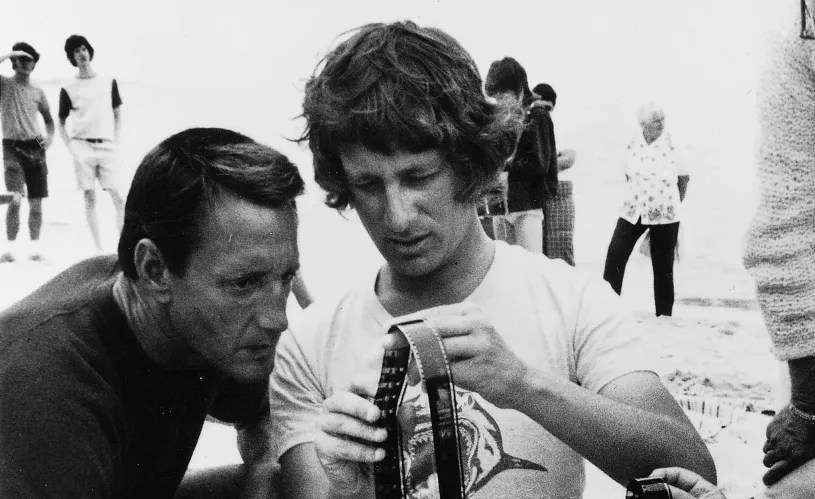
It is fun to look back on the career of Spielberg and trace the moments when his celebrity began to take shape en route to him becoming the most successful director in history. The astounding thing about Jaws is that everything that he became famous for – staggering set pieces, a whimsical sense of adventure, strong characters, highlighting the importance of family, deft camera movement, emotional manipulation, themes of trauma, stories of ordinary people in extraordinary circumstances – are all already comfortably on display here, in only his third picture. Even his fascination with World War II (a topic that would go on to inform some of the most important works in his filmography) gets due mention through Quint’s famous monologue about the USS Indianapolis, which Spielberg has since recognized as his favorite moment in the movie. The bottom line is that Jaws has it all, and even after fifty years, it hasn’t lost an ounce of its bite. It remains, for this viewer at least, the best and most rewarding example of Spielberg’s brand of cinema, and possibly the greatest film ever made worthy of the summer blockbuster title.
 Generation X Wire