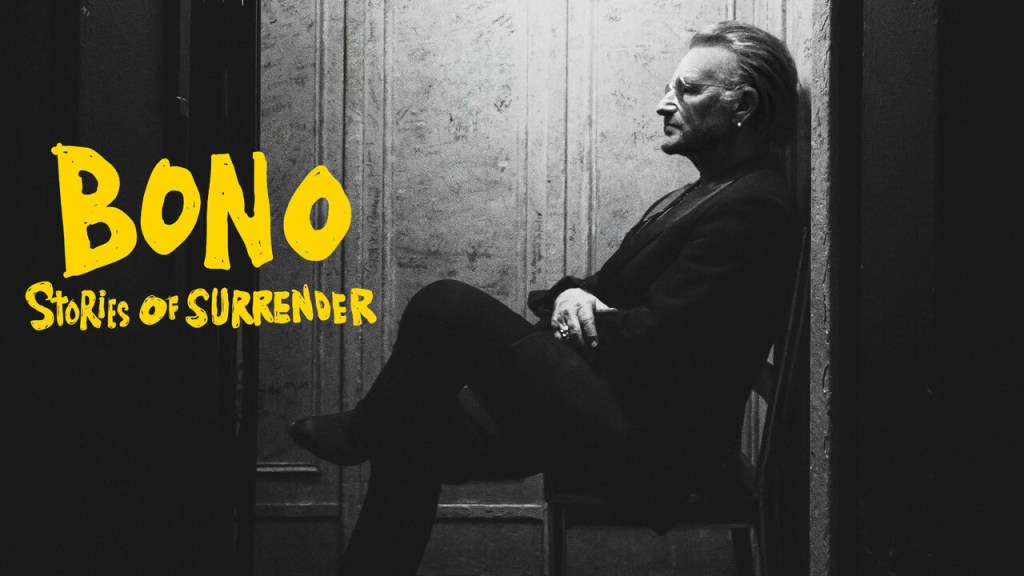
Bono: Stories of Surrender
4 out of 5 stars
By J.C. Correa
Bono, the lead singer of U2, and one of the world’s most prominent activists of the past 25 years, is a polarizing individual. I guess that’s what happens when you front a band whose earnest approach to themes of love, spirituality, injustice, and redemption are at odds with a world as cynical as ours. A reputation for spending the rest of his time embracing (some might say flaunting) his wealth while befriending and rubbing shoulders with politicians from both the far right and radical left, all in the name of love, or more specifically, poverty and sickness in Africa, likely only complicates his image.
There are waves of contradictions that form the man born Paul David Hewson in Dublin, Ireland in 1960, and he is the first to gleefully own up to that. Doing so, in fact, forms part of the narrative of Bono: Stories of Surrender, a filmed version of his one-man show which has just been released on Apple TV+. The play itself is a performed companion piece to the singer’s written memoir, which preceded it. It was booked as a brief residency at New York’s Beacon Theatre in the spring of 2023, a performance of which was captured by Andrew Dominik for this feature, both with and without an audience.
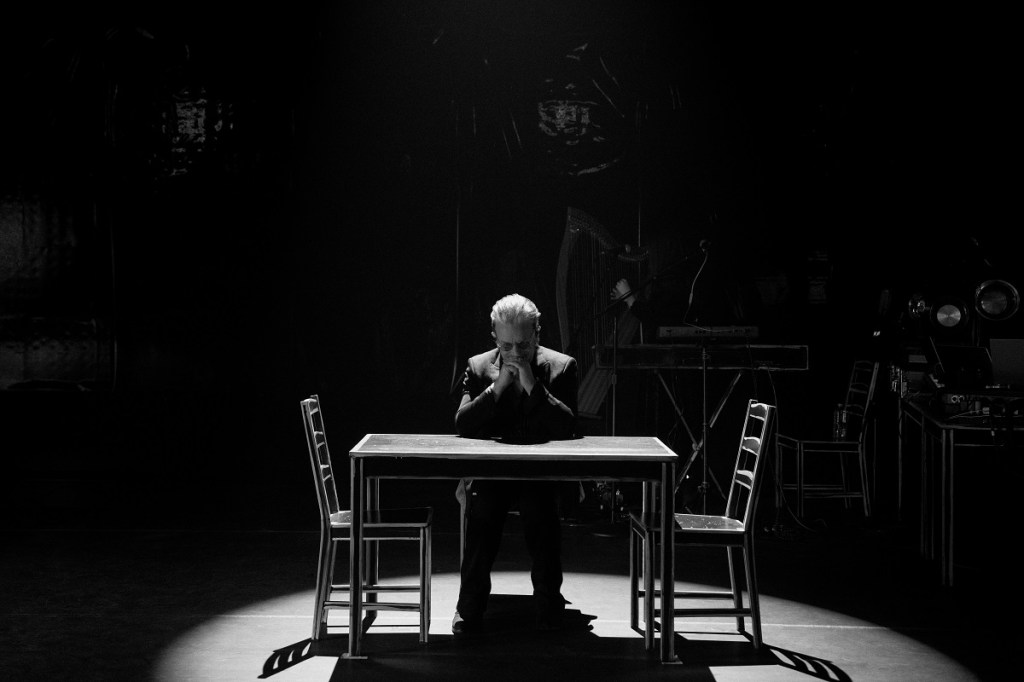
Set on a bare stage with nothing but a table and a few chairs to serve as its set, the film presents a production that is part rumination, part pantomime, part comedy, part concert, and even part recital, with a narration that occasionally weaves in and out. The first thing that draws attention is the stark and luscious black and white cinematography from Erik Messerschmidt. With a known preference for visually-stunning pictures (The Assassination of Jesse James by the Coward Robert Ford, Blonde), Dominik covers the show from a multitude of great angles across the space, and the sharp contrasts of the black and white look stellar when Bono is under a spotlight – which is frequently – allowing for the black edges around him to further dramatize his presence. The only others who occasionally share the stage with him are a trio of musicians: Gemma Doherty (harp, keyboards, vocals), Kate Ellis (cello, keyboards, vocals), and Musical Director Jacknife Lee (percussion, keyboards).
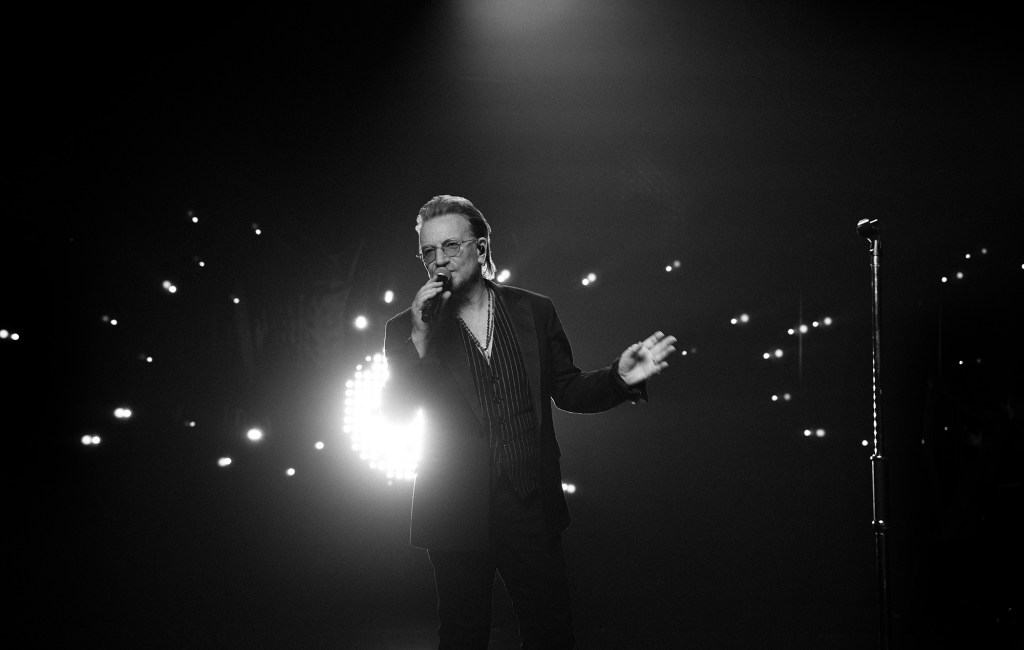
Viewers who tune in to watch the singer of one of the world’s most famous bands do the very thing that made him famous won’t be disappointed. Bono performs a dozen or so of U2’s most recognizable songs in reimagined form – albeit only in segments – including “Sunday Bloody Sunday,” “Pride (In the Name of Love),” “Where the Streets Have No Name,” and “Desire.” And perhaps most pleasantly surprising of all is the fact that, even without the cushion of his usual band’s sonics to support him, his 63-year-old voice is not only in fine form, but at times sounds genuinely powerful and stunningly beautiful as he surrenders himself to certain melodies. Yet, even in spite of the musical moments, the aptly-titled picture is at its strongest when Bono embraces and explores the core themes he has constructed the show around, which he does through spoken word and a fair bit of acting and theatrics.
The film does take the first 15 minutes to properly find its footing, and for its protagonist to hit a stride. From the onset, the singer explains that both the loss of his mother at an early age and a tempestuous relationship with his father throughout most of his life formed the basis of his greatest struggles, as well as his art. In a chilling moment, he reenacts the genesis of U2’s early hit “I Will Follow” by implying that he not only willed it into existence as a teenager, but that he may have unconsciously done so by the mere fact that his mother’s grave lay a stone’s throw away from the rehearsal space where he and his band gave it birth.
Perhaps somewhat pretentiously, Bono describes the production as being the opera of his life. And opera itself is a major theme as it was the thing that most strongly connected him to his late father Bob, himself an aspiring opera tenor. To put it more succinctly, it was the only avenue at his disposal to allow him some closeness to his old man, as he recalls bittersweetly. But in spite of the sad and tragic underpinnings of his home life, he doesn’t dwell on them in a way as to make the show feel like a heavy drama. On the contrary, he embraces humor as a frequent vessel, and this is most apparent during moments when he reenacts three conversations that he had with the elder Hewson at an Irish pub which served as their common meeting point. One can even say that they delineate the three acts of this play. With a simple turn of the head to give voice and presence to his father, Bono regals the audience with hilarious tales drawn from two of these encounters that somehow connected the father and son team to both Luciano Pavarotti and Diana, Princess of Wales. With Doherty’s harp (ever an Irish symbol if there was one) looming in the background in certain shots, the point is made as well as it can be.
Expectedly, Bono includes his three bandmates in the narrative and represents them each via one of the empty chairs. Of equal or greater significance is the mention of his wife Ali and his description of their 40-plus year union, through all its ups and down. Ending the segment with an impassioned rendition of “With or Without You,” Bono creates a genuinely cathartic instant as he further explains, via narration, the nature of their relationship, as well as what he believes to be his place in the world. Later on, after bringing to life the third conversation with his father, one that inevitably ends with his old man’s passing, and whose descriptions of his final moments are very poignant and emotional, he performs “Beautiful Day” with a rapturous energy that fittingly elevates the moment.
Not everything works as effectively, however. There is a point two thirds of the way through in which Bono leaves the stage and takes a ride in the building’s elevator. It serves as an intermission of sorts, and the star even admits that they are using it as an opportunity to change camera angles. The elevator, with its enclosed box-like structure, resembles a church confessional, so it is no surprise that the singer dubs this episode just that and treats it as such. He uses it to briefly ruminate about the difficulties of having children when you might still be one yourself. But it is all done rather quickly and not approached with a more deserving depth, making the dalliance feel like both a distraction and a wasted opportunity.
What is wonderful, though, is the manner in which it all concludes, as well as the room where it happens. Dominik and Bono have ensured to end their presentation in the one place that can best make it all come full circle: the Teatro di San Carlo in Naples, Italy. It is here that the showman (like the title of the song that he sardonically sings during the credits) gives the most meaningful performance of all; one that for viewers may seem unexpectedly surprising while also feeling fitting and obvious.
In the end, the film works in part because its subject is a great storyteller. If anything, he’s had decades of practice in that department, which have bore some of the most iconic and emotionally-resonating songs in pop culture. The secret to the success of U2 lies primarily in the power of the unrestrained emotion behind their delivery, whether it be a celebration or a defiance. As its singer, the largest part of that responsibility has naturally fallen on Bono, a man whose soulful voice has rightfully made him one of rock’s preeminent singers. In Bono: Stories of Surrender, it is encouraging to see that he is still willing to put all of that into practice, even as he is out there, more or less, on his own.
Bono: Stories of Surrender is currently streaming on Apple TV+.
 Generation X Wire