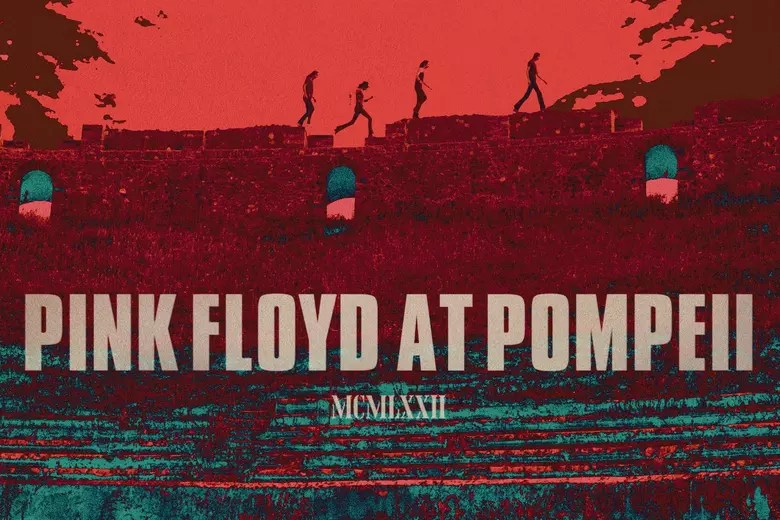
Pink Floyd at Pompeii – MCMLXXII
4 out of 5 stars
By J.C. Correa
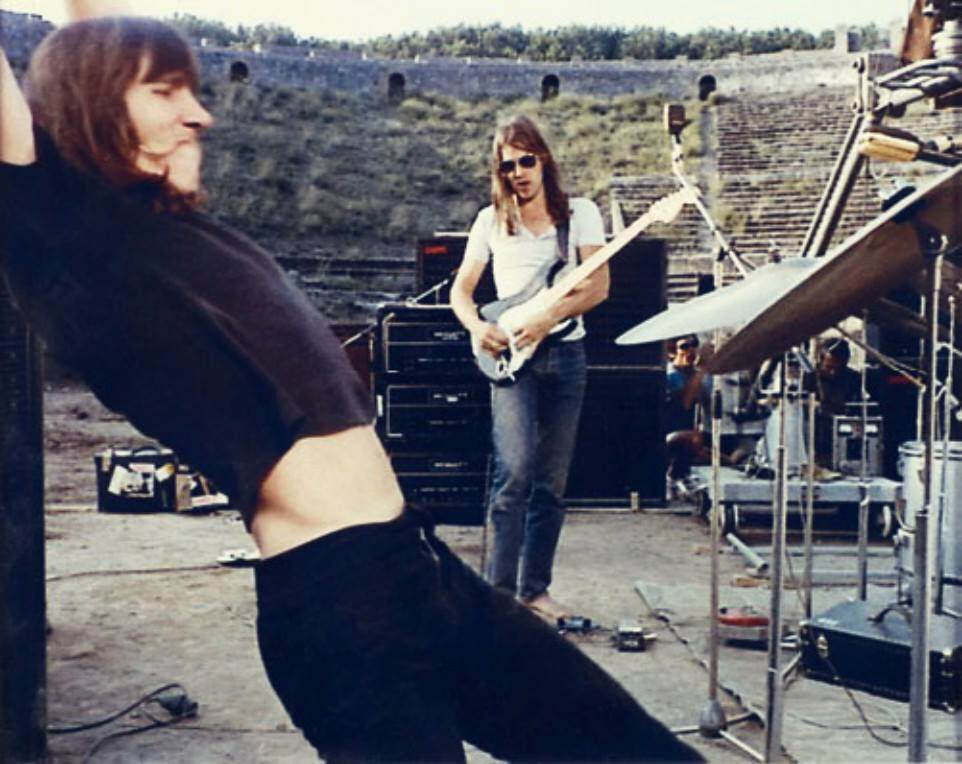
It takes approximately a full three minutes (possibly more) for the camera lens to absorb the deserted vastness of the ancient Roman amphitheater in Pompeii before slowly settling on the four members of Pink Floyd as they leisurely run through their 1971 tune “Echoes” under the blazing Neapolitan sun. Some, like guitarist/singer David Gilmour, understandably do it shirtless. The snail-like pace of the zoom also helps to establish that there is no one else there except the band and a film crew of about ten people. Which explains why director Adrian Maben seems intent on filling the space with the spirits of Rome’s past by conjuring up images of mosaics and rock sculptures fitting for the setting. That is, when he isn’t relying on footage of boiling mud and volcanic eruptions to really drive the point home.
But the gods on display are not only of these types. Gilmour and keyboardist Richard Wright are shot in extreme close-ups as they intone the song’s lyrics, while the guitarist’s Fender Stratocaster is given a similar treatment to help establish its deity-like status. It isn’t long before bassist and principal songwriter Roger Waters is dramatically banging a giant gong during “A Saucerful of Secrets” that rests behind drummer Nick Mason. Lit from behind by the setting sun, the strikes are made to look epic in their otherworldly grandeur and blunt savagery.
Though the approach may seem pretentious – and let’s face it, there are many who would describe Pink Floyd’s music as being just that – it is nonetheless fitting precisely because of the dreamy and mystical quality of the band’s sound and compositions. The idea to perform in complete isolation, sans an audience, in a location as peculiar as this one is actually an inspired and thoroughly fitting choice, in a way that it would never be for, say, a group like Kiss. As such, Maben’s project, Pink Floyd: Live at Pompeii, which was recently re-released in a 4K restoration under the title Pink Floyd at Pompeii – MCMLXXII, certainly justifies its existence. Its soundtrack, having also just dropped two weeks ago, now serves as an official band release.
Filmed over the course of four days in late 1971, the movie, which was initially released the following year (before having additional releases in subsequent years), is widely regarded as one of the most influential concert films of all time. At the very least, the isolated nature of the performance was not only a direct result of wanting to do the exact opposite of what was trendy at the time in concert cinema, but has also since gone on to inspire a lot of other artists in terms of how to capture their performances, be it for the purposes of live documents or music videos.
With a dolly track set up around the band, Maben frequently shoots them in an encircling fashion. Besides offering variety, this helps to create a sense of dynamism that not only amplifies their presence but also helps to portray them as extensions of the majestic location. Elsewhere, the director resorts to quick, rhythmic cuts (usually between Mason and Gilmour) to channel energy, or a full-on screen collage of Mason pounding his drums on selections like “One of These Days” and “Set the Controls for the Heart of the Sun.” The latter also gives Wright his big moment, as the silhouettes of him and his keyboard are superimposed over ethereal-looking images of rocks and temples.
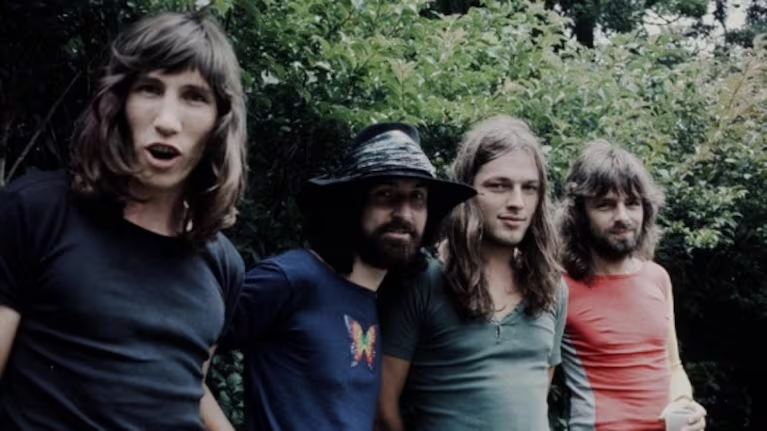
To break the monotony, the performances at Pompeii are frequently interspersed with footage of the bandmates sharing a meal at the Abbey Road Studios cafeteria, while offering occasional nuggets about their recording predilections and philosophies as a band. Gilmour and Waters wax poetic on the logistics of equipment and technology, highlighting how important the manipulation of the latter is to their sound. Waters further explains that their mastery over such makes their need to hire a producer a moot point and goes on to elaborate about rock music’s then expanding market, confidently stating that the genre will not die. Understandably, that statement takes on a different meaning when considered 54 years on. Elsewhere, in a moment now viewed with ironic hindsight, Gilmour asserts that the band members usually get along well and don’t fight too much, and Mason jokes that as a collective they are inexplicably not into money. It is fitting then that the song “Money” was on the cusp of being recorded at the time and would soon end up as one of their more popular numbers.
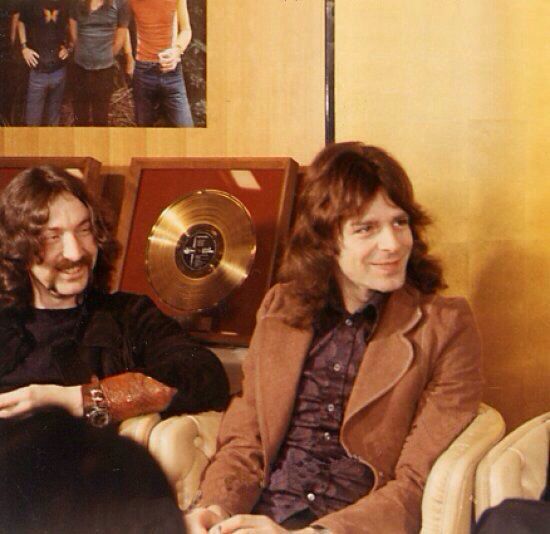
On that note, it is important to consider that the events depicted catch Pink Floyd at a point where they were just about to make a substantial transition into massive mainstream success. That means that this was all before The Dark Side of the Moon and Wish You Were Here. Before The Wall. In fact, some of the Abbey Road footage was apparently captured a year later in the midst of the recording sessions for The Dark Side of the Moon, which allows for makeshift studio renditions of “On the Run,” “Us and Them” and “Brain Damage.”
Before bowing out with a reprise of “Echoes” that exactly mirrors the opening of the movie but in reverse – save for the inclusion of a few shots of the band members either walking through hilly ruins or braving a sandstorm – there is a brief nighttime performance of a bluesy number called “Mademoiselle Nobs.” It is notable primarily for the presence of a Russian Wolfhound who is more than willing to accompany Gilmour’s harmonica with howls of its own. This footage was apparently not shot on the site, but rather, in a Paris studio later on, and the cooperative canine was thanked by having the song named after her.

Whether you have seen the picture before or are experiencing it for the first time via this magnificent restoration with a stellar new sound mix, the one thing that undoubtedly becomes evident when taking it all in is what many with a broad understanding of the genre wholeheartedly believe: Rock music was at its pinnacle in the 1970s. It was that decade that gave birth to its most powerful form of expression, something that artists like Pink Floyd, along with Led Zeppelin, The Rolling Stones, Eagles and Fleetwood Mac have been reminding us of ever since.
 Generation X Wire