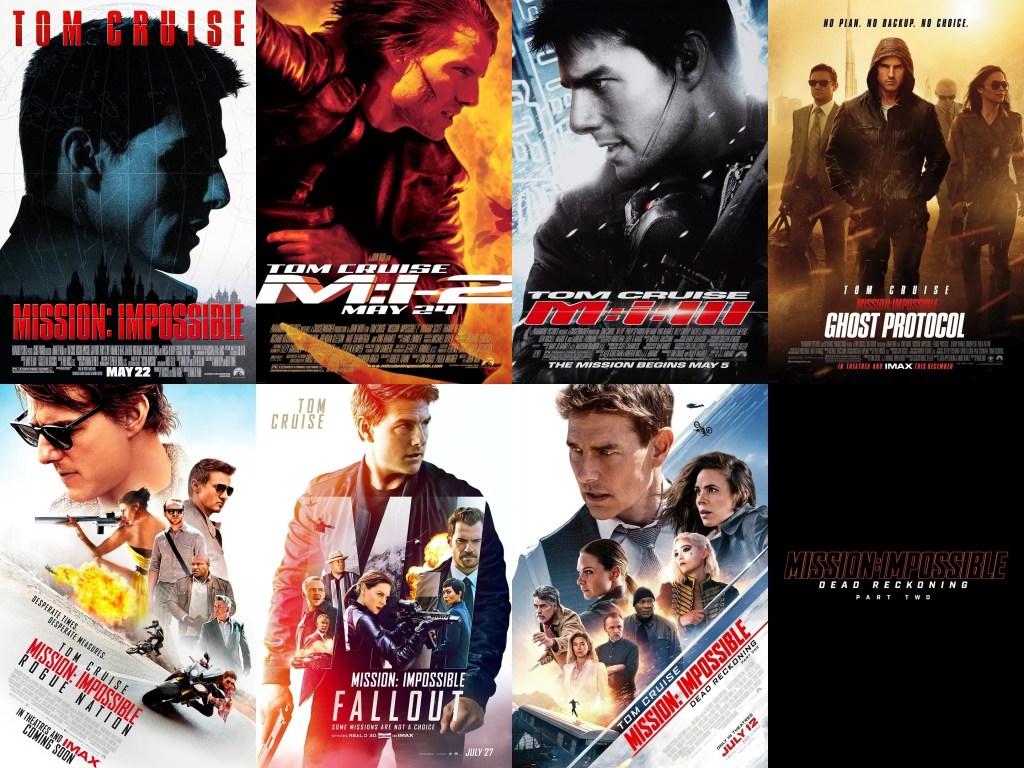
Mission: Impossible film series
By J.C. Correa
Almost thirty years ago, Tom Cruise, then already one of the world’s biggest movie stars, accepted the task to produce and star in a big-screen adaptation of Mission: Impossible, the celebrated late ‘60s espionage television show with the even more famous pulsing theme music. Three decades later, he remarkably still retains that glorified status, one unquestionably helped by that very choice he made in the mid ‘90s. After seven blockbuster films, and on the eve of the release of the eighth and, supposedly, final one, the Mission: Impossible movie franchise has become a cultural juggernaut, in part because of how Cruise has continuously used it as a vehicle to risk his life and limb in the most daring and insane fashion for our amusement. Critical to their success, however, is also the fact that, after a somewhat inconsistent start, the series has only gotten better and better with each installment and defied conventional Hollywood wisdom in doing so.
With Mission: Impossible – The Final Reckoning set to drop in cinemas across the globe on May 23, the weekend before, the Museum of the Moving Image in Queens, New York will be screening all of the previous seven features as part of its See It Big: Stunts series. Considering that the Academy of Motion Picture Arts and Sciences will soon be instituting an award that recognizes stunt work, it’s as good a time as any to revisit these movies and playfully imagine an alternate universe where said prize had always been in place and Cruise had by now amassed at least a handful of Oscars in that category for this franchise alone. At the very least, they may have given it to him for having run more miles as IMF agent Ethan Hunt than can be found in a half marathon. Either way, when the actor finally does call it a career, it should not surprise anyone if these films turn out to be the thing he is most remembered for. And that would surely be saying something.
With all this in mind, we now present a critical overview of the series and trace its evolution, all the while allowing you to decide if you like your Cruise with a side of cropped or shaggy hair (FYI – you will get both in equal measure).
Mission: Impossible (1996). For a franchise now legendarily known for its outrageous stunts and high-octane action, it is interesting to note that that is not at all how it began. In the hands of director Brian De Palma, the first Mission expectedly trades this in for the guise of a suspense thriller. The movie embraces film noir (echoes of The Third Man abound in its Prague-based first act) and even plays like a whodunnit at times. Besides employing the trademark look of his pictures, it also exploits the director’s immense talent for creating dynamic set pieces, of which, none is more memorable or expertly executed (a point that might extend to the entire series) than a break-in to the CIA Headquarters in Langley. The image of Cruise dangling above a computer terminal inside a sterile-looking white room is as iconic as it gets, and De Palma gloriously taps into his inner Hitchcock for the pulse-pounding ten-minute sequence where the absence of sound screams loudest. Featuring a distinguished cast (Jon Voight, Vanessa Redgrave, Kristin Scott Thomas), the flick is also bold enough to subvert expectations for fans of the original television show. Significantly, it also introduces Ving Rhames as expert computer hacker Luther Stickell, the only series constant besides Hunt. Some dated visual effects during a climactic set piece aboard a speeding train, as well as some faulty plot logic, do bring things down a bit. But it is an interesting, deftly-done and worthy start all the same, even if it does make you wonder how much different the franchise may have been had it continued down this particular course.
(3.5 out of 5 stars)

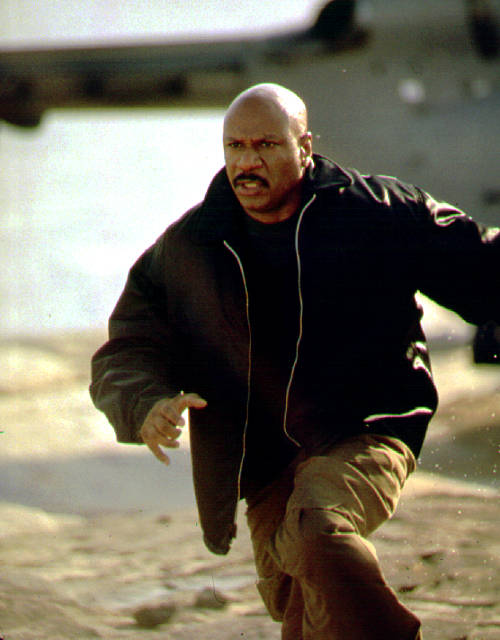
Mission: Impossible II (2000). This second entry is a misguided and overstuffed clunker that practically surrenders whatever goodwill was attained from the first go-round. Bringing in flavor-of-the-month director John Woo to endow the picture with his signature balletic approach to action scenes proves to be a mistake as these sacrifice any sense of reality for sheer style. But the biggest problem really amounts to a lackluster script that is heavy on melodrama but thin on characterizations, plot coherence and believability. It asks us to care, but never earns that request. Thandie Newton plays a love interest who has no romantic chemistry with Cruise. And though Rhames returns here for the first time, his character is sadly wasted. Woo does execute a clever and thrilling set piece involving a motorcycle chase in the final act that at least feels ingenious in its boldness. However, the movie’s true legacy lies in the fact that it represents the first time that Cruise was willing to risk it all for the sake of the stunt. While the opening rock-climbing sequence in Utah may not do anything to advance the story, it did announce to its audience that its star/producer had a daredevil streak in him only waiting to be unleashed.
(1.5 out of 5 stars)
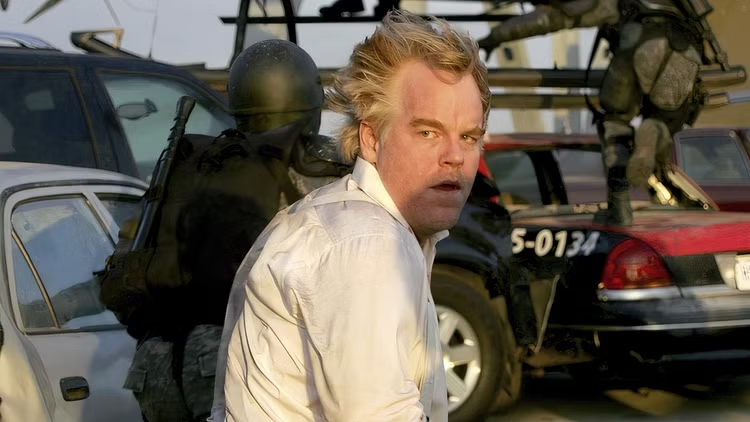
Mission: Impossible III (2006) After much success in television, J.J. Abrams made the jump to feature films by helming this third installment (which he also helped to write). This one feels much more centered and focused than its immediate predecessor and makes it a point to hone in on Ethan Hunt, the person, as opposed to the cipher. As a result, the stakes are raised by making them personal in a way we hadn’t yet seen, and this is accomplished in large part through a stupendous villain played by the always-exquisite Philip Seymour Hoffman. The late thespian brings tremendous menace and power to the proceedings and proves to be one of the series’ best antagonists. This third lap also introduces Benji Dunn (Simon Pegg), a quirky and affable tech geek who becomes a major player and ally to Ethan from this point onward. At times, Abrams’ previous adherence to the smaller TV medium seeps through, as it is clear he is finding his footing on a larger canvas. But it was a good choice to recruit him all the same, as his contributions sustain and expand on what De Palma initially set up, especially after such an insipid second chapter. As a bonus, this is the film that officially puts Cruise on the sprint train, something that quickly goes on to become an amusing trademark.
(3.5 out of 5 stars)
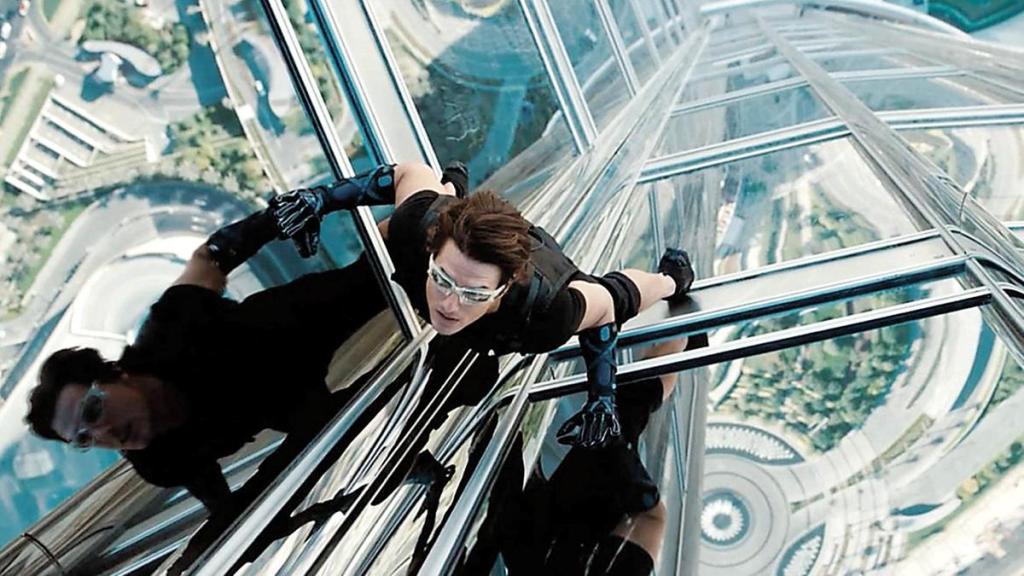
Mission: Impossible – Ghost Protocol (2011). Having helmed one of the best action flicks of the century’s first decade with The Incredibles, director Brad Bird here transfers that expertise from an animation aesthetic onto a live-action one without missing a beat. In his one-off contribution, he proves to be an excellent fit for the proceedings and raises the level of intensity and spectacle to literal new heights. From here on in, the franchise not only finds solid footing in a reliable formula that would pay off excellent dividends moving forward, but also pivots into a showcase of hair-raising, death-defying stunts performed by Cruise himself. Ghost Protocol features a hilarious and thrilling set piece inside the Kremlin, as well as a taut climax in a car-park tower. But the undisputed main event is the sight of Cruise scaling the outside of the Burj Khalifa – filmed with IMAX cameras, no less – an image on which the movie smartly based its entire marketing campaign. Thus, all future sequels would sell themselves primarily on their attempt to top it. With Jeremy Renner and Paula Patton as welcome new additions to the IMF team (though the latter sadly only appears here), the picture significantly raised the bar on what these movies could and should be.
(4 out of 5 stars)
Mission: Impossible – Rogue Nation (2015). Opening with Cruise hanging off the side of a cargo plane during takeoff, then following it up with a stellar assassination sequence at the Vienna State Opera, and some fantastic car and motorcycle chases in between, it was clear by this point that the Mission: Impossible films were besting the James Bond ones at their own game. The fifth entry changed directors once again, but it would be the last time that this occurred as Cruise finally found his perfect partner in crime in Christopher McQuarrie, who also wrote the script (and would go on to even help the star with Top Gun: Maverick). McQuarrie clearly understands what worked on Bird’s picture, and not only replicates it but also expands upon it. His best contribution here is the introduction of Ilsa Faust (Rebecca Ferguson), an MI6 agent in the femme fatale mode who is one of the series’ best characters and a terrific match for Ethan Hunt. Renner returns once more, along with the ever-reliable team of Pegg and Rhames. By this point the relationships between these characters are central to the appeal of the movies and the filmmakers henceforth astutely put that at the forefront and make us invest in them.
(4 out of 5 stars)

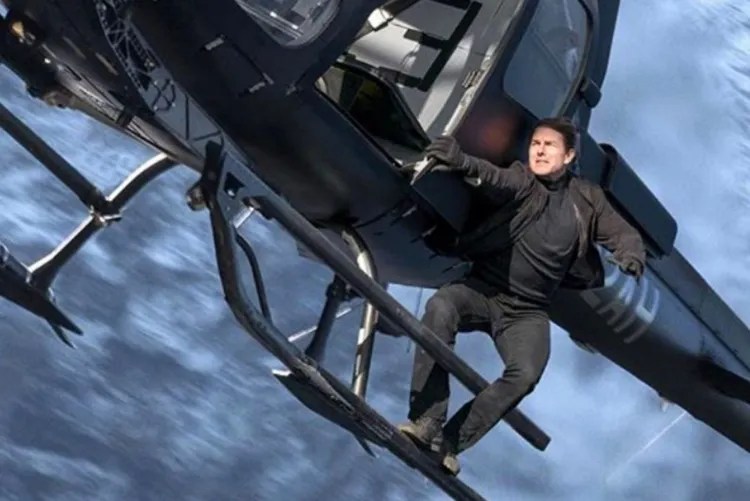
Mission: Impossible – Fallout (2018). Raising the stakes, scale and spectacle even further this time around, Fallout finds the Mission: Impossible franchise firing on all cylinders. Henry Cavill is brought in as one heck of a foil for Hunt, and the one-time Superman has never been better or more magnetic. Angela Bassett and Vanessa Kirby are also introduced into the series, and Alec Baldwin returns in a sympathetic turn after debuting in Rogue Nation. As expected, the menagerie of stunts is off the charts once again, with Cruise this time HALO jumping into Paris and eventually chasing down a helicopter by dangling underneath it across some breathtaking and vertiginous landscapes in New Zealand. McQuarrie not only made sure to shoot both of those sequences with IMAX cameras for maximum effect, but also developed Hunt’s character to an even greater extent with his screenplay. Everything seems to work on this one, so it is no surprise that it remains the franchise’s biggest box office hit to date.
(4.5 out of 5 stars)
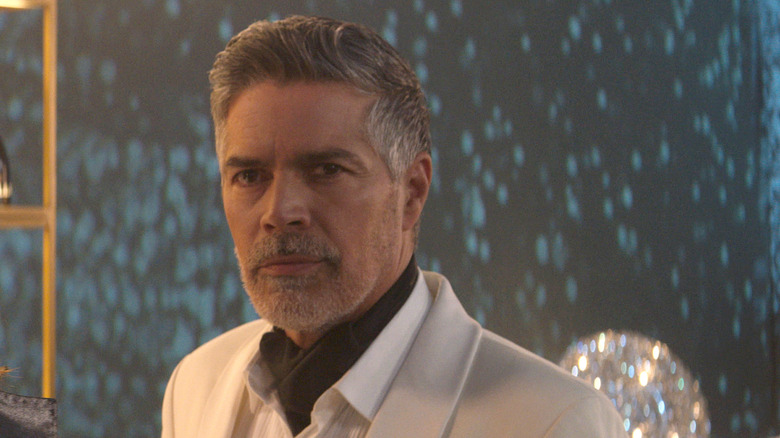
Mission: Impossible – Dead Reckoning (2023). Continuing the tradition of selling a movie on a single stunt that puts Cruise near death, this sixth sequel sees him drive a motorcycle off a cliff and into a never-ending abyss only to pull the parachute chord just in time. In all fairness, Bond did a similar thing in 1995’s GoldenEye but had to clearly rely on a stuntman to do so. McQuarrie, however, captures it all in a manner that is substantially more spectacular, while always ensuring that it is clear that Cruise is the one performing it. Originally conceived as a two-parter with the upcoming eighth chapter, this one does sputter slightly and occasionally feels clunky by virtue of being the longest of the films to date. But it still manages to be up to snuff and meet the standards of action and thrills we have come to expect, helped in part by the introduction of Hayley Atwell as a clever thief and romantic interest, Pom Klementieff as a menacing killer, and Esai Morales as one of the best villains in the franchise. The film is also notable for the unexpected and welcome return of Henry Czerny as Kittridge, the former IMF director and Hunt’s thorn in the side, bringing things full circle by directly connecting them to the first movie.
(4 out of 5 stars)
The films are currently all streaming on Amazon Prime, and will also be screening at the Museum of the Moving Image in Queens, New York as follows:
Mission: Impossible (Friday, May 16 at 5:45 pm)
Mission: Impossible II (Friday, May 16 at 8:00 pm)
Mission: Impossible III (Saturday, May 17 at 12:30 pm)
Mission: Impossible – Ghost Protocol (Saturday, May 17 at 3:00 pm)
Mission: Impossible – Rogue Nation (Saturday, May 17 at 6:00 pm)
Mission: Impossible – Fallout (Sunday, May 18 at 12:30 pm)
Mission: Impossible – Dead Reckoning (Sunday, May 18 at 3:15 pm)
 Generation X Wire