Glengarry Glen Ross
By J.C. Correa
Fans of Broadway and New York City theater are surely aware that there is a new revival currently playing of the 1984 Pulitzer Prize-winning sizzler, Glengarry Glen Ross. That is likely the case because its marketing team has leaned heavily on promoting its all-star cast in the months since it was announced, one led by recent Academy Award-winner Kieran Culkin, along with heavyweights like Bob Odenkirk, Bill Burr, and Michael McKean. To meet the expected demand that those names might bring, the production has booked itself into the ginormous Palace Theatre, one of the largest buildings on the Great White Way.
Almost two months after the Oscars, and a week before the Tony Award nominations were announced (where Odenkirk was recognized with a nod for Best Actor in a Featured Role in a Play), I caught a midweek matinee performance of this latest revival of David Mamet’s classic, unflinching look at the cutthroat world of real estate salesmen, and, as The New York Times so eloquently put it recently, his “melancholy indictment of empty capitalism and toxic masculinity.”
Generation X Wire readers might be familiar with the material mostly through the famous, if not necessarily mainstream, 1992 film adaptation of the play. Directed by James Foley, the star power of its cast puts even the current one to shame as it features no less than Al Pacino (Oscar-nominated for his role), Jack Lemmon, Alec Baldwin, Ed Harris, Kevin Spacey, Alan Arkin, and Jonathan Pryce. Its profanity-filled dialogue, and, more specifically, its plethora of colorful insults, have surely since been quoted ad nauseam by members of fraternity houses or chest-beating types. In spite of all this – and in part because of it – it remains one of the all-time best movie adaptions of a work of theater.
The story of the play centers on a group of salesmen at a competitive Chicago-based real estate firm. Its owners keep the salesforce on their toes by implementing contests that reward success, but also fear and intimidation tactics against those who do not perform up to the expected standards. It is a system designed to not just remunerate the tough and powerful, but also to ensure that they stay at the top, thus leaving little opportunity for security, let alone advancement, for anyone else. In other words, it is a cold and all-too accurate reflection of corporate America.
Shelley “The Machine” Levene (Odenkirk), a one-time ace peddler now at the twilight of his career, is desperate to keep his job in order to help his sick daughter. As such, he will stop at nothing to find a way to get his hands on the premium leads that are only awarded to the top dogs; men like Richard Roma (Culkin), who smooth-talk their self-aggrandizing life philosophies onto unsuspecting folks on a regular basis as the first step in reeling them in for the eventual close. In the middle of the pack are Dave Moss and George Aaronow (Burr and McKean, respectively), themselves trying to find any which way to stay afloat and not get canned.

One day the office is robbed, causing uptight office manager John Williamson (Donald Webber Jr., recently seen on Broadway in Our Town and Hamilton) to bring in a cop (Howard W. Overshown) to investigate, while keeping a close eye on his revolving door of salesmen in the hope that one of them might give himself away as the culprit who walked out with the premium leads.
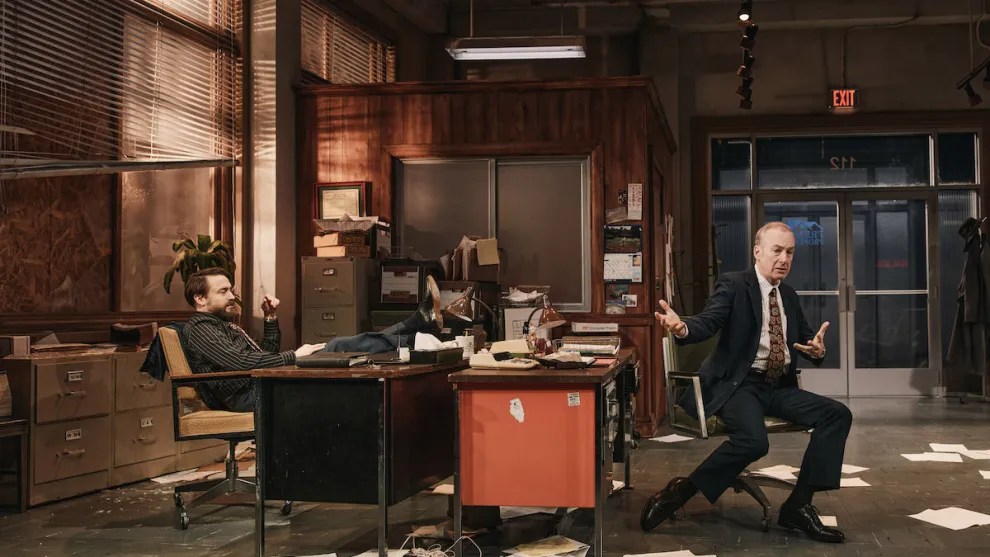
Directed by Tony-winner Patrick Marber (Leopoldstadt, Closer, Travesties), the production is broken up into two acts. The first of these is comprised of three scenes inside a Chinese restaurant, in which we get to know the players as we watch them bickering with and manipulating each other; or, in Roma’s case, in full sales-pitch mode against a weak-willed patron (John Pirruccello). The second act unfolds in the office space, immediately after the robbery, and it takes full advantage of the chaotically vibrant and spacious set by designer Scott Pask (Good Night, and Good Luck; The Producers).
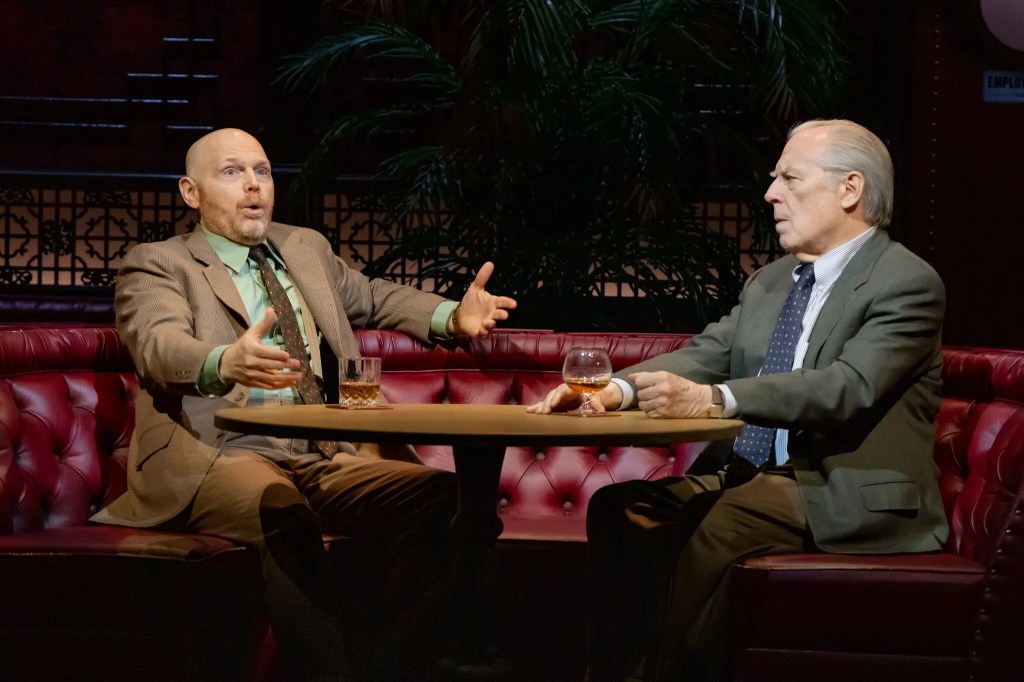
Burr, in his Broadway debut, balances the required level of his character’s conniving menace with just enough of the humor and timing that he has built his career on. He finds a refreshing nuance to a role that was originated by James Tolkan in the 1984 production, and then taken on by Ed Harris for the film version. As a result, he is the pleasantly-surprising standout among the cast of luminaries. Part of his success, it should be said, is due to McKean’s hilarious interpretation of the overburdened and slightly-neurotic Aaronow, who also becomes a victim of Moss’s explicit scheming and macho bravura. In fact, the veteran actor of both stage and film takes a character usually portrayed as a paranoid victim and gives him a winking self-deprecation that is absolutely welcome and refreshing. His scene with Burr is the production’s best moment.
The most colorful persona in Glengarry Glen Ross has always been the foul-mouthed, shark-of-a-salesman Roma. Pacino’s volcanic interpretation of him towers largely in areas of pop culture, but he is not the only thespian to find success in the role. After winning a Tony for playing him in the original Broadway production, Joe Mantegna’s hard-nosed take was followed by one from Liev Schreiber that was heavy on sarcasm but no less inspired in the play’s 2005 revival, and then by a 2012 turn from Bobby Cannavale that was also successful in its adherence to the charisma brought on by Pacino and Mantegna. In this regard, Culkin has very big shoes to fill, and it is something that most with even a faint knowledge of the material’s history will be aware of. It should be said that he succeeds in his turn, but only partially. While he is charming, funny, and unexpectedly disarming in a way that taps into his particular rhythms, he is most comfortable with Mamet’s language in scenarios that require him to converse with others. Roma’s introductory monologue is one of the greatest and most memorable pieces of stage drama of the late 20th century, but Culkin sadly throws most of it away, as evidenced by the flat reception to the majority of terrific lines that the playwright endowed it with. Towards the end of his first scene, as soon as he begins to directly interact with his gullible prey, the actor settles into the performance at a level of comfort that quickly becomes clear.
Which brings us back to Odenkirk. The affable performer who lit up television screens for over a decade as unscrupulous lawyer Saul Goodman in Breaking Bad and Better Call Saul actually got his start in comedy as both a writer and performer. The fact that this production ironically reunites him with both Burr and McKean is something that likely will not be lost on fans of those acclaimed TV shows. And like Burr and Pirruccello, this endeavor also represents his Broadway debut. Odenkirk’s greatest quality is precisely his likeable, charismatic demeanor; one that hints at a mischievous big kid trapped in an adult’s body. All of this makes him very easy to root for, while awarding him frequent laughs. The same can be said for his take on Levene. The actor’s comic timing is undoubtedly on display, and he milks these sensibilities for all they are worth. The problem is that underneath the humorous surface lies what is ultimately a tragic character. Levene is flawed in many ways, and while Odenkirk does bring these to light, he sidesteps the essential heartache that goes hand in hand with his character’s fate, making his overall performance feel incomplete.

Fortunately, Mamet’s trademark rapid fire dialogue is executed with a lively precision by the collective so as to never make you doubt that you are watching the real thing. In this general regard, the company ensures that the play has not lost any of its bite, and, if anything, reaffirms its timelessness and validity as a critique of capitalism run amok in contemporary times. Though I do wish that the production had been booked in a smaller venue prone to more intimacy, as I imagine that experiencing it from the back of the orchestra or the third-tier balcony might lessen its impact somewhat. Either way, while this is not the definitive interpretation of this hallowed material, it nonetheless offers a fresh and vibrant take that should excite and entertain audiences looking for a breezy and gripping hour and forty minutes of theater.
Glengarry Glen Ross is playing on Broadway at the Palace Theatre through June 28, 2025.
 Generation X Wire