
Star Wars: Episode III – Revenge of the Sith
3.5 out of 5 stars
By J.C. Correa
George Lucas was never a subtle filmmaker. At least as far as his approach to Star Wars was concerned. His biggest crime, more so than the consistently wooden dialogue or subpar acting, was probably his tendency to tell you as much as he was willing to show you. And that is a shame considering that his gift for visual storytelling was among the greatest in the history of the medium. I suspect I am not alone in believing that he would have excelled in the silent film era.
He was, however, always an artist willing to tread through big ideas. Though most of these concepts and philosophies were adopted from his study of history and other cultures, he nonetheless used the Star Wars movies as his ultimate canvas for their display. As such, Revenge of the Sith, the third film in his intended chronology, and the last of these pictures he ever got to make, is the one most willing to put these beliefs forth, and in a fairly uncompromising fashion. The movie has just been re-released in theaters nationwide for a one-week engagement on occasion of its 20th anniversary.
Back in 2005, Episode III represented the last of Lucas’ contentious prequels; the one where Hayden Christensen’s Anakin Skywalker would finally employ his Faustian pact and become Darth Vader. Considering that its two predecessors hardly hinted at this – a point that irritated many fans – this was at least the one prequel where we were already clued in to the tale at large. For audiences, it was not so much about the what, as the why and how.

But Lucas had a second story to tell underneath all that; one that was arguably more important than Anakin’s fall to the dark side. His depiction of how a democracy transformed into an empire has a potentially different meaning when viewed with 2025 eyes. And watching the movie now – which depicts a society willingly handing over its elective government to a tyrant who has been manipulating it all along – you suspect that this aspect of his story was the one he was most interested in.
“Our allegiance is to the senate, not to its leader.” “This war represents a failure to listen.” “All who gain power are afraid to lose it.” “He has control of the senate and the courts.” “This is how liberty dies, with thunderous applause.” “For a safe and secure society.” All of these sentiments are ones that one might easily find splattered across social media platforms during these charged political times, if not directly on bumper stickers. They also represent actual quotes from Revenge of the Sith. Subtlety be damned!
Similar to the other prequels, the quality of its acting leaves much to be desired, at least for viewers not interested in operatic melodrama, which seems to be precisely what Lucas wants to trade in. That said, these sensibilities feel more at home in this movie than in the other chapters precisely because of the Shakespearean scope of the tragedy he is zeroing in on. In this regard, the dialogue, while perfunctory, feels less jarring than before and more congruent with the whole enterprise.
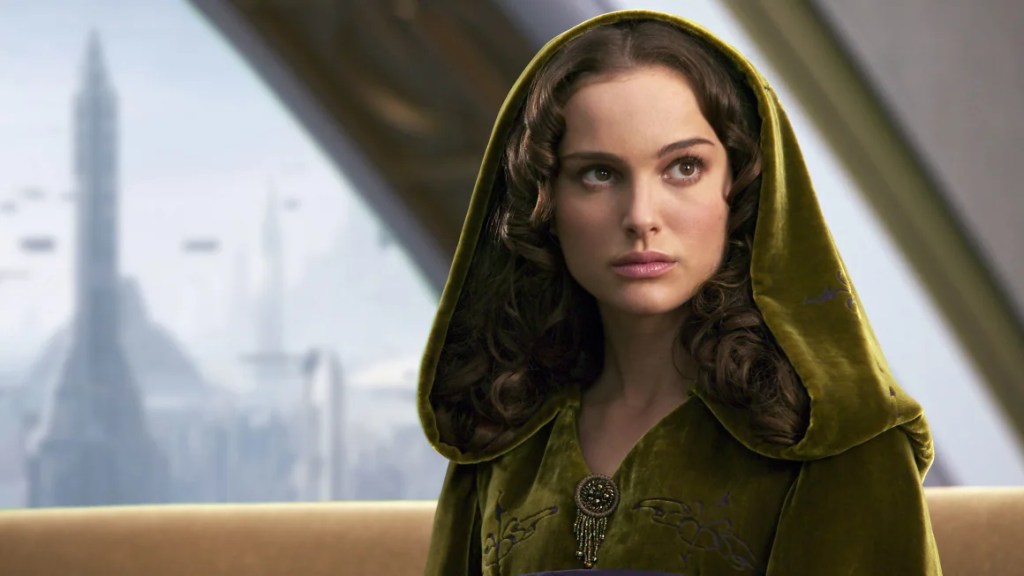
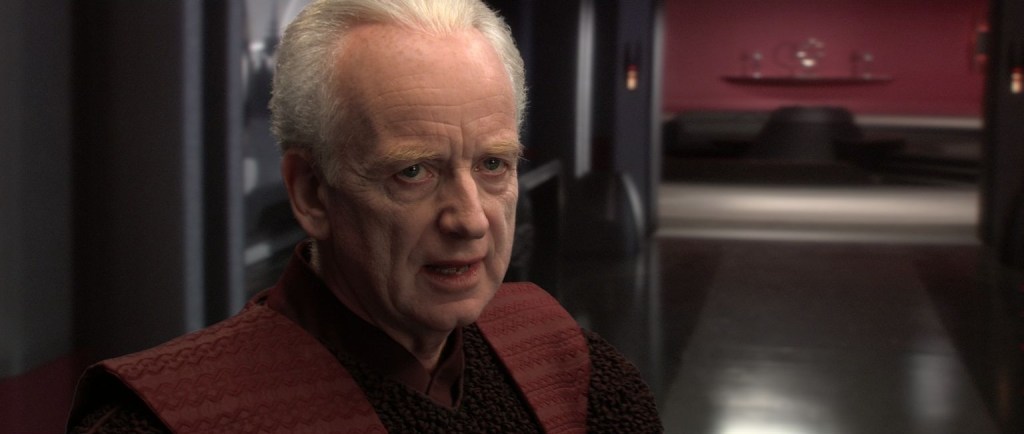
Ian McDiarmid, the English actor who charismatically brings to life the evil Darth Sidious/Emperor, chews the scenery with much delight and gives the most memorable performance. Christensen still struggles with Lucas’ dialogue and direction, but less so than he did in the immediate predecessor, Attack of the Clones. He and Natalie Portman, who plays his wife Padmé, are better in the quieter moments, of which, thankfully, there are a few. As Obi-Wan Kenobi, Ewan McGregor gives a curiously tongue-in-cheek turn. That is, of course, until he has to rise to operatic levels and prove that he is more adept at it than most of the company.
Speaking of silence, the best moment in the entire prequel trilogy can be found in Sith. Anakin and Padmé, alone in chambers that are across the city from each other, sense the connection, presence and destiny of the other by merely looking out their respective windows into a tranquil sunset. It is a beautiful scene, elegantly done by how it is photographed, performed and scored. Here, Lucas makes it a point to not tell us a thing but speaks in volumes all the same by what he is showing us.
The visual elegance extends to the type of wipes that the director uses to transition between scenes; ones of greater sophistication than those employed elsewhere across his saga. His opening shot is also a thing of substantial beauty as it follows two lone star fighters who dive along the edge of a large space cruiser only to reveal a massive intergalactic battle unfolding below. In terms of how effectively he is able to convey scale, it recalls the iconic opening of his original 1977 film which told you everything by simply flying, over camera, two ships of widely different sizes.
Unfortunately, not all of the action is engaging or particularly interesting for anyone not invested in comic books. A 25-minute first act involving space battles, a lightsaber battle and some escape hijinks aboard a vessel appear a bit overstuffed and mundane. The same can be said about a subplot involving Kenobi and a cyborg foe amidst a sinkhole planet. The thing is, considering the dark trajectory of his plot, with the former at least, it is understandable why Lucas might have felt the need to start things off with some lighthearted silliness.
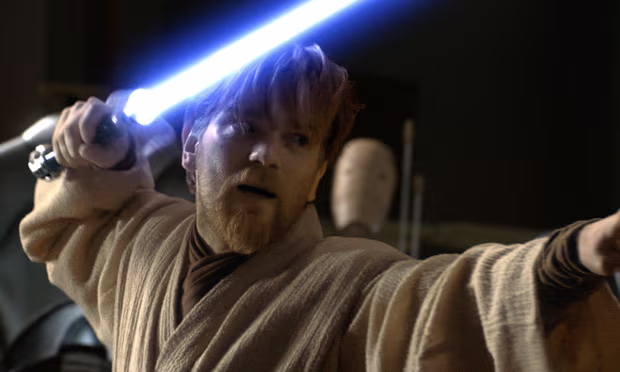
The centerpiece, for most, is likely the extended lightsaber duel between Anakin and his former mentor, Kenobi. The choreography, like in most of these sword battles, is undoubtedly great. But one cannot help but feel that it just goes on too long so as to lose its novelty, not to mention the visual convolution generated by the ocean of lava that surrounds it. Much more effective and thrilling is one between Sidious and Yoda, the tiny, venerable Jedi Master. The fact that it takes place inside the Galactic Senate chamber, and actually ends up using it as a weapon, is absolutely thrilling and powerful stuff. Aided by John Williams’ orchestral magic, this is Lucas at his best. Though many fans understandably consider the acrobatic, three-way showdown at the end of The Phantom Menace as the prequels’ most exciting moment, I believe this one to be more accomplished instead because the players, the stakes and the metaphor are that much richer and more significant. And this time around, he is actually saying something.
Of the six Star Wars flicks created by Lucas, Sith is the one with the greatest level of spectacle. A large part of this, naturally, has to do with the fact that, at the time, he designed it to function as the last of these films that would ever get made. And in that regard, despite being a prequel and a movie that offers little in terms of surprises, it succeeded. Part of that is due to the artistic flourishes I mentioned (there is even a brief visual allusion to War and Peace) and the willingness to tell an unusually darker story without compromise. Its pacing is also brisk. Unlike Episode II for instance, you don’t feel its 2-hour and 20-minute runtime.
If you can get past its occasionally-dumb logic (security holograms invalidate a key plot point, speeding elevators come to a full stop with no physical consequences for its riders), there are more than a few things for film buffs to hold onto, such as Lucas’ overt allusion to movie monsters of lore, be it Frankenstein’s, Dracula, or Lucifer himself. In the last ten minutes we also witness a visual homage to 2001: A Space Odyssey, and the brief appearance of a gynecologist droid that, amusingly, seems to have gone on to inspire some of the sounds and designs of Pixar’s WALL-E.
Whether you want to simply revisit a Star Wars picture in the cinema for nostalgic reasons, discover it entirely, or more deeply engage with its sociopolitical rhetoric, the big screen surely is the best avenue to do so. And Christensen will be there in a pre-recorded message to remind you of just that.
Star Wars: Episode III – Revenge of the Sith is playing in theaters through April 30.
 Generation X Wire