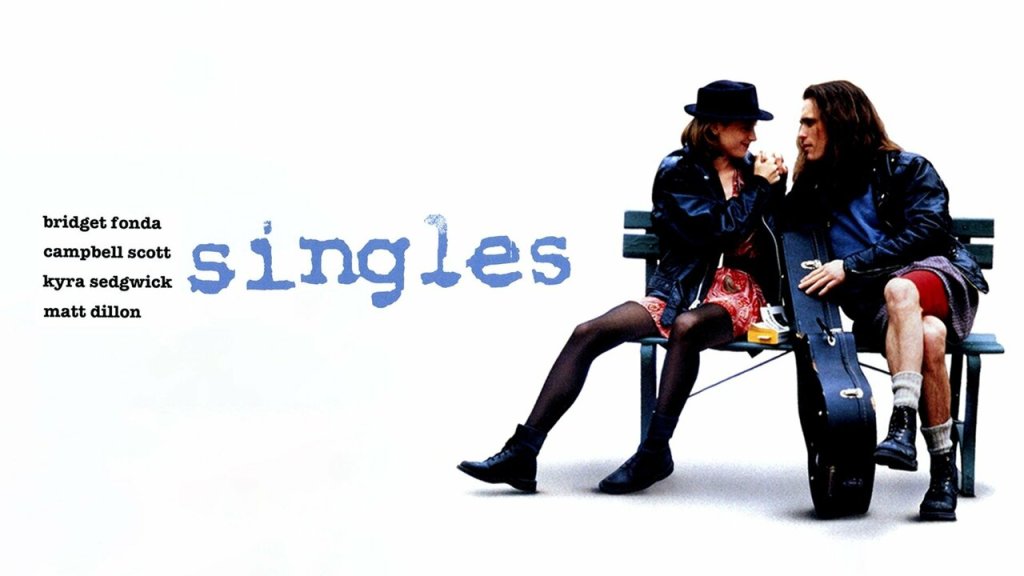
Singles
3 out of 5 stars
By J.C. Correa
In the fall of 1992, at the absolute height of the grunge movement, writer-director Cameron Crowe released this modest exploration of love and relationships and set it against this very backdrop. It was Crowe’s second directorial feature following his breakout hit Say Anything, one that quickly earned universal praise, eventually going on to attain the status of late ‘80s romantic drama classic.
Singles was Crowe’s attempt to frame a story around his clear passion and fly-on-the-wall knowledge of music, and it certainly would not be his last to do so. Having just finished reading Dave Grohl’s autobiography, The Storyteller, as well as being in attendance at a concert that featured a terrific lineup of early ‘90s tribute bands, I decided that now might be a good time to revisit the movie.

The film is structured around the lives of four characters (two couples), and marginally around a fifth. At the center of focus is the on-and-off relationship between Linda (Kyra Sedgwick), an environmentalist, and Steve (Campbell Scott), an affable fellow who works in city planning. We also spend time with Janet (Bridget Fonda), a barista, and follow her as she hopelessly pines for Cliff (Matt Dillon), an ambitious but somewhat aloof musician trying to make it in the Seattle scene. Cliff plays in a rock band called Citizen Dick whose members also include Eddie Vedder, Jeff Ament and Stone Gossard of Pearl Jam. It is to Dillon’s credit that he genuinely looks like he fits right in.
Crowe devotes a smaller narrative thread to Debbie, played by Sheila Kelley. She is a budding socialite who devotes all of her energies and efforts to finding a man at all costs. While her storyline provides some laughs as a result of her pursuit (she signs up to be part of a video dating service, allowing Tim Burton to actually make a cameo as a director), it mostly comes across as silly and superfluous due to the desperate nature of it all. It plays, at best, like occasional comic relief.
Singles has a loosey-goosey narrative that is broken up into chapters, each with its own title card; something that was very much a thing in American cinema of the early ‘90s (Clerks is another example that immediately comes to mind). Though it is probably meant as an endearing touch for the sake of connecting the juggling storylines (which it does), the chapter titles themselves tend to have a pretentious flair that ultimately proves debatable.

Besides the intentional design of the story structure, what links the characters is the fact that Janet and Cliff both work at the same coffee shop (it’s Seattle, after all), and Steve lives in a housing complex with other secondary characters that pop in and out. The apartment units being advertised are labeled as “singles.” As a group, many of these people usually only interact at the coffee shop, since the movie devotes the rest of its time to chronicling their individual couplings.
There is a fair amount of humor scattered throughout the picture, all of it of the organic, unforced variety, which is very much a staple of Crowe’s filmography and style. For one thing, Citizen Dick has a song in its arsenal with the very Spinal Tappy title of “Touch Me I’m Dick” that is impossible not to chuckle at. An initial mention of former Seattle Sonics star Xavier McDaniel has a humorous payoff during a sexual encounter as well. And there is also a memorable scene devoted to analyzing the socially accepted time to wait before calling someone after sex; something that Swingers, admittedly, did better a few years later, if a little more theatrically.
Last but not least, there is the music. As I disclosed earlier, members of Pearl Jam do get themselves onscreen in bit acting parts (and lend a few tunes to the soundtrack, naturally). But Crowe makes sure to authenticate his story and setting by having characters attend actual performances of Alice in Chains and Soundgarden. However briefly, the director makes it a point to place his camera very much in the middle of the onstage action for maximum effect. These well-executed moments should hold particular value for fans of these artists or the genre as a whole.
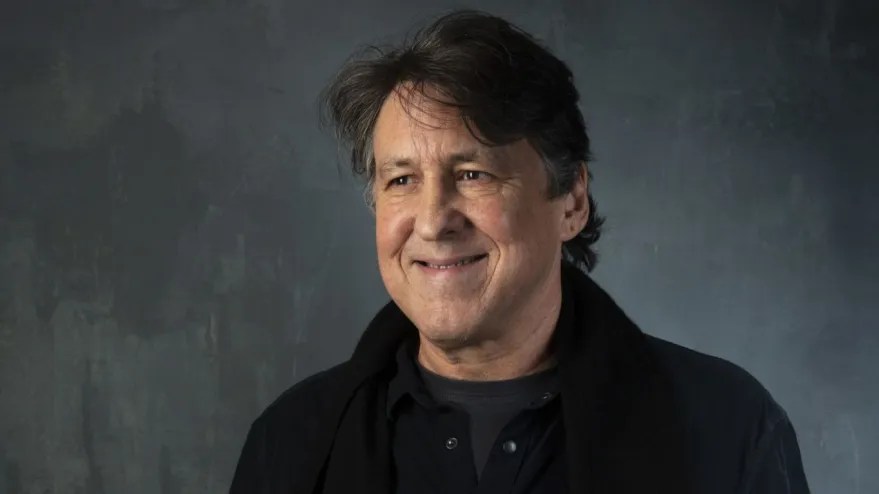
It may have seemed surprising at the time to have a feature film depict the Seattle craze less than a year after it exploded into the mainstream. And it is worth remembering that much like punk in the ’70s, grunge was indeed a very brief era, disappearing almost as quickly as it came, yet leaving a massive mark in its wake. But if you are familiar with Crowe’s reputation beyond his career as a director – namely his years as a rock journalist and someone with a firm finger on its pulse – it should not surprise you to learn that he actually happened to be living in Seattle since the late ‘80s, and thus got to personally witness all of this upfront as it was going on. As such, he staged his shoot in the spring of 1991 for the sake of documenting an exciting movement. It is sheer serendipity that would ensure that in just a few months all of these bands would go on to become household names.
And yet, a disappointing aspect of the whole thing is that despite the authentic presentation and feel of this particular environment, the bands and the whole grunge thing are only examined peripherally. Apart from Dillon’s character being a musician in one of them, it is an aspect that does not necessarily connect to the story in any meaningful way beyond serving as a device to bring the characters together. Perhaps that is the whole point all along. The intention might have been to give this an anthropological look, but what we are left with does not define the picture in any marked cultural way either, at least one befitting of a throbbing pulse. The overall approach is strangely passive and detached, resulting in something that at times comes off as arbitrary and even somewhat forced.

The most positive trait that Singles has is its original voice, a point that extends to its killer soundtrack. Even though the film jumps around a lot in a manner that can at times feel disjointed, it is nonetheless clear, even this early on, that Crowe has a gift for dissecting the human experience in a very personal and humane way (cue the scenes with Bill Pullman’s character), and one that always gives special attention to the humor of it all. After a stunning debut, this movie ends up representing a small dip for the filmmaker. But it is one that would inevitably prime him for the one-two punch of Jerry Maguire and Almost Famous – two pictures that rightfully went on to become instant classics.
In hindsight, we can look at Singles as a training exercise for what would go on to ultimately cement Crowe’s legacy. Through the way in which he shoots the bands performing, and via a scene between Linda and Steve devoted to reminiscing about the wonders of vinyl – just mere years after its temporary demise – we witness an artist that, by the end of the decade would really flex his muscles by returning to the closest thing to home.
 Generation X Wire