
The Alto Knights
2.5 out of 5 stars
By J.C. Correa
Robert De Niro sits across a table from himself and begins to have a conversation. The De Niro seen on screen right has a haggard face with light-colored eyes and a rough-looking, pronounced nose. He speaks, though, like Robert De Niro. The version that sits opposite him is one whose eyes are the same color as the iconic actor’s, but more visible from the wider eyelids that decorate his face. His nose looks smoother than his counterpart’s, and his skin displays a glossy sheen that makes him look, if not younger than his interlocutor, at least as someone who takes better care of himself. His voice, while still recognizably De Niro’s, has a higher pitch reminiscent of Joe Pesci’s, even though his slicked back hair and overall appearance instead recall Robert Duvall.
If you haven’t guessed it by now, the big conceit behind De Niro’s new film, The Alto Knights, is the opportunity to see him play two real-life gangster legends from the mid-20th century: Vito Genovese and Frank Costello. For those unfamiliar with their particular story, both men were childhood friends from New York who went on to become prominent bosses of the Luciano crime family during the 1950s. But their radically different personalities planted jealousy and seeds of distrust in Vito, causing him to attempt to eliminate Frank during a botched hit. Surviving the shot, and tired of the constant stress that a life in crime trapped him and his wife with, Costello needed to come to terms with what to do next: Exact his rightful retribution on his old pal or exit the life altogether. All of this is more or less covered in the interesting, yet highly uneven feature, which was directed by Oscar winner Barry Levinson (Rain Man).
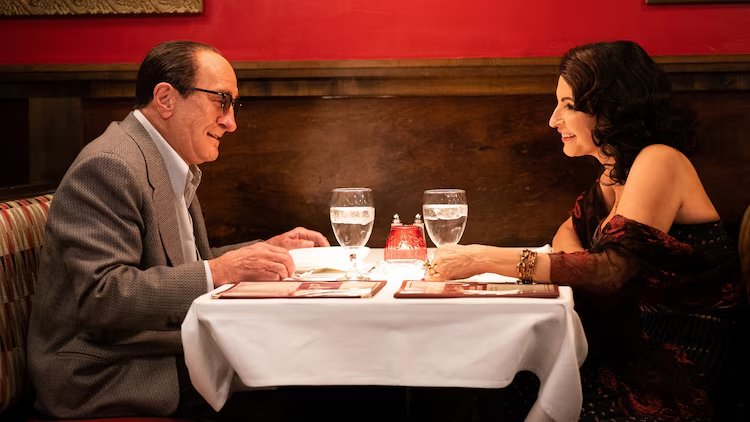
Unsurprisingly, both characters do get shared screen time, but it only happens on two occasions. The first of these is an early scene at a candy store where they sit down to have an agreeable chat. The second occurs at a restaurant much later in the film (as well as in their lives), at a point when Frank, concerned by Vito’s ambitious and reckless ways, tries to convince and warn his old friend about pulling back and approaching things more levelheadedly. Both instances are effective and are relative high points of the picture. They also allow us to better appreciate the differences in makeup, performance, and digital alterations bestowed on each character in order to sell the illusion. For reference, Costello’s is the first of the two aforementioned characterizations. As such, it probably won’t surprise you to learn that the spunkier, more combustible Vito is the one that resembles Pesci’s mob movie personas in ways that extend beyond the voice.

Besides De Niro’s and Levinson’s participations, the film’s pedigree extends to some truly noteworthy credits, namely Goodfellas and Casino screenwriter Nicholas Pileggi (also a producer on The Irishman) and producer Irwin Winkler (Goodfellas, Raging Bull and an Oscar-winner for Rocky). The cast is rounded out by Debra Messing as Frank’s supportive and loving wife Bobbie; Kathrine Narducci as Anna, Vito’s feisty and scorned spouse; and many Italian American acting alumni from The Sopranos and other fare of this ilk. And yet, despite having all of these heavyweights, the movie flounders more often than not and ends up as a half-baked concoction.
Part of this has to do with the fact that Pileggi’s script relies on too much forced exposition, such as when Vito and his crew, after witnessing Frank give voluntary testimony to U.S. senators, start explaining to one another, in turn, everything they believe led up to him having done so. It’s supposed to be a moment of tension, but it only comes off as awkward. The narrative itself doesn’t always flow smoothly either, and at times jumps ahead clumsily simply for the sake of hitting its historical bullet points. Furthermore, the movie features a score by David Fleming that just doesn’t let up. But that is not the result of a subpar work by the composer as much as an indicator that Levinson doesn’t trust his material enough to let some scenes actually breathe in silence.

After one of Vito’s goons (Cosmo Jarvis) misses his attempt on Frank’s life, he is mercilessly reprimanded and interrogated by Vito as to why he failed at his mission. The scene goes on too long and ends long after it has made its point. In fact, Jarvis’ dimwitted enforcer actually looks like an overweight Sonny Corleone, but with Fredo’s personality. As amusing as this may sound – if not outright bizarre – it is just one more example of the endless mafia movie clichés that the film tries to desperately recall for the sake of appearing authentic.
Despite its numerable flaws, The Alto Knights, which gets its name from a real-life social club in New York’s Little Italy that these characters frequented, is not a boring picture. At least not, I imagine, for genre fans. Even though her screen time is brief, the criminally underrated Narducci shows once again why her career should have been befitting of more leading roles. There is a tense and lively courtroom scene in which Anna is trying to sue her husband over money that she feels he has stolen from her, and Narducci is largely the reason why it works as it does. Elsewhere, there is a terrifically staged assassination of a mobster in a barber shop that is not only a standout here, but also a somewhat fresh riff on a tired trope. Later on, at the dead man’s funeral, an important conversation is had between Frank and his personal enforcer (Frank Piccirillo) that feels inspired only because it takes place in a room full of open, empty caskets.

On a personal note, I would rather see De Niro do double duty (some might call it a gimmick) in this kind of picture than revert back to the silly comedic phase he got stuck in for a while around the turn of the century. Even though I applauded his work six years ago in “The Irishman,” the de-aging experiment there showed its seams when, during early scenes, the veteran actor was tasked with portraying the sprightly body language of a man in his late 30s/early 40s. The Alto Knights, besides having the benefit of employing more advanced technology, also doesn’t require him to do that, thus making it easier to sell the trick. And while casting a different actor to play either Vito or Frank would have been logical and expected, the stunt works as an emphasis on the idea that both men, because of their bonded upbringing, always were two sides of the same coin. Was it necessary? No. Interesting? Without question.
The Alto Knights is currently playing in theaters.
 Generation X Wire