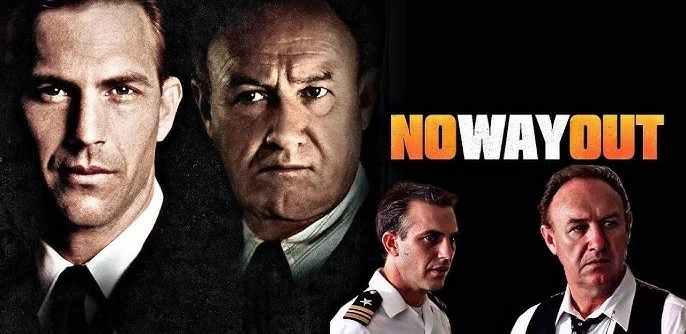
3.5 out of 5 stars
By J.C. Correa
The recent death of Hollywood screen legend Gene Hackman is one that has undoubtedly left a hollow mark across the movie industry. Part of this, unfortunately, has to do with the eerie circumstances behind his and his wife’s demise. But above all, it is the natural result of the actor’s enormous talent and the imprint he left on audiences and peers across an illustrious filmography that spanned four decades. He was a favorite of this writer, worthy of inclusion on a Mount Rushmore of screen performers. As such, I will be looking back on his body of work throughout the remainder of this year and revisiting films, both noteworthy and lesser-known ones, that were automatically elevated by virtue of his unique presence in them.
In 1987, for reasons that could not be anything other than the need for a paycheck, Hackman reprised his role as Lex Luthor in the absolutely abhorrent Superman IV: The Quest for Peace. It is a rightfully forgettable offering by any metric, and the less said about it, the better. However, that same year he also starred opposite Kevin Costner in another oft-forgotten production: the sexy political thriller No Way Out. Though a well-reviewed, minor hit in its day, the movie quickly got overshadowed by The Untouchables, Brian DePalma’s considerably more popular and culturally iconic vehicle from that same summer; one that also served as the primary launching pad for Costner’s leading man status.
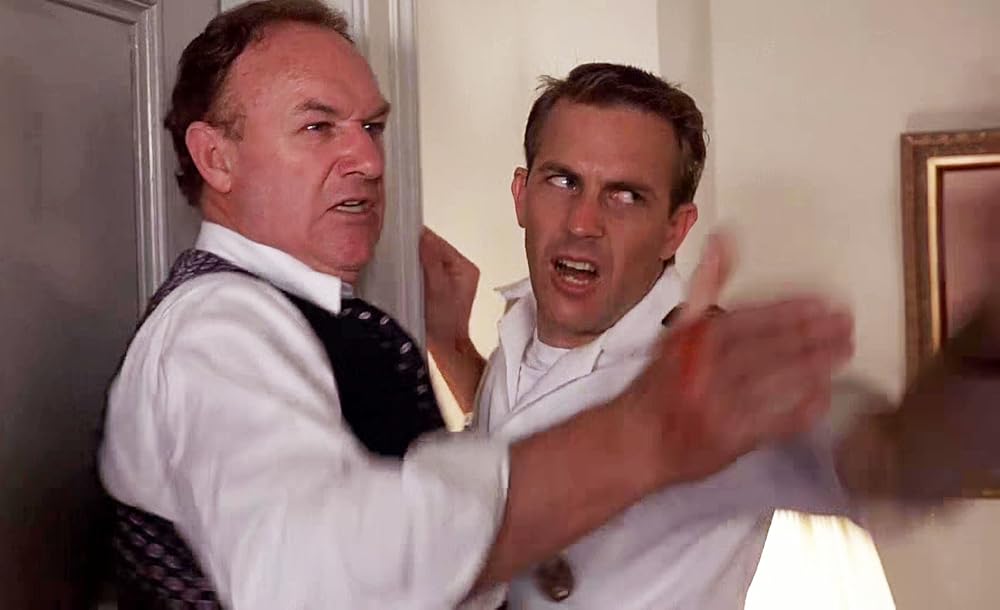
No Way Out was written by Robert Garland and directed by Australian filmmaker Roger Donaldson. It was based on The Big Clock, a 1946 novel by Kenneth Fearing, subsequently adapted into a picture of the same name two years later, and also as a French iteration in 1976 under the title of Police Python 357. It centers around the premise of a high-profile politician (Hackman) accidentally murdering his mistress and going to every conceivable length to cover it up.
Hackman plays David Brice, the U.S. Secretary of Defense who is having an affair with a flirtatious, free-spirited woman named Susan (Sean Young), one drawn to powerful men. It is unclear if she works as a professional escort, though it is certainly hinted at based on her lifestyle and demeanor, with Brice essentially serving as her sugar daddy. Upon meeting high-ranking Naval Officer Tom Farrell (Costner), she begins a romance with him and allows herself to be instantly swept away by the much-younger, fully eligible bachelor. They quickly fall hard for one another, too quickly in fact, some might say. It is clear that Susan is beyond smitten with Farrell, a point she exhibits through physical gestures that are highly exaggerated and suggestive of a certain immaturity and loneliness. At the very least, she knows Farrell might be the way out of the loveless trap she finds herself in with Brice, in which she stays only out of convenience.
Upon suspecting that Susan has another lover, Brice confronts her angrily, resulting in his accidental murder of her. He calls on Scott Pritchard, his general counsel, fixer and personal lapdog to help him cover it up. Pritchard is an old acquaintance of Farrell’s, who had recently convinced Brice to hire him as his private spy within the CIA. Naturally, the urgency of needing to handle the aftermath of Susan’s death causes them to redirect Farrell’s priorities into aiding them in not just the cover-up (a point they don’t know he is aware of), but a witch-hunt against a supposed Russian mole within the Pentagon whom they secretly intend to frame for the incident.
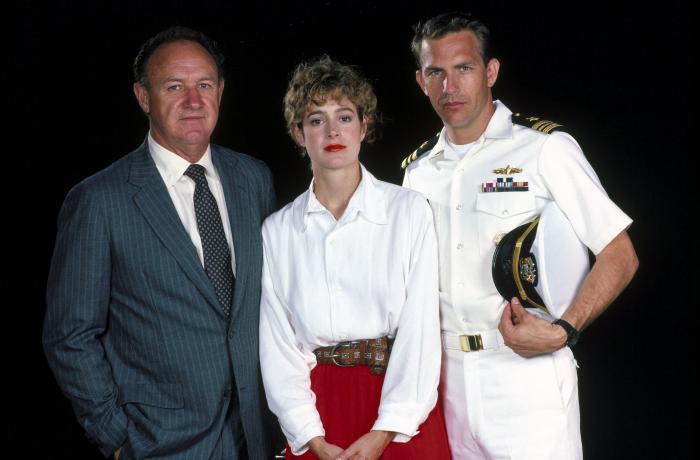
What complicates things for Farrell, beyond his personal feelings about having lost Susan – let alone so tragically – is that Pritchard has planted a piece of evidence that he found at her home. Without revealing too much here, it was something born out of their relationship that would also immediately implicate Farrell, and by default, make him the prime suspect in her killing. Farrell is thus put in a position of having to race against time to protect his innocence, while also covertly doing all he can to expose Brice and bring him to justice.
No Way Out is done in the style of those long-since-abandoned ‘80s suspense thrillers with an erotic tinge. Susan’s relationships, particularly her dynamic with Farrell, allow her to display an overt sexuality. Their first encounter is a racy one that takes place in the back seat of a limousine, in full view of the driver. It is played for laughs as much as for titillation. But the explicit portrayal of their chemistry also serves to compensate for an apparent lack of development in their romantic union, which I hinted at earlier.
Young was then in the early stages of her long career, and she plays Susan in a childlike manner that at times comes off as irritating. At the same time, it is implied that her character needs rescuing from her lifestyle, and Costner’s Farrell is just the man for that. The celebrated leading man was just ascending at the time, and in three years he would be the biggest movie star in the world for a hot minute. Here, Costner wears his short-sleeved, Summer White Service Uniform like a superhero costume, using it to stately prowl through the halls of the Pentagon with the same ease that he does while climbing into ceiling vents or tumbling with baddies after being chased on foot across Washington D.C.

For his part, Hackman brings his usual arsenal of fluid naturalness, nervous energy, and impeccable timing to his performance. Always the consummate character actor – when not placed front and center as a commanding leading man – he found an additional niche playing second-billed antagonists throughout the last two decades of his career. Brice is not a traditional villain in that he is not necessarily out to do horrible things. He is primarily a ruthless politician intent on taking down his political enemies. It is only when his reputation and livelihood are suddenly on the line that he throws the rulebook out in order to stay afloat. But when all is said and done, Brice is weak and frail, and Hackman expertly opens up small enough windows in the man’s tough-like exterior to allow us a glance at that frailty.
Interestingly, one performer who significantly stands out among the troupe is Will Patton as Pritchard. Obsessed with protecting Brice (a point with likely sexual origins from the disclosure that he is gay), Patton plays Pritchard as an arrogant, high-strung weasel, nursing a sleazy intensity that only grows as the story’s progression mirrors his mounting desperation. When viewed through contemporary eyes, he does fit the problematic trope of mentally troubled homosexuals whose loose circuits are the result of sexual repression. From a dramatic standpoint, though, Pritchard is the true villain of the piece and gives the film a proper tension whenever he appears. If anything, the character comes across as a sort of template for Michael Kelly’s steely fixer from Netflix’s House of Cards, albeit 25 years later. On a greater level, perhaps it is also no coincidence that Brice describes his own situation as just that – “a house of cards.” Someone may have been taking note way back in 1987.

Despite a somewhat uninvolving start, No Way Out picks up considerable thrust after Susan’s demise. This has less to do with Young’s character than it does with the movie’s wheels finally latching on to the rails that it was designed for. By abandoning the erotic drama trappings in exchange for a ticking-clock, cat-and-mouse thriller, the film embraces its true purpose and, with little regard for plausibility, rides it excitingly to the finish line.
If you have never seen the picture, it is worth mentioning that there is a brief prologue and denouement that are used as a twist. Though unexpected and surprising, this plot device adds an additional level of stakes when reconsidering the events of the story but isn’t fundamental either in the grand scheme of things. In fact, it is actually something that may prove unsatisfying to some viewers. It should not, however, in any way deter from the genre joys to be had elsewhere in the narrative, especially at first glance.
No Way Out is currently streaming on Tubi and is also available for online rental.
 Generation X Wire