
Batman Begins
3.5 out of 5 stars
By J.C. Correa
It may be difficult to remember, let alone believe, but twenty years ago the character of Batman was dead in the water. At least as far as his cinematic viability was concerned. After a string of three consecutive hits from 1989 through 1995, the lucrative property was all but destroyed when director Joel Schumacher traded in Tim Burton’s dark, gothic stylings for bright neon colors and the exorbitant camp to match it in 1997’s Batman and Robin. Though the metamorphosis had already begun on the previous film, the fourth movie practically killed the Caped Crusader overnight by not only diminishing his box office returns, but by basically making him an outright joke. It would take almost a full decade before Warner Bros. would attempt to bring him back in any form.
It is also worth remembering that eight years was not a long time back then. In those days, before the official boom of superhero movies (i.e., the age of Marvel), comic book characters were ushered out on a generational basis, if revisited at all. Franchises were not rebooted with the brevity and tendencies towards oversaturation that have become commonplace over the past decade and a half. In other words, there was a clear effort on the part of the studios to award audiences enough time to develop a hunger for another iteration of a beloved character. And in 2005, in large part because of how spectacularly it had fizzled out, no one was exactly sure how much of that there was for Batman.
Warner Bros. decided to gamble anyway by bringing on board a critical piece of the puzzle in the form of British director Christopher Nolan. Fresh off the success of the crime thriller Insomnia (also for the studio), not to mention that of his arthouse, breakout hit Memento a few years earlier, Nolan had quickly established himself as a cerebral filmmaker with a penchant for clever concepts and strong character work. With screenwriter David S. Goyer – an admitted comic book scholar – Nolan set to work on not only an origin story, but on one that would completely eliminate the heightened and stylized trimmings of both Burton’s and Schumacher’s worlds and substitute them with as realistic a take as possible; one that would be grounded in the real world and within the realms of scientific logic.
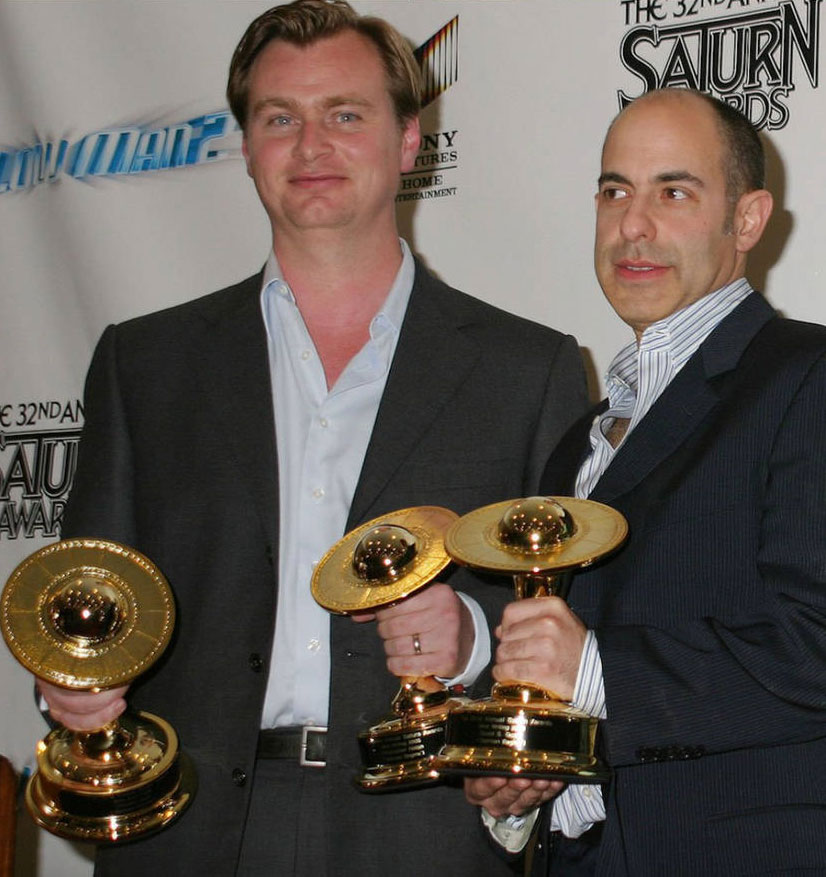
Batman Begins debuted in the summer of 2005 sans much fanfare, but with a cautious curiosity in its place instead. Audiences and critics quickly responded to its off-kilter approach, and the manner in which it instantly brought the IP back to vibrant life, generating much renewed excitement in the process. As it celebrates its 20th anniversary, I revisited the movie the other day to see how well it holds up, not only on its own, but also with regards to the greater legacy of the trilogy it spawned, and to the character’s constant presence in movie screens ever since.
Without warning, Nolan thrusts us right into the action by depicting a disheveled Bruce Wayne (Christian Bale) slaving away in what looks like a Himalayan chain gang. There is no background given whatsoever; we are simply forced to accept this reality and go with it to the best of our ability, at least for the moment. Stylistically, this proves to be a radical departure from any previous version we have seen, and, though effective, it also does come across as somewhat jarring and untethered.
Thankfully, it is not long before we are introduced to flashbacks that not only show us young Bruce as a child, but also the requisite depiction of the murder of his parents that these movies inevitably depend on. Anyone versed in Batman lore will know that that critical moment is what sets the young man off on his course to eventually create his adult alter ego. However, the most important thing that the film accomplishes during these flashbacks is that it sets up the fundamental role that bats play in the boy’s life. Young Bruce initially experiences a paralyzing fear of these creatures. And we can understand why, as Nolan unleashes what seems like fleets of them throughout critical points in the movie. Part of the film’s principal arc is to illustrate how, through sheer will, Wayne adjusts his attitude towards bats until he comes to realize that he can actually use them to his absolute advantage in fighting crime. This initial, acute phobia is a crucial point in defining his character, but also in establishing the importance of fear as perhaps the most major theme of the picture.
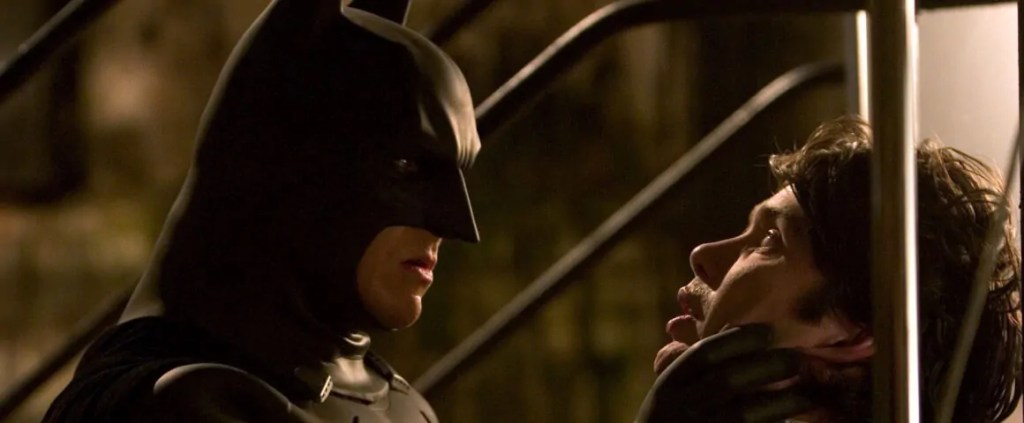
Wayne has gone to the aforementioned desolate location to purposefully train with a legendary band of warriors known as the League of Shadows. It is through their influence that he learns all of the necessary skills that he will later be able to put to practical use as a dark avenger. Though this section of the movie drags a bit at times, it nonetheless pays off once we eventually see him successfully implement it all under the cape and cowl.
Keeping with the origin story aesthetic, the screenplay sets up two villains that could be categorized as minor ones within the Batman lore: Scarecrow and Ra’s Al Ghul. Though on the surface their inclusion may seem like a small-scale approach to everything, it is actually an inspired decision because it not only bets on the strength of the enterprise and the foundations being laid out, but also on the idea of reserving the heavy hitters for the even more delectable main course later on that the sequels turn out to be. In this film, Scarecrow weaponizes hallucinogenic drugs to a degree that lines up with Nolan’s very adult approach to the world he is depicting. And though the character’s entire gimmick tends to get a little muddled, it is fun seeing recent Oscar-winner Cillian Murphy leave a memorable, early impression in a Nolan film.

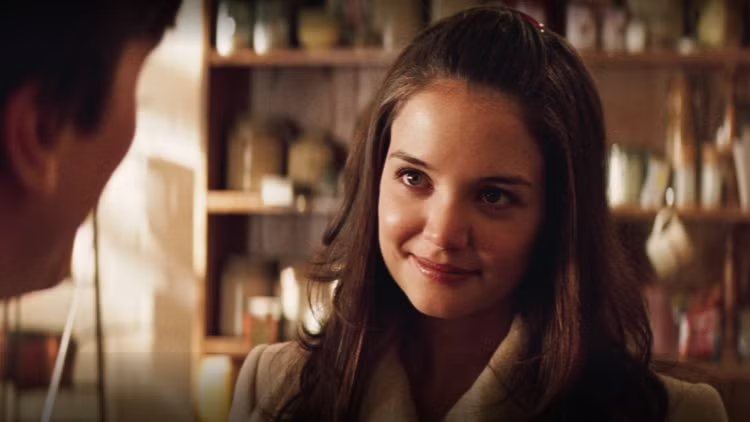
Part of the success of the picture rests on the strength of casting an A-list ensemble. Liam Neeson and Ken Watanabe grace the early scenes as Ra’s Al Ghul and his first lieutenant, Ducard, respectively. Elsewhere, the movie features the participation of Gary Oldman, Tom Wilkinson, Rutger Hauer and Morgan Freeman, all in weighty roles. With his work in this film – as well as in its two sequels – the great Sir Michael Caine goes on to create, to this viewer at least, the definitive portrayal of Alfred, Bruce Wayne’s ever-loving butler/father figure and most-trusted friend. Only Katie Holmes as Rachel Dawes, Gotham City’s Assistant District Attorney and childhood friend/love interest of Wayne, comes off as somewhat of a weak link. Though she is fine during the first half, as the story progresses and gains in dramatic complexity, the actress seems a little out of her depth with what she is tasked to do. Three years later in The Dark Knight, she was replaced in the role by Maggie Gyllenhaal and not a single person complained.
When all is said and done, no cast member contributes more to the movie’s success than Christian Bale. The actor brings a stoic, strong-willed determination to his portrayal of Wayne/Batman, which is characterized in part by how physical it is. Though he never intentionally plays anything for laughs, he is still able to organically bring out the humor in any given scene. Before Wayne’s self-imposed, seven-year exile to the Himalayas, there is an important sequence in which the actor is made to look appropriately younger simply by how he dresses and the manner in which his hair falls over his forehead. It is only as effective as it is because Bale does all the necessary work, facially and physically, to complement that reality. It is not something that gets brought up much, but across the three films, I believe those early flashback scenes in Batman Begins are the best work he ever did as Bruce Wayne.
In the sequels, Gotham City is presented as nothing more than a contemporary metropolis, interchangeable with just about any other major American city. That is in large part due to the fact that The Dark Knight used Chicago as a stand-in, while New York, Los Angeles and Pittsburgh served the same function in The Dark Knight Rises. And though Batman Begins also relied on Chicago exclusively for these purposes, it is the only one of the three pictures that visually portrays Gotham City in a stylistically elegant and futuristic light; one that owes a little more to Nolan’s predecessors than to the overall aesthetic he went on to establish in his trilogy. As a result, it comes across as more enhanced and vivacious, even as it sacrifices the real-world aim of everything else.
Viewing it today, the film probably makes its greatest impact if we recontextualize its message to our contemporary world at large. Ra’s Al Ghul and the League of Shadows are hell-bent on the destruction of corrupt civilizations they consider to be irredeemable. It is implied that, across the ages, they had a hand in the fate of Rome and Constantinople, among others. As such, Gotham City is the most recent target they deem worthy of mass annihilation for the sake of ushering it back to a state of balance. Considering just how dangerously radical and unhinged American society is becoming today from the standards set daily by its current government, it does make one wonder if our current reality shares one too many things with the movie’s fictitious city. And if so, have our own institutions and laws become so impenetrable now that they are indeed in need of some sort of blunt reset? Batman Begins makes the bold claim that, while these scenarios require radial measures, these need not always involve megadeaths and immeasurable violence. Sometimes all it takes is the right person with enough selfless insight and bravery to rise above it all in the face of adversity and challenge the system to show us the way. Cape and cowl are optional.
 Generation X Wire