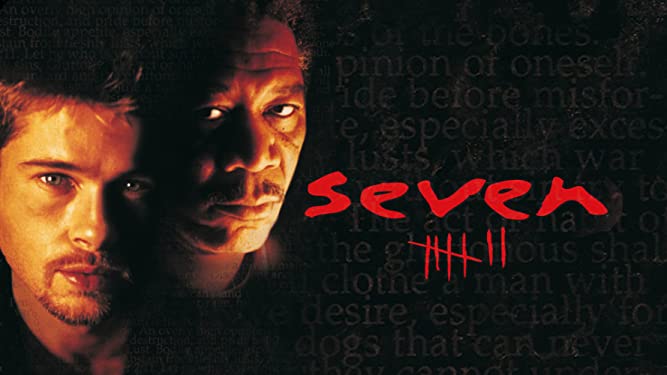
Se7en
4 out of 5 stars
By J.C. Correa
After a string of iconic and influential music videos in the late ‘80s/early ‘90s like Paula Abdul’s “Straight Up,” Madonna’s “Vogue,” George Michael’s “Freedom! ’90,” and Aerosmith’s “Janie’s Got a Gun,” director David Fincher made the leap to feature films with the controversial and much-maligned Alien 3 in 1992. Thoroughly unhappy with that debut (he has since disowned it), the filmmaker felt a huge need to recalibrate and start fresh again as if that offering never happened. Three years later, a script landed on his lap that afforded him a chance at redemption.
Released in the fall of 1995 by then small-scale New Line Cinema, Se7en was a psychological thriller/murder mystery suspense/police procedural that kind of came out of nowhere. In that respect at least, as well as in its overall aesthetic and genre leanings, it was very similar to The Silence of the Lambs, the eventual Academy Award-winner for Best Picture from 1991. As it celebrates its 30th anniversary this year, I decided to revisit Se7en last weekend at a theatrical screening and see how this surprise hit from the mid ‘90s helped to properly launch the directing career of one of the industry’s true visionaries.
While it has since been shrouded in a thick mystique centering on its disturbing and sinister ending – not to mention the entirety of its chilling concept – we must first remember that Se7en is, above all, a partner cop movie. This is not to say that it resembles a buddy cop film of the Lethal Weapon variety with its inherent comic schtick. Still, it does share a few traits all the same with that popular ‘80s touchstone in that it partners an older black detective eyeing retirement (Morgan Freeman) with a brash young white one (Brad Pitt). More crucially, it is established from the very onset that these two men are polar opposites in every respect, and the picture derives the majority of its energy from that fact.
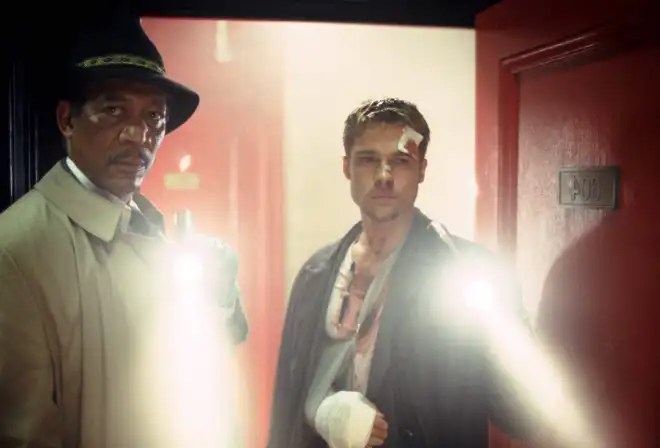
Freeman plays Somerset, a veteran policeman about to call it a career, while Pitt is Mills, a young investigator who, though not technically a rookie, certainly behaves that way most of the time. Where Somerset is disillusioned, cautious, and jaded, Mills is impetuous, boisterous, and reckless. Wisened by years, Somerset speaks calmly and only when he has to, whereas Mills’ bravado won’t let him shut up. The movie seldom plays this polarity for laughs, though, and it is clear that both men get on each other’s nerves in a very real way that only adds to the tension of what they are up against.
If you are somehow still unfamiliar with it, the plot centers on their investigation of a peculiar case of gruesome murders that are all thematically linked to the seven deadly sins. These occur in more or less a week’s time (Somerset’s last on the job), and they are very cleverly conceived and executed by a mysterious killer. With the exception of a crucial one at the very end, Fincher avoids showing us the act itself, and rather, focusses exclusively on the discovery of the corpses, all in crime scenes decorated with a sign (usually painted in blood) that indicates which of the seven sins each represents. It may be psychotic stuff, but it is no less fascinating all the same due to the genius sophistication behind it all. The fresh and original concept is only enhanced because Fincher lays it out bare in all its disgusting, visual splendor. And though the images depicted are naturally crude, the director uses an elegant style for his camera work, ensuring a precise framing and fluidity of movement throughout.
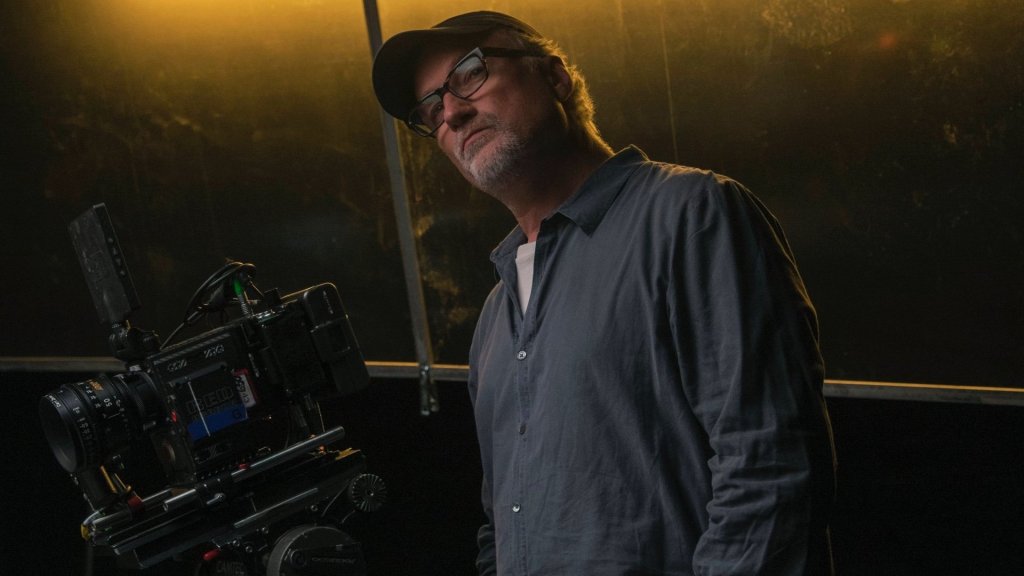
In his subsequent filmography, Fincher went on to establish a signature impression to his films that more or less has gone on to define him, partially because it perfectly underscores the dark nature of his frequent themes. The cold, nihilistic feel established by his predominant use of greens and yellows is very prevalent in everything from Fight Club and Panic Room to Zodiac and the recent The Killer. In Se7en, however, he was not there yet in terms of his preference for that particular look. But that does not mean that he did not bestow the movie with a fitting visual style that nonetheless still feels very much like his stamp. Befitting the picture’s themes of corruption, hopelessness, and despair, Fincher uses very desaturated colors that are drained of life. And he makes sure to underline it all by starting off with what was, at the time at least, an unforgettable title sequence. Through a weird blend of graphic and motion design with music video language, it features a sordid and jarring depiction of the twisted and methodical mind of a serial killer. Scoring it all to a remix of “Closer” from Nine Inch Nails only foreshadows, in hindsight, the director’s eventual collaboration with Trent Reznor in his later films.
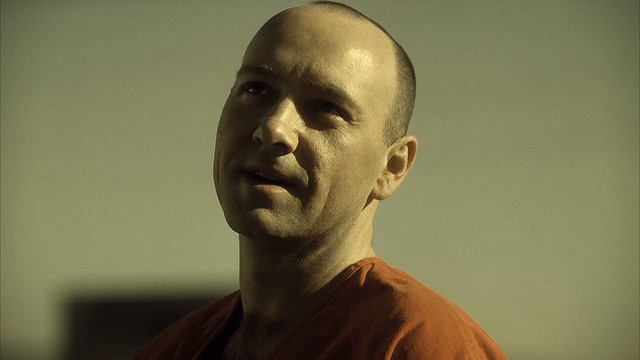
The movie’s story goes on to enhance these aforementioned feelings by setting the events in an unnamed city where it rains 24 hours a day. And even though the majority of scenes are set indoors, the presence of the rain is frequently glimpsed at, or at the very least, always felt. It is only in the third act, when the killer, played by Kevin Spacey and simply referred to as John Doe, enters the picture that the sun literally comes out and stays through the finale that is anything but. Spacey, then in his heyday as an actor, plays Doe with a passive, calculating menace that still finds a way to be creepy. It is fun watching him try to get under Mills’ skin through constant provocation, which admittedly, is not a hard thing to do to the brash young cop.
If there is one glaring demerit, (though it may not be an issue for other viewers) it is the fact that Mills, with his nervous energy and constant outbursts that betray his impatience and inexperience, is a borderline unbearable character. He actually reminds me a little of Sonny Corleone; perpetually losing his cool at every turn. The big difference is that Sonny is a wonderfully written part played on par by James Caan in The Godfather who made the most of the mafioso’s barrage of magnificent lines. Pitt, at the time trying to distance himself from heartthrob roles by taking on this very unglamorous one, does all he can with the character. But in the end, it really comes down to how the part is written in Andrew Kevin Walker’s otherwise terrific screenplay.
There is much to like and admire in this early Fincher offering that has indeed stood the test of time across three decades. I am a particular fan of the pains that the filmmaker takes to establish the sharp contrast between his protagonists, be it the simple act of drinking wine or beer with dinner (you can guess who drinks which), or the elegant montage scored to Bach’s “Suite No. 3 in D Major” that cross-cuts between them to illustrate their divergent approaches to researching the case (Somerset spends hours in the library while Mills settles for CliffsNotes at home). Amidst it all, Fincher still finds ways to develop character and harness emotion, such as in a scene where, after trying to bring the detective partners together by inviting Somerset over for a home-cooked meal, Mills’ wife, played by Gwyneth Paltrow, asks him to secretly meet her in a diner so she can seek his advice on personal matters. As a bonus, it is nice to see Richard Roundtree in a small role as the district attorney, much as it is to have R. Lee Ermey as the, surprisingly, calm and soft-spoken police chief. After all, I imagine that squaring off his usual drill sergeant routine against the histrionics of Pitt’s character may have been too much for even Fincher to handle.
 Generation X Wire