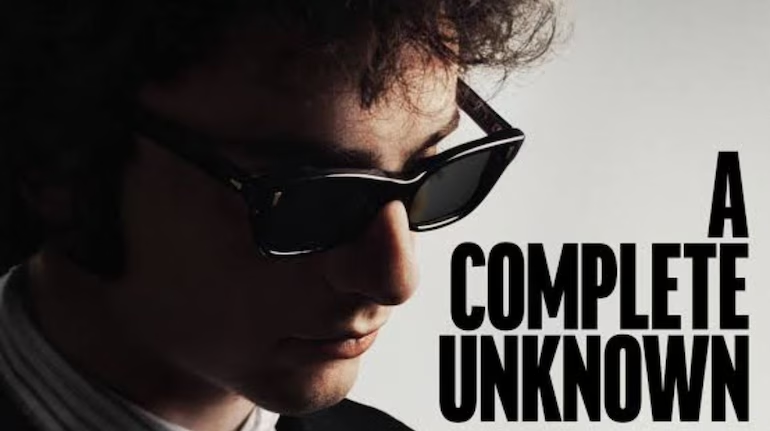
A Complete Unknown
3 out of 5 stars
By J.C. Correa
There is no denying that Bob Dylan is one of the greatest and most prolific songwriters in history. In the same manner, I don’t think anyone will ever argue that his work and legacy have left a print on our culture that has only enriched it, for which he’s been rewarded with a passionate and decades-long loyal following, not to mention a Nobel Prize for literature. That’s not bad for someone who, beyond his creative output, remains an absolute enigma to the millions who adore him.
James Mangold’s new biopic on the elusive legend, I’m afraid to say, will not shed much light on the matter either. But it will likely entertain you for two plus hours all the same, as you patiently wait for the small chance that it just might offer you a glimmer. How much you enjoy it will squarely depend on which of those two points you place a higher importance.

Current Hollywood golden boy Timothée Chalamet has been awarded the arduous (and I imagine, enviable) task of playing the revered singer-songwriter. It is on his sprightly shoulders that the weight of this entire enterprise lies, and fortunately for everyone involved, Chalamet is more than up to the task and wastes nothing of this singular opportunity. The young thespian digs deep into himself and manages to find a way to channel Dylan by not only painstakingly having learned how to play the guitar in the folk hero’s style, but by expertly mimicking the lazy, high-pitched whine that is Dylan’s speaking/singing voice. Dylan’s peculiar style of singing is not particularly difficult to imitate, something that many comedians can attest to. Playing his songs and embodying his spirit while doing it, however, is a different matter altogether. Just marvel at the way in which Chalamet organically knows just which notes to hold and for how long. In short, the performance offers further proof that he is probably the best actor of his generation working today.
The movie is based on author Elijah Wald’s 2015 book Dylan Goes Electric! As such, it charts young Dylan’s arrival in New York City in 1961 and his quick rise in the local folk scene, after having been ushered into it by Pete Seeger, whom he met while visiting a dying Woody Guthrie at the hospital. He soon begins a relationship with a pretty girl named Sylvie (Elle Fanning), while developing a similar one behind her back with Joan Baez, the local folk star whose career trajectory matches his. Dylan achieves fame rather quickly but doesn’t have the personality to handle it well. Frustrated by what he believes is expected of him (and sensing the changes in the country’s musical landscape), he decides to abandon his singer-songwriter persona and adopt the one of a bandleader, all of which culminates in the infamous 1965 Newport Folk Festival where he, to the dismay of thousands, decided to plug in for the first time.
Focusing the story on those four critical years of Dylan’s life allows Mangold to recreate some iconic moments in the history of both folk music and pop culture, if not actually imagine some along the way as well. For one thing, New York City, particularly Greenwich Village, is brought to life to marvelous, period effect. Baez, wonderfully played by Monica Barbaro, is one of the film’s standouts. Having taken Chamalet’s approach in adopting musician skills, her voice is absolutely beautiful when she sings several of Baez’s numbers. Her performance of “House of the Rising Sun” at a club early on when she and Dylan first meet is a particular showstopper. Along the same lines is a scene where she spots him performing at the Gaslight Cafe, as well as one in which she first observes him composing the iconic “Blowin’ in the Wind” while on her bed, joining him in singing it as he goes through the verses. This last sequence lays his talent fully bare, and it is in that moment that she falls for him, along with the audience I imagine.

There are two, tellingly, heroic presences that loom large in the part of Dylan’s life that the movie covers. The first of these is Guthrie, who is effectively played in a completely silent turn by Scoot McNairy. As his primary inspiration, Guthrie is the only person he feels the need to do right by. The other of these is Johnny Cash, who as we learn early on, is someone who Dylan admired, and as it turns out, it’s something that was also reciprocated. Cash is played by Boyd Holbrook as the larger-than-life rascal that he was, and effectively, a proper rock star. To Dylan, he serves as a symbol of rebellion and freedom more than anything.
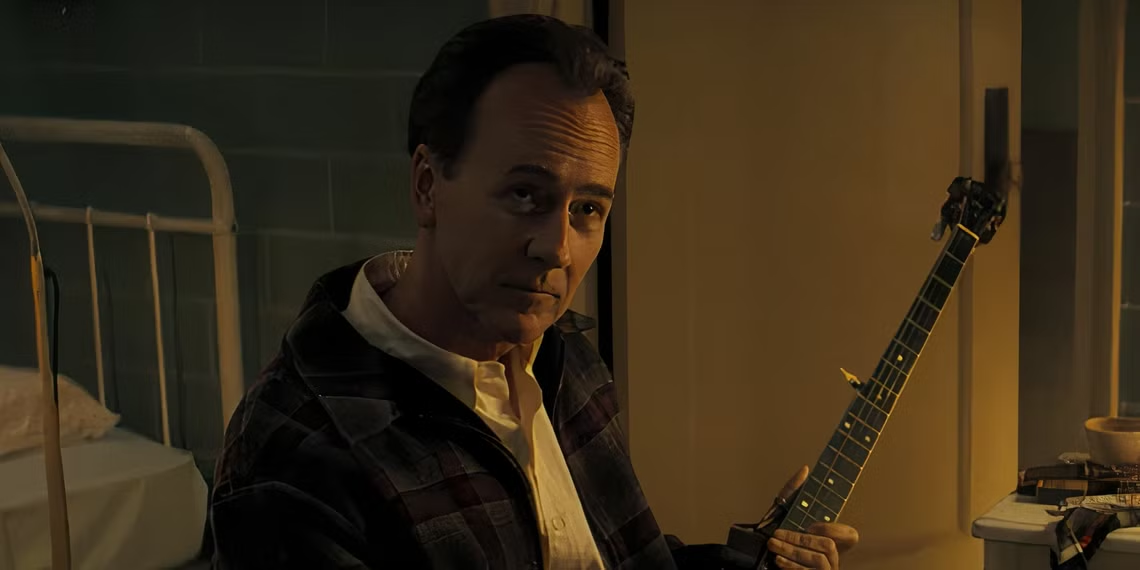
In the middle of all of this is Seeger, the widely renowned folk icon who saw in Dylan not only a kindred spirit, but also his potential successor. Edward Norton brings him to life in a charming and wholesome turn that provides the picture its deepest sense of roots. The film positions Seeger as the safe old guard while using Cash and fellow singer-songwriter Bobby Neuwirth as the embodiment of a riskier and more exciting future. Suspecting that Dylan is about to buck the trend by going electric at Newport, Seeger pleads with him to reconsider, allowing Norton to deliver a lovely monologue that relies on the concept of a seesaw to make its case.

The 1965 Newport show, which culminates with Dylan and his band performing “Like a Rolling Stone” as they are pelted by objects from an angry crowd, is staged as cathartically as you would expect. As many already know, that moment, more than any other, proved to be the metaphorical turning point for everything that was going on in the 60s, with music being the agent most suited to reflect it. However, it is here that Mangold misses a huge opportunity in ignoring the greater symbolic ramifications of it all by instead insisting on paying tribute to and glorifying Dylan’s legacy. Here, he repeats the tendency to shoot Chalamet from behind when onstage as he stares out into the audience, slowly pushing the camera in on his backlit frame to give off a godlike persona. The effect is reverential, for sure, but it also serves to trap the filmmaker into worshipping the legend with more interest than actually exploring it.
The fact of the matter is that, in spite of its breezy watchability and collection of enjoyable scenes (most of them musical), we leave the aptly titled A Complete Unknown knowing as much about Bob Dylan as we did going in. Sylvie, before leaving on a trip to Europe, speaks for all of us when she tells him point blank that she doesn’t know him at all. And by virtue of having Chalamet perform upwards of three dozen songs (and not just a verse here, a line there, mind you), the film is essentially telling us that the only way to really get to know this person is through his art. Which begs the more delicate question about whether or not the movie even justifies its existence. Or is watching a very gifted actor authentically sing and perform Dylan’s tunes while made to look like him reason enough to jump on board?
Biopics, as a very specific type of genre, are a tricky thing. Especially when taking into account their almost stubborn necessity to adhere to a formula. A Complete Unknown, like Mangold’s own Walk the Line, is no different in this regard. But his take on Johnny Cash, while far from perfect, pulsated with drama and trauma, enough at least to make us care. In Dylan’s case, we are presented with a protagonist whose motivations are never clear, while choosing instead to be distant and aloof, when not being an outright jerk. From an artist’s standpoint, his need to change is actually the best thing about the story. But that can only pay off if we understand exactly why that is so important to him, beyond just the wish to not be boxed in or defined. Drawing it so sketchily comes off as a CliffsNotes approach to a sacred text that, frankly, deserves better.
You’ll enjoy A Complete Unknown if you like Dylan and his music. Otherwise, listening to his records is just as comparable an option, and likely a more accessible one.
A Complete Unknown is now playing in theaters.
 Generation X Wire