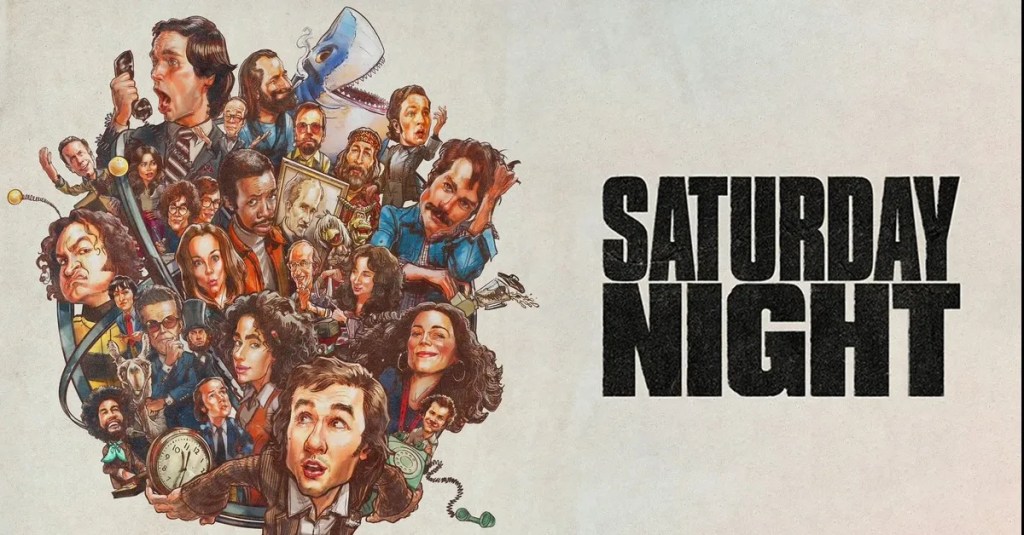
Saturday Night
4 out of 5 stars
By J.C. Correa
In one long, uninterrupted take we are swiftly hurdled through several of the rooms at NBC studios where it seems pretty much everything is going on at once. Like flies on the wall, what we witness is an abundance of chaos and panic that are gradually mounting in the 90 minutes before a brand new show is about to debut live in front of both a studio and national audience. But as we all know, this is no regular program. The date is October 11, 1975, and Saturday Night Live is about to air for the very first time and effectively change the culture forever. And like anything of long-lasting beauty, its birth is usually an awfully painful experience.
One of the great thrills of Jason Reitman’s new movie Saturday Night (which opened nationwide exactly 50 years to the date of this celebrated occasion) is that it recounts all of those hundreds of details, real or exaggerated, in riveting real time. Another one is the fact that all of this is nostalgically captured in grainy 16mm film stock that makes it look like a bona fide product of the mid 1970s. The shot I previously referenced lasts a good four minutes, and in its voyeuristic, cinema verité style, showcases so much going on at once that it owes a lot to Robert Altman, and more recently, Paul Thomas Anderson. But because it arrives very early in the picture, it serves as a microcosm of what is in store for SNL creator Lorne Michaels as he frantically navigates through bedlam to make the impossible happen.

“The show doesn’t go on because it’s ready. It goes on because it’s 11:30.” Michaels used that as his working motto, and it is one that can surely be appreciated by anyone who has ever had to adhere to a deadline. The task of portraying the SNL guru falls on Gabriel LaBelle, who plays him with the jittery energy of a brash visionary who also knows he just might be in way over his head. After impressing two years ago as Steven Spielberg’s stand-in in the famed director’s autobiographical The Fabelmans, LaBelle strides through various floors of 30 Rockefeller Plaza – and the sidewalk out front – looking like a very young Bruno Kirby on the verge of a nervous breakdown, while desperately striving to keep a lid on the madness. As much of an ensemble piece as the topic requires the movie to be, this is Michaels’ story first and foremost, and all of the characters in the film are there to either support him, challenge him, or make his life a living hell.
If you are familiar with the grimy details of what it took to get SNL off the ground back in the mid ’70s, then you know that it happened on the shoulders of people like Chevy Chase, Dan Aykroyd, Gilda Radner and John Belushi. Played by Cory Michael Smith, Dylan O’Brien, Ella Hunt and Matt Wood, respectively, all of these comedy legends are accurately represented, with an emphasis on their individual eccentricities; be it Chase’s prima-donna behavior and obsession with being the sought-after playboy, Belushi’s self-loathing and contempt for the process and the industry, or simply the downright hatred that each feels for the other. Add to that the presence of an always-unpredictable Andy Kaufman (Nicholas Braun), a coked-up George Carlin (Matthew Rhys) just waiting to sabotage the show as its maiden host, and an exasperated Jim Henson (Nicholas Braun again) who doesn’t quite know what is expected of his Muppets during the broadcast, hoping only that they leave with their decency intact. It’s all a train wreck waiting to happen no matter how you look at it.
As hard as it may be to believe however, the aforementioned insanity is just on the talent side of things. Michaels has to face a variety of technical challenges as well, including a lighting director who walks out an hour before the broadcast, an actual lighting rig that comes crashing onto the stage floor during a final rehearsal, and a set that cannot be completed because the bricks it requires get caught in a quagmire of union politics. If that weren’t enough, Michaels is constantly under the suspicious eyes of the network affiliates who don’t know what to make of his show. One of the NBC heads (Willem Dafoe) is there to constantly breathe down his neck and has no qualms about admitting that he wants him to fail. The latter sentiment is also expressed to Michaels by none other than Johnny Carson, the then king of late night who feared that SNL could somehow threaten his beloved Tonight Show. In other words, Lorne Michaels birthed his baby under the healthiest of working conditions, and Jason Reitman captures the hilarity that resulted from that backdrop of madcap lunacy with much aplomb.

One of the most entertaining things about the movie involves the presence of a stuffy network censor (Catherine Curtin) and the infinite battles she finds herself in with these artsy counterculture anarchists. The best of these occurs with Michael O’Donoghue (Tommy Dewey), the show’s head writer, who relishes in ridiculing her with deadpan sarcasm. At another point, others misleadingly explain to her the meaning of a “golden shower” just to keep the poor lady at ease. It’s a genuinely riotous moment.
When Dafoe’s character reveals to Michaels that the network green-lighted his creation because its inner politics would benefit from a show that was guaranteed to bomb, echoes of The Producers are inevitable. As bizarre at it sounds, it does make one wonder if the NBC suits at the time were perhaps in any way inspired by the plot of Mel Brooks’ 1967 film classic. Regardless of whether or not that was the case, I suspect that that particular story point might resonate for some contemporary audience members who are more familiar with the more recent and higher-profile Broadway adaption.
It is worth pointing out that because of the nature of the story, the script by Reitman and Gil Kenan has very little time to develop any of the roles other than Michaels and, to a lesser extent, Rosie Shuster (Rachel Sennott), who at the time was both a writer on the show as well as Michaels’ wife. I personally do not see this as a flaw, but rather a byproduct of the film’s structure. In this case, I believe it is worth sacrificing the chance to better get to know some of the characters for the sake of pulling off a dense, real-time experiment that gives the film its specific purpose. I do consider however, that some viewers might be let down by this particular tradeoff.
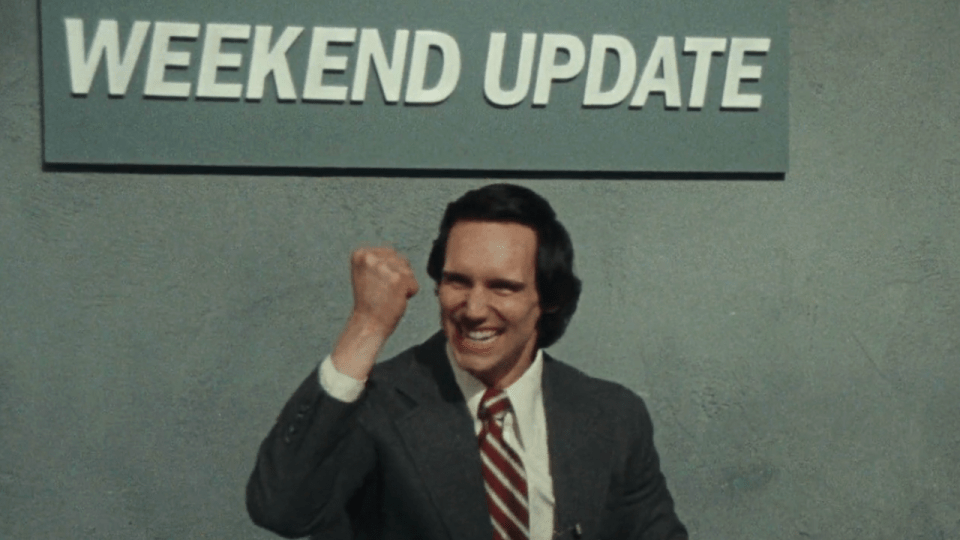
Be it through the effective percussive score, the red lights on a studio camera resembling two ominous eyes staring down the talent during Weekend Update rehearsals, or lines like, “I’d ship you back, but on this budget we can’t afford the postage,” Reitman’s movie is a stylishly tense romp with ample wit. It serves as not only a nostalgic look back at an iconic time – albeit a shamelessly sexist and misogynistic one – but also as an examination of and testament to a leader who threw caution to the wind in the name of genius instinct. Whether the events depicted truly are an accurate detailing of what went down on that mythical evening or just a fictionalized love letter to that storied era might be beside the point. Reitman’s primary interest seems to be to craft his film in a style that intentionally captures Saturday Night Live’s spirit on a subtextual level. Once the lead is let out of the balloon, in some ways it feels like a celebration of the brand and legacy, and I imagine many moviegoers, particularly if they are fans of the show, will not have a problem with that.
Saturday Night is now streaming on Netflix.
 Generation X Wire