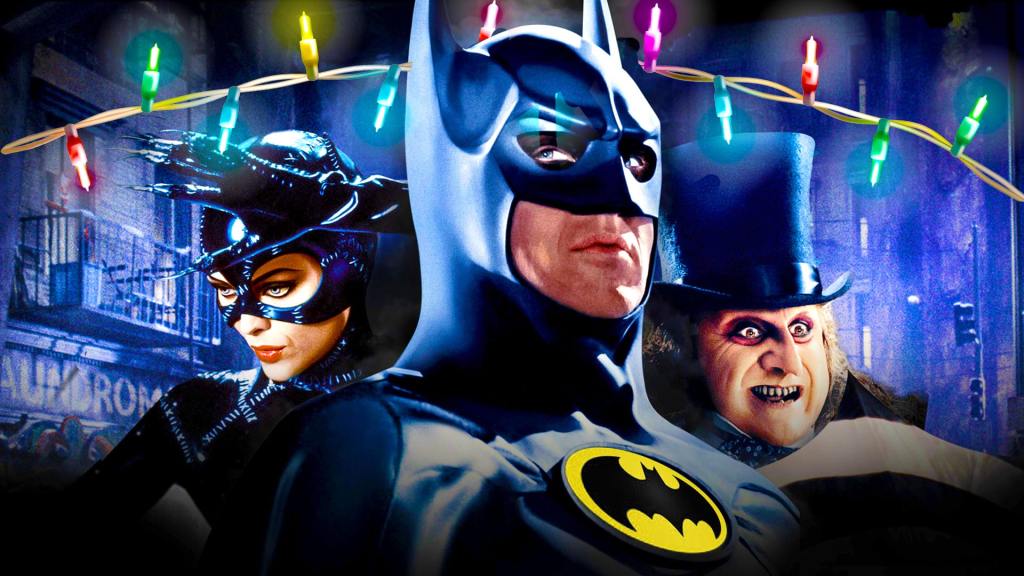
Batman Returns
4 out of 5 stars
By J.C. Correa
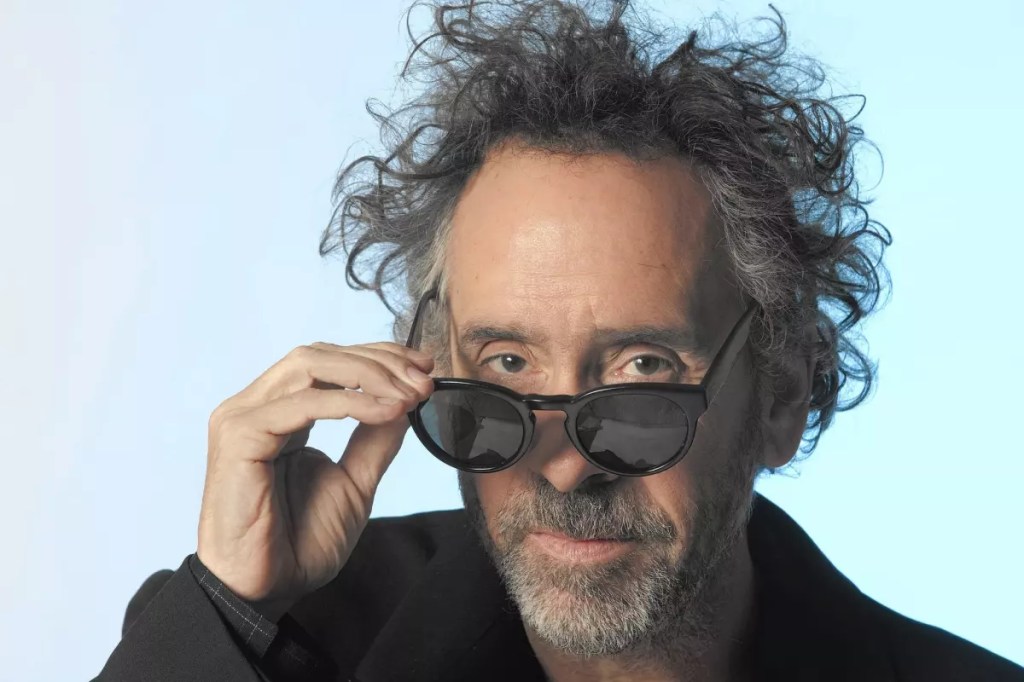
After the triumphant one-two punch of Pee-wee’s Big Adventure and Beetlejuice, Warner Bros. gave Tim Burton the keys to the Batcave in 1989, effectively allowing him to, for better or worse, launch the modern-day superhero cinema craze with the uber-successful Batman. It was a gamble that proved so fruitful that, three years later, the studio allowed the visually-eccentric, Gothic-leaning auteur to do pretty much whatever he wanted for an encore. Which is precisely what he did when he tested the auteur theory on a piece of pop entertainment.
Unveiled in the summer of 1992, Batman Returns was such a sharp departure from its predecessor in mood, feel and overall aesthetic, enough to jar more than a few people upon its release (just ask the executives at McDonald’s). In Batman, Burton was tasked with making Gotham’s Dark Knight a viable cinematic commodity. It was an endeavor with so much riding on it that the director had to take an almost surgical approach to it. Being only on his third feature, Burton undoubtedly had everyone looking over his shoulder and was forced to make concessions (such as the inclusion of a handful of songs by Prince) that may not have usually lined up with his sensibilities. Though still very much his movie, the end result was surely a compromise between artistic integrity and corporate demands. And while the staggering success of the picture left everyone happy, few were probably more so than Burton, who knew he could now negotiate with Warner Bros. to give him carte blanche on a sequel.
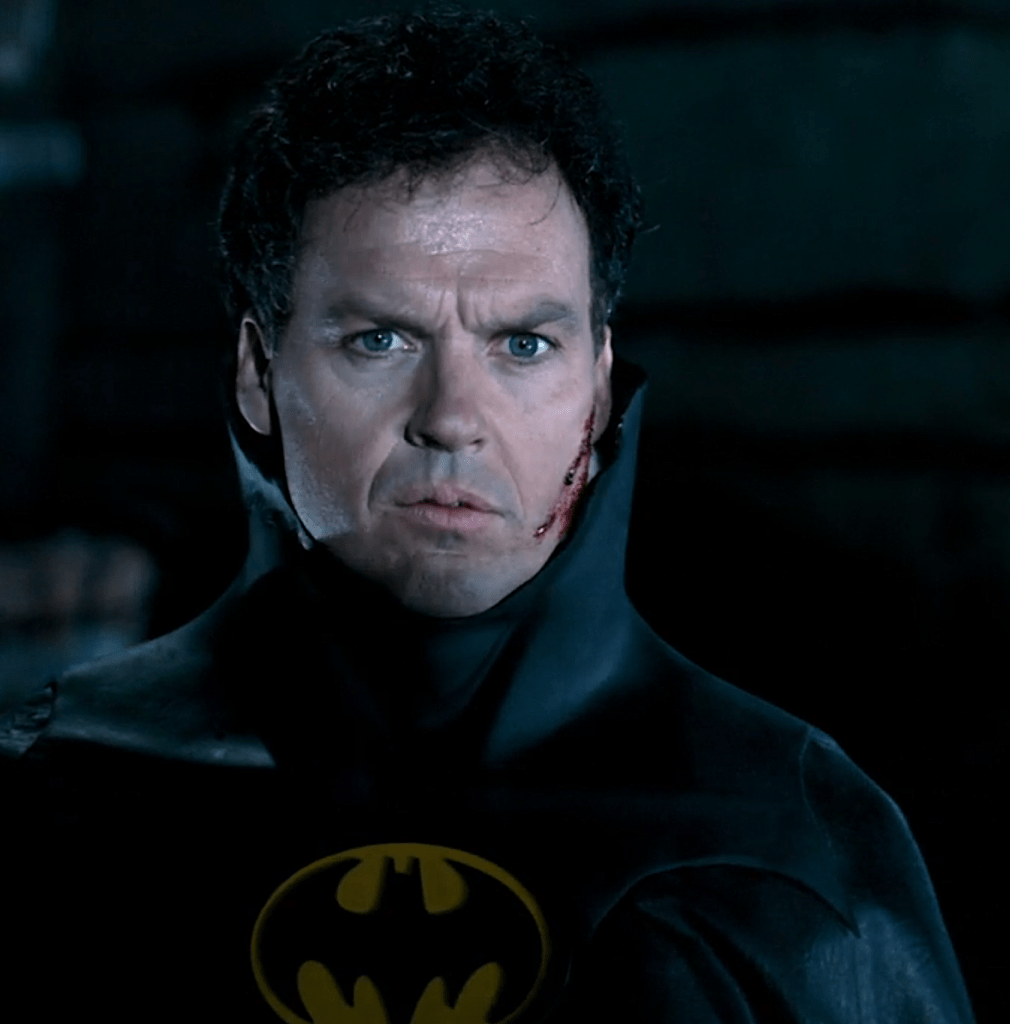
Perhaps still overcome with financial glee, the studio agreed and Burton responded with the Batman movie he probably always wished he could make. As such, a more fitting title for it could have been “Burton Unleashed!” The second film is less interested in honoring characters from DC Comics as it is in letting the filmmaker’s wildest instincts run rampant. In much the same way that 16 years later, Christopher Nolan’s The Dark Knight was a post-9/11 crime epic akin to Michael Mann’s Heat that just happened to feature the Caped Crusader and his clown-faced nemesis, Batman Returns, while an essay on the consequences of alienating society’s less fortunate, only at times turns its attention to Batman. In filmographic terms, it is really the spiritual sequel to Edward Scissorhands more than anything else, and a hyper-sexualized one at that. And it just happens to be set in late December.
“Give the constitution a rest, it’s Christmas,” barks Max Shreck, a shrewd industrialist played with usual bizarro flair by Christopher Walken, reminding us for the umpteenth time of the movie’s holiday flavor.
From the snow falling behind the Warner Bros. logo that opens it, Burton invites us into his winter wonderland right out of the gate (and then later again with a spectacular aerial shot that cruises through his wintry set). We are thrust into a snowy prologue that is vintage Burton and a far cry from anything having to do with Batman. When the story proper begins 33 years later – clearly a Jesus metaphor – it is still snowing. I have always been aware of the dominant Christmas themes that adorn the film, but during a recent rewatch I purposely paid closer attention to these to determine if it can indeed be justified as being a Christmas movie. Consider this: Besides the overt winter setting, the picture features a tree lighting, an Ice Princess, mistletoe, a resurrection, church choirs and Christmas carols, a masked ball, as well as wrapped presents of immense size that are more than what they seem. Furthermore, the majority of the film’s scenes take place at night (a Christmas movie staple more often than not), and the picture actually ends with a Christmas greeting between Bruce Wayne (Michael Keaton) and his trusty butler, Alfred (Michael Gough). How’s that for Yuletide cred?
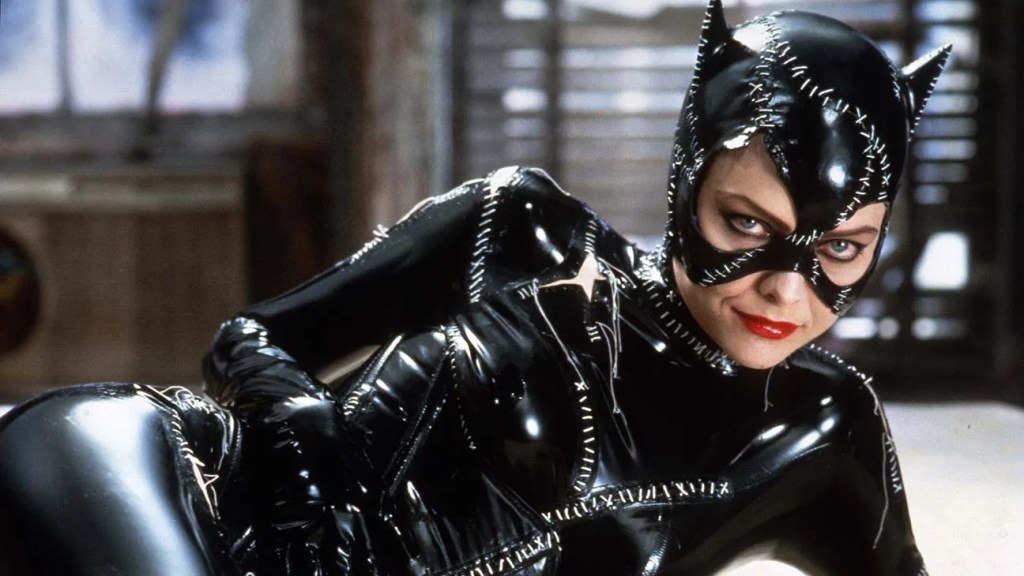
Holiday cheer aside, the movie is, amusingly, primarily concerned with monsters, both physical and symbolic. To say that it is one big freak show is an understatement. But more profoundly, its central theme is that of wounded individuals reinventing themselves. That label applies to Penguin (Danny DeVito) and Catwoman (Michelle Pfeiffer) – the film’s two principal villains – as much as it does to Batman. Shreck is the movie’s third antagonist, and even though his character arc makes him less of an oddity, his look alone (with a sprouting mane of gray hair) fits right in like some kind of electrified wax figure. Even Vincent Schiavelli lends his epic baggy eyes to the proceedings as a background circus goon listed simply as Organ Grinder. The circus theme is prevalent all throughout the picture, and it is one that is sprinkled across most of the director’s filmography, either allegorically, or in a few specific cases like this one, in a literal fashion. Of the entire horror show, however, the exclamation point may actually be Wayne Manor. In the first film, from the exterior, Bruce Wayne’s home seems like an opulent, gothic mansion. In Batman Returns, it looks like a dwelling fit for Dracula.
It is not a stretch to say that Transylvania’s infamous Count would not have been entirely out of place here. Part of the reason for that is that the film is quite bloody for its part, at least compared to the first movie. Here, Burton takes a much more graphic approach to the violence, which casually includes a face-slashing dripped in blood and a nose-biting that squirts it. Catwoman’s lipstick is also blood red, and I do not see that as a coincidence, any more than I do the pasty white, lifeless skin that she and Penguin share, along with some of the other background heavies. The heightened violence only echoes the brooding and eerie tone that courses through the picture. There is something brutally animalistic about the way characters behave and about much that is on display, which is sort of the point considering that Burton’s leading triumvirate is comprised of a bat, a cat and a penguin, the latter of which lives in the sewer below a zoo. When the three of them finally converge, the first word that is uttered is “Meow.”
All of this is firmly in Burton’s wheelhouse. Even during the opening titles, the filmmaker’s name precedes that of the main cast; something that did not occur in Batman. It may be a small detail, but I find it to be a telling one. Perhaps it is Burton’s way of announcing to the world that, unlike the first, this one really is his movie. If so, is Batman Returns superior to its predecessor? Yes, but not in the manner you may think. I will say that while the original is a better movie about Batman, the sequel is a richer and bolder work of cinema, one that is also less interested in him, and that’s the rub. This time around, Bruce Wayne/Batman has less screen time than all of the villains, including Shreck. Story-wise, the first film is also a little more direct because it is more personal, and therefore easier to get behind. Elsewhere, however, Batman Returns surpasses it, especially with regards to production design, makeup, costumes (Batman’s cowl has a cool reflective quality in this one), cinematography, direction and overall vision. Pfeiffer and DeVito are both terrific in their own ways, and even Keaton briefly channels his farcical tendencies as the millionaire bachelor. Musically, Danny Elfman’s score is also taken up a notch. A somber melody played on what sounds like an isolated classical guitar is particularly memorable.

However, I would like to get back to the sex if I may. In the early ’90s, superhero flicks were still a fairly new thing, and they were aimed primarily at children and teenagers. For some reason, Burton did not get that memo (or he did and just did not give a damn) and went buck wild on Batman Returns with regards to sexuality. There are innuendos and sexual references everywhere; when they are not bluntly spelled out, that is. Simply put, the three major characters in the movie are intensely horny, and not afraid to admit it either. After all, they are animals, right? Wayne and his alter ego want to get it on with Selina Kyle and hers, respectively, both of whom feverishly desire to reciprocate in turn. Penguin openly lusts for Catwoman, and just about any other female that crosses his path. He cannot seem to focus on the anti-Batman alliance that she pitches to him because he is too busy trying to seduce her with lines like, “Just the pussy I’ve been looking for.” “Unlimited poontang,” as promised by Shreck, is what finally convinces him to run for mayor. The benefits of such, as he savagely conveys, will allow him to touch and grope people. And when he makes clear his intent to murder the children of Gotham City, he is quick to point out that he would like to blow their erogenous zones sky-high. Selina is less vulgar, but she is not above acknowledging Bruce’s erection during a dance they share, or slowly licking his face as a substitute for a kiss. Needless to say, this is not your usual family entertainment, let alone a typical Christmas movie. And if you still refuse to consider it as such, you may agree that it is at least one of the horniest flicks to take place during that holiday, this side of Eyes Wide Shut.
“It’s gonna be a hot time in the cold town tonight,” suggests Selina with delicious irony. Indeed.
 Generation X Wire